
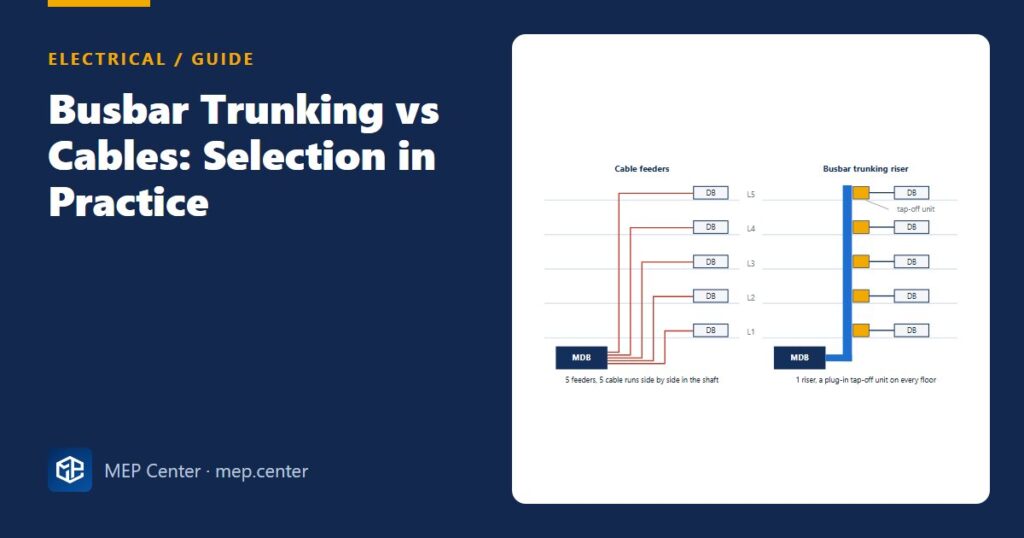
Above about 1000 A, a main feeder made of cables turns into four or five parallel runs per phase. They are heavy to pull, hard to terminate and fill the riser shaft. Busbar trunking is the usual alternative. It is not always cheaper, though, so the choice should come from a few checks and not from habit.
Where each one wins
| Criterion | Cables | Busbar trunking |
|---|---|---|
| Typical range | Any size; becomes awkward above ≈ 3–4 parallel runs per phase | 160–6300 A; common choice above ≈ 1000–1600 A |
| Many loads along the route | One feeder per board, one run each | One run with a plug-in tap-off unit at each board |
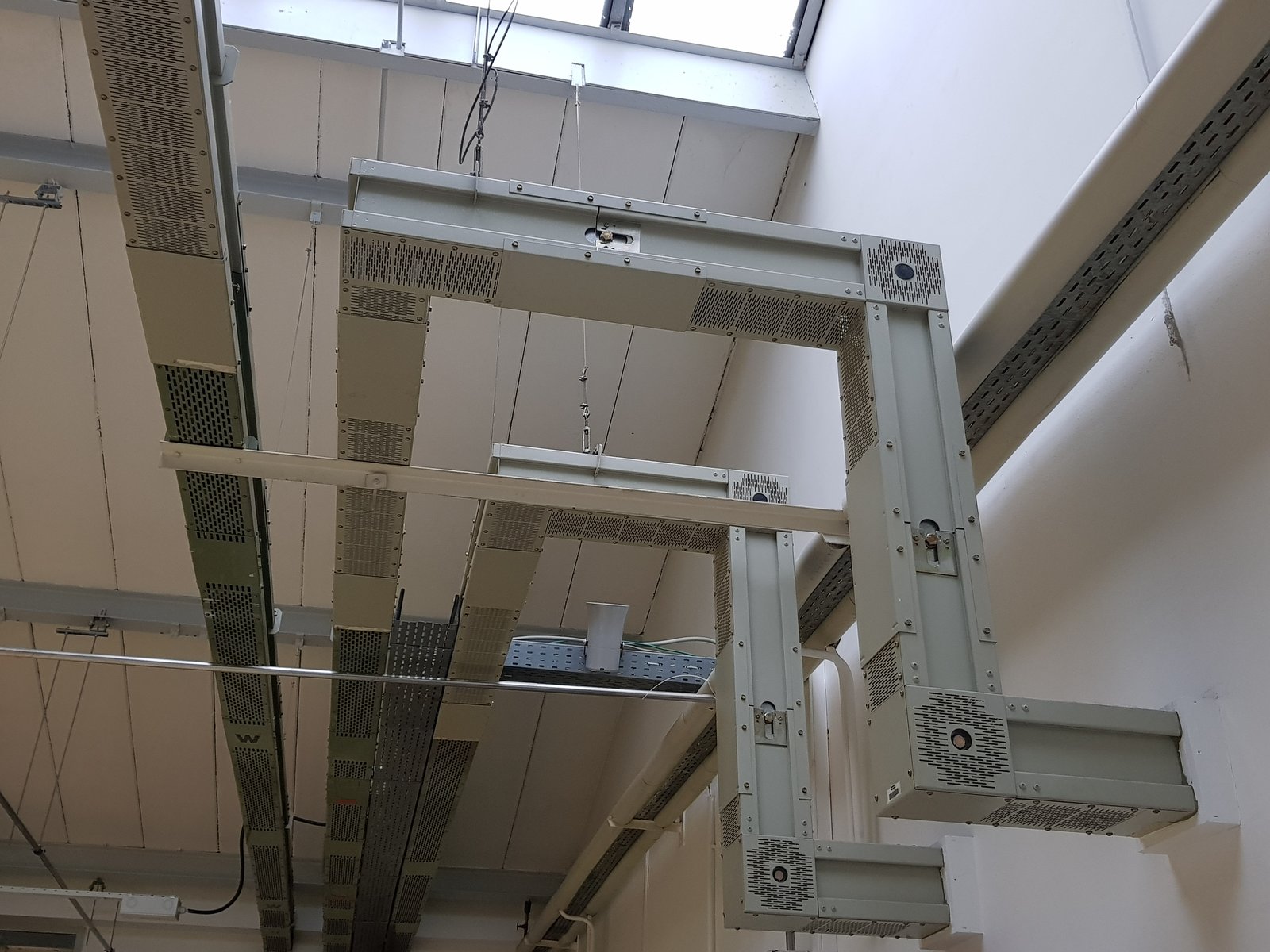
| Space in riser or ceiling | Large: wide trays and big bending radii | Compact, but needs straight, coordinated routes |
| Reactance (voltage drop) | ≈ 0.08 mΩ/m per run | ≈ 0.02–0.05 mΩ/m (data sheet) |
| Changes later | New feeder needed | Add or move tap-off units, often live-pluggable |
| Site work | Pulling, glanding and lugging many cores | Bolted joints, torque checks, prefabricated elbows |
| Weak points | Termination quality, grouping derating | Joint torque, water ingress, long lead time, exact routing needed |
Selecting the trunking: six checks
- Rated current at site ambient. Catalogue ratings refer to a stated ambient (often 35–40 °C average). Apply the maker’s correction for hotter ceilings, plant rooms or sunny facades. Why: trunking in a 45 °C ceiling void does not carry its nameplate current.
- Mounting position. Some designs are rated differently edgewise, flat or vertical. Why: a riser and a horizontal run of the same type may not have the same rating.
- Short-circuit rating. Icw (for example for 1 s) and Ipk must cover the prospective fault current at the start of the run, and the tap-off units must be protected for the fault level at their position. Why: a 1600 A run next to a large transformer can see 35–50 kA.
- Voltage drop. Use the data-sheet R and X per metre. For loads spread evenly along the run, the drop is about half of the end-loaded value. Why: this is often what lets you use a smaller rating than cables would need.
- Neutral and PE. Use a 100 % neutral normally and 200 % where third-harmonic loads dominate (IT floors, LED-heavy lighting). Check the PE path impedance (housing or separate bar) for disconnection times. Why: the neutral can carry more current than a phase conductor.
- Environment and fire. Use IP54/IP55 in risers and wherever sprinklers or washdown can wet the run. Fit tested internal and external fire barriers wherever it passes a compartment floor or wall. Why: water in a joint and fire spread along the housing are the classic failures.
Worked example: 40 m office riser
End-loaded drop: ΔU = √3 × I × L × (R cosφ + X sinφ) = 1.732 × 800 A × 40 m × (0.07 × 0.85 + 0.03 × 0.527) mΩ/m = 55 424 × 0.0753 mΩ ≈ 4.17 V → 1.04 %.
Distributed load: ≈ ½ × 4.17 ≈ 2.1 V (0.52 %) at the top floor.
Result: the voltage drop is small, so current rating and Icw decide the size. Add the drop of the feeder from the transformer to the MDB and of the final circuits, and check the total against your limit.
When cables are still the better answer
- Point-to-point feeders with many direction changes, for example from a remote substation to a plant room.
- Critical loads that need separate feeders (fire pumps, life-safety boards). One trunking run is one common failure point, and fire-rated feeders usually have to be fire-resistant cable anyway.
- Small or uncertain projects where trunking lead times and exact measured routes are a risk.
- Underground or outdoor runs: cables in ducts are simpler and cheaper.
If you stay with cables, size them with cable sizing and voltage drop and plan the containment with cable tray sizing. Large parallel runs need equal lengths and a proper phase arrangement so that the current shares evenly.
Details reviewers check
- Expansion units on long straight runs and across building expansion joints.
- Joint torque recorded at installation, and an insulation resistance test before energising.
- Tap-off device ratings and breaking capacity shown on the single-line diagram.
- Selectivity between the MDB feeder and the tap-off devices (see MCB selection and discrimination).
- No water pipes directly above horizontal runs, or a drip tray where this cannot be avoided.
Typical values — verify with the edition adopted locally and with the trunking maker’s data sheet.
Electrical Power Systems Design for Buildings
35 modules from the MV connection to the socket: transformers, short circuit, protection and selectivity, cable sizing, boards, generators, earthing, surge and lightning protection. Includes 50 % off TEKHAT.
Modules 1–3 are free, no account needed · full course €15,00 one-time
FAQ
At what current does busbar trunking become better than cables?
As a rule of thumb, above about 1000–1600 A, or whenever one run feeds many boards along its length, such as a riser with a board on every floor. Below about 630–800 A, cables are usually cheaper and more flexible.
How do I calculate voltage drop on busbar trunking?
Use ΔU = √3 × I × L × (R cosφ + X sinφ) with R and X per metre from the data sheet. If the load is spread evenly along the run, take about half of the end-loaded result.
Can busbar trunking be used for fire pumps or life-safety loads?
Usually not. These loads normally need dedicated feeders, often fire-resistant cable routed separately, so that one failure cannot take out both normal and safety supplies. Follow the national fire and electrical rules.
TEKHAT – Single-Line Diagram & Load Schedule
Draw panel single-line diagrams and load schedules in minutes, with breaker, RCD and cable sizing. Buyers of the Electrical Power Systems Design course get 50 % off.
Free install from the Microsoft Store · 30-day trial · licence 20 € for all your devices or €15 per computer on our site
More Electrical articles
- How to Connect an SPD in a Distribution Board (the 0.5 m Rule)
- IP Ratings Explained: Choosing IP44, IP54, IP65 on Site
- PV Systems: DC Isolation, Fuses and Earthing Basics
- EV Charger Installation: An Electrical Checklist
- Cable Gland Selection: Size, Armour, IP and Earthing
- Emergency Lighting: Quick Design Rules (EN 1838 / NFPA 101)