
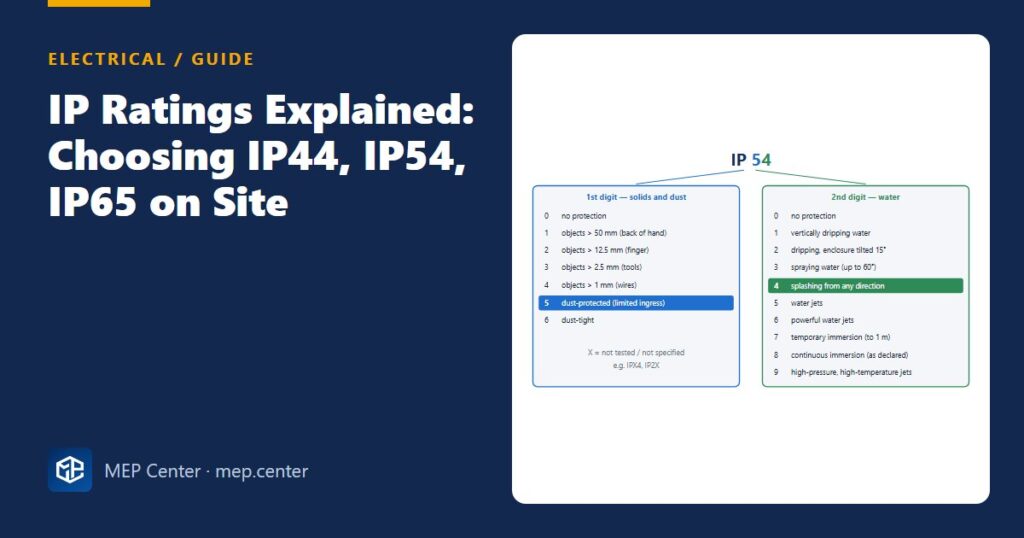
“IP65 outside, IP44 in the plant room” gets copied from one specification to the next, often without anyone checking what the digits mean. Then a luminaire fails in a car park wash-down, or a board fills with dust in a workshop. Reading the code takes thirty seconds and prevents both.
Reading the two digits
Two details catch people out:
- Higher is not always “more”. Immersion (7, 8) and jets (5, 6) are different tests. An IPX7 product has not necessarily passed the jet test. Equipment that must survive both is marked with both, for example IPX5/IPX7.
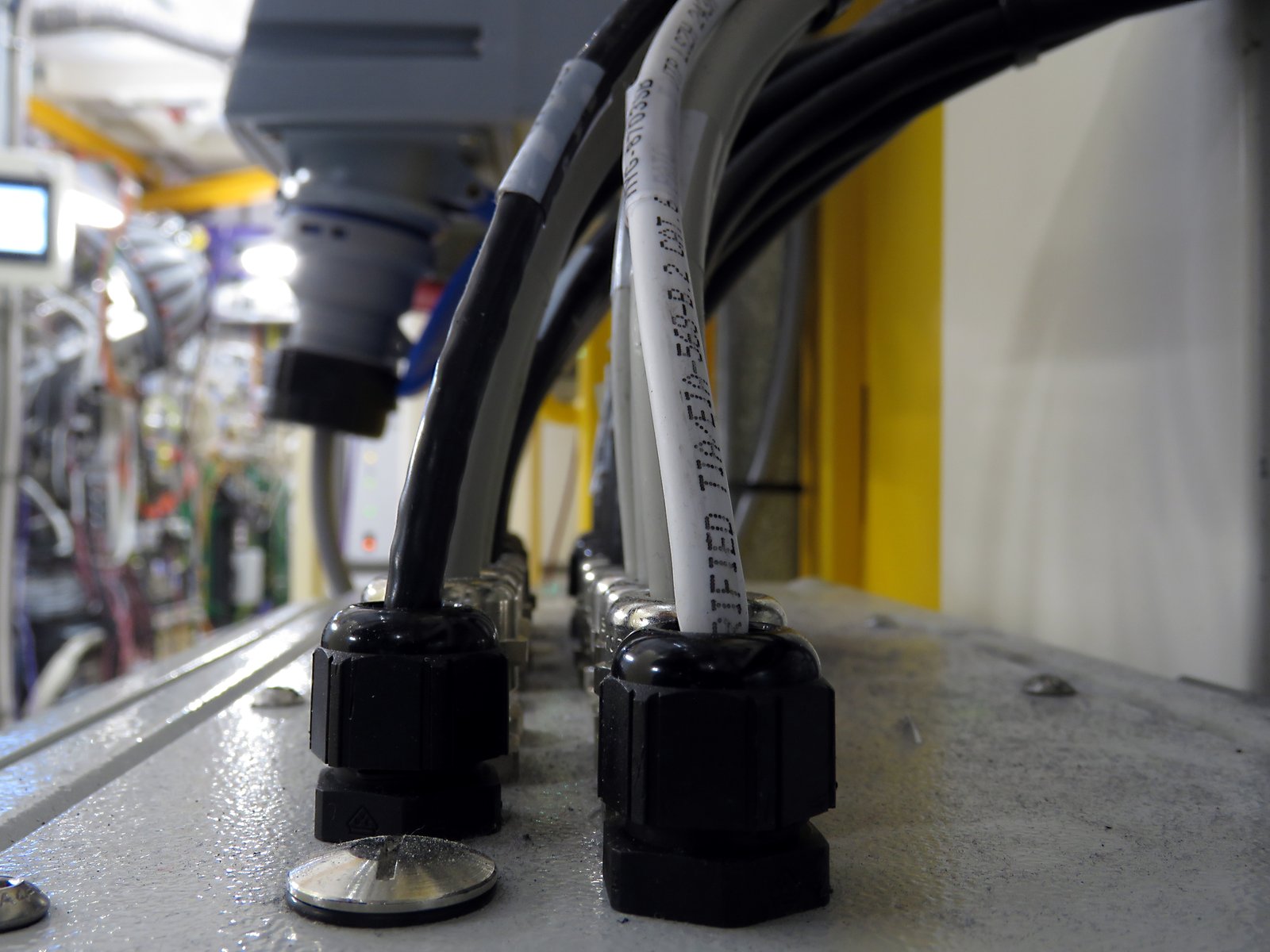
- The rating belongs to the installed product. An IP65 enclosure with an unused knock-out, a wrong cable gland or a door left without its gasket is no longer IP65.
What to specify, where
| Location | Typical minimum | Note |
|---|---|---|
| Inside boards, live parts behind covers | IP2X / IPXXB | Finger-safe |
| Dry indoor plant rooms | IP31 | Drips from pipes above? Go higher |
| General indoor service areas | IP41–IP43 | |
| Bathroom zones 1–2 | IPX4 | IPX5 where jets are used for cleaning |
| Bathroom zone 0 (inside bath / tray) | IPX7 | SELV only |
| Swimming pool zone 0 / zone 1 | IPX8 / IPX5 | IPX4 indoors without jet cleaning |
| Outdoor socket, sheltered | IP44 | |
| Car parks, dusty or damp workshops | IP54 | Car-park wash-down → IP55 or higher |
| Exposed outdoor equipment | IP55–IP65 | IP66 where hose-down or driving rain |
Typical values — verify with the edition adopted locally and with the special-location rules in force.
Five practical tips
- Ask how the space is cleaned. A hose or pressure washer means a “5” or “6” second digit, whatever the drawings call the room. Why: cleaning, not weather, is the most common cause of water ingress indoors.
- Specify the glands and entries, not just the box. Why: the cable entry is where most enclosures lose their rating.
- Bottom entry outdoors. Bring cables in from below with a drip loop. Why: water running down a cable flows into a top entry.
- Remember the heat penalty. A switchboard upgraded from IP31 to IP54 can lose roughly 10–20 % of its current capacity because it cannot ventilate. Why: the IP choice affects temperature rise.
- Do not confuse IP with IK. IK is impact resistance: IK07 general, IK08 public areas, IK10 vandal-prone. Why: a car-park luminaire usually needs both.
US equivalent
In North America, enclosures are usually specified with NEMA type numbers (for example Type 1 indoor, Type 3R outdoor rain, Type 4X wash-down and corrosion). NEMA types also cover things IP does not, such as corrosion and icing. They therefore do not convert one-to-one into IP codes: a NEMA type can be said to meet a given IP code, but not the other way round. For more IEC/US differences, see IEC vs NEC earthing and grounding terms. For bathroom and outdoor circuits, also read RCD types AC, A, F and B.
Electrical Power Systems Design for Buildings
35 modules from the MV connection to the socket: transformers, short circuit, protection and selectivity, cable sizing, boards, generators, earthing, surge and lightning protection. Includes 50 % off TEKHAT.
Modules 1–3 are free, no account needed · full course €15,00 one-time
FAQ
What is the difference between IP44 and IP54?
Both resist splashing water from any direction. IP44 keeps out solid objects larger than 1 mm, while IP54 is also dust-protected, so it suits car parks, workshops and other dusty interiors.
Is IP65 waterproof?
IP65 is dust-tight and protected against water jets from any direction. It is not rated for immersion, which needs IPX7 (temporary) or IPX8 (continuous, as declared by the maker).
What IP rating is needed in a bathroom?
Typically IPX4 minimum in zones 1 and 2, IPX5 where water jets are used for cleaning, and IPX7 for equipment inside the bath or shower tray (zone 0), which must also be SELV.
What does X mean in an IP rating?
X means the digit was not tested or not specified. IPX4 gives only the water protection, and IP2X gives only the protection against solid objects.
TEKHAT – Single-Line Diagram & Load Schedule
Draw panel single-line diagrams and load schedules in minutes, with breaker, RCD and cable sizing. Buyers of the Electrical Power Systems Design course get 50 % off.
Free install from the Microsoft Store · 30-day trial · licence 20 € for all your devices or €15 per computer on our site
More Electrical articles
- EV Charger Installation: An Electrical Checklist
- Phase Balancing in Panel Schedules: Measure and Fix Unbalance
- IEC vs NEC: Earthing, Grounding and Bonding Terms Compared
- MCB Selection and Discrimination: A Practical Design Guide
- 10 Common Mistakes on Single-Line Diagrams
- TN-S vs TN-C-S vs TT Earthing: Systems Explained (Plus IT)