
An RCD that cannot “see” the type of leakage current a load produces gives no protection at all. The usual problems are nuisance trips on socket circuits, and drives or EV chargers fitted behind a cheap type AC device that DC leakage has quietly blinded.
What the letters mean
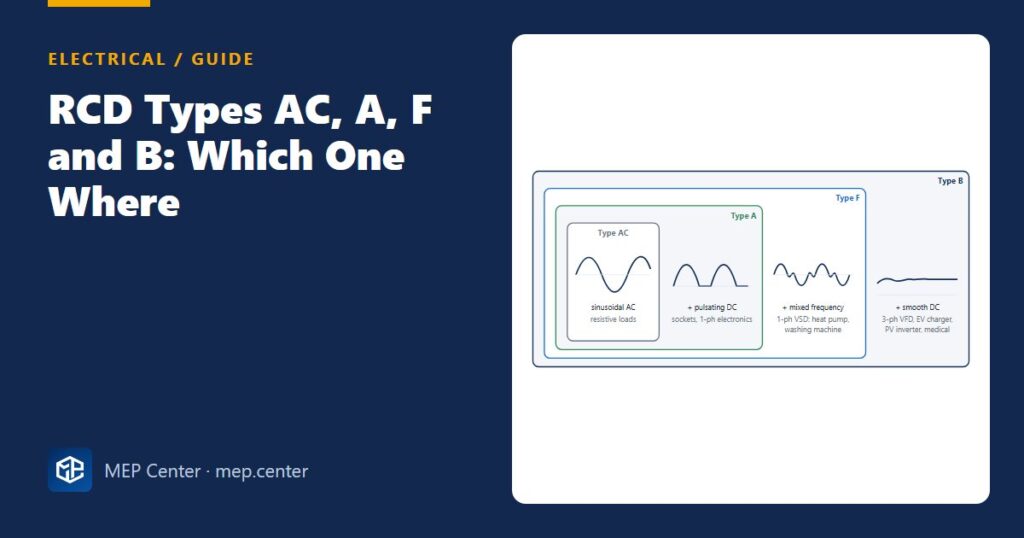
An RCD measures the difference between the outgoing and returning current through a toroidal core. Electronic loads do not leak a neat sine wave. Rectifiers produce pulsating DC, frequency converters produce a mix of frequencies, and three-phase rectifiers produce almost smooth DC. Smooth DC can saturate the core of a simple RCD so that it stops responding even to an ordinary AC fault. The types are nested: each one detects everything the previous one does, plus more.
Which one where
| Type | Detects | Use it for | Avoid |
|---|---|---|---|
| AC | Sinusoidal AC only | Fixed resistive equipment known to produce no DC leakage (where national rules still allow it) | Anything with electronics: LED drivers, IT, chargers |
| A | AC + pulsating DC | Socket circuits, lighting, single-phase electronics. The default for general circuits | 3-phase drives, EV chargers without DC detection |
| F | A + mixed frequency | Single-phase variable-speed appliances: heat pumps, inverter air conditioners, washing machines | 3-phase rectifier loads |
| B | F + smooth DC | 3-phase VFDs, EV charge points (or type A/F + 6 mA DC detection), PV inverters without guaranteed separation, medical equipment | Placing it downstream of a type A or AC device |
Sensitivity and timing are separate choices
The type describes the waveform. The sensitivity IΔn and the time behaviour are separate choices:
- 30 mA: additional protection of people. Typically required for socket outlets up to 32 A, mobile outdoor equipment, bathrooms, EV charge points and, in several national rules, cables buried shallow in walls.
- 100 mA: group protection in TT installations, where RA × IΔn ≤ 50 V must hold.
- 300 mA: fire protection, often time-delayed type S at the origin or a sub-main.
A general-type RCD must trip within 300 ms at IΔn and 40 ms at 5 × IΔn. A type S device delays (130–500 ms at IΔn), so a 30 mA device downstream can act first. “S” is about time; “A”, “F” and “B” are about waveform. A device can be both, for example “type B, S, 300 mA”.
The trap that catches experienced designers
A type A RCD upstream of a load that leaks smooth DC can be blinded. This happens even if the load has its own type B device, because the DC fault current also flows through the upstream type A core. The rule: a type B circuit must not be fed through a type A or AC RCD. Feed it from a separate type B device, from a non-RCD way, or from a board whose incoming RCD is itself type B.
EV charging is the usual case. Each charge point needs its own 30 mA RCD: either type B, or type A/F combined with 6 mA DC fault detection (often built into the charger). Check which one the charger provides before you write the board schedule.
Typical values — verify with the edition adopted locally. Rules on type AC differ between countries.
US practice in one line
In North America, personnel protection uses GFCI devices that trip at about 4–6 mA in specified locations, and equipment ground-fault protection (GFPE) on large services. The IEC letters AC/A/F/B have no direct NEC counterpart. See IEC vs NEC earthing and grounding terms.
Related: TN, TT and IT earthing systems and MCB selection and discrimination.
Electrical Power Systems Design for Buildings
35 modules from the MV connection to the socket: transformers, short circuit, protection and selectivity, cable sizing, boards, generators, earthing, surge and lightning protection. Includes 50 % off TEKHAT.
Modules 1–3 are free, no account needed · full course €15,00 one-time
FAQ
Is a type A RCD enough for a house?
For most general and socket circuits, yes. Type A is the usual default. Heat pumps and inverter appliances may need type F, and EV chargers need type B or type A/F with 6 mA DC detection.
Why is type AC being phased out?
Almost every modern load contains electronics that can produce DC components in a fault. A type AC RCD may not detect these, and DC can saturate its core so it also misses ordinary AC faults.
Can I put a type B RCD downstream of a type A RCD?
No. Smooth DC leakage from the type B circuit also flows through the upstream type A device and can blind it. Feed type B circuits so that no type A or AC RCD is upstream.
What does type S mean on an RCD?
S means selective, or time-delayed. It trips more slowly than a general-type RCD, so a downstream 30 mA device clears a fault first. It says nothing about the waveforms the device can detect.
TEKHAT – Single-Line Diagram & Load Schedule
Draw panel single-line diagrams and load schedules in minutes, with breaker, RCD and cable sizing. Buyers of the Electrical Power Systems Design course get 50 % off.
Free install from the Microsoft Store · 30-day trial · licence 20 € for all your devices or €15 per computer on our site
More Electrical articles
- Motor Starting: DOL, Star-Delta, Soft Starter or VFD
- How to Measure Earth Electrode Resistance (Fall-of-Potential)
- Cable Tray Sizing: Fill, Spacing and Derating in Practice
- Cable Gland Selection: Size, Armour, IP and Earthing
- MCB Selection and Discrimination: A Practical Design Guide
- Standby Generator Sizing: A Quick Method That Works