
Generators are rarely undersized for their running load. They are undersized for the moment the biggest motor starts: the voltage collapses, contactors drop out and the UPS goes to battery. A quick method checks both the running load and the motor start before you ask anyone for a quotation.
The four-step method
- List the loads the set must carry (life-safety plus chosen standby loads) with kW and power factor. Why: “the whole building” is almost never the brief.
- Running rating: kWe ≥ Σ kW / 0.8, then kVA = kWe / 0.8. Why: margin for load growth and for the steps of the load sequence.
- Derate for site conditions, typically 3–4 % per 300 m above 1000 m and 1–2 % per 5 °C above 40 °C (maker data). Why: a set at 1600 m in a hot plant room delivers much less than its nameplate.
- Check the largest motor start and non-linear loads (UPS, VFDs). Why: this step decides the final size more often than the running load does.
Worked example: office building
Running rating: 320 / 0.8 = 400 kWe → 400 / 0.8 = 500 kVA (standby rating). The 320 kW running load is 80 % of 400 kWe (400 kVA at pf 0.8).
Derating: sea level, below 40 °C → none.
Motor start (75 kW fire pump), x = 0.25:
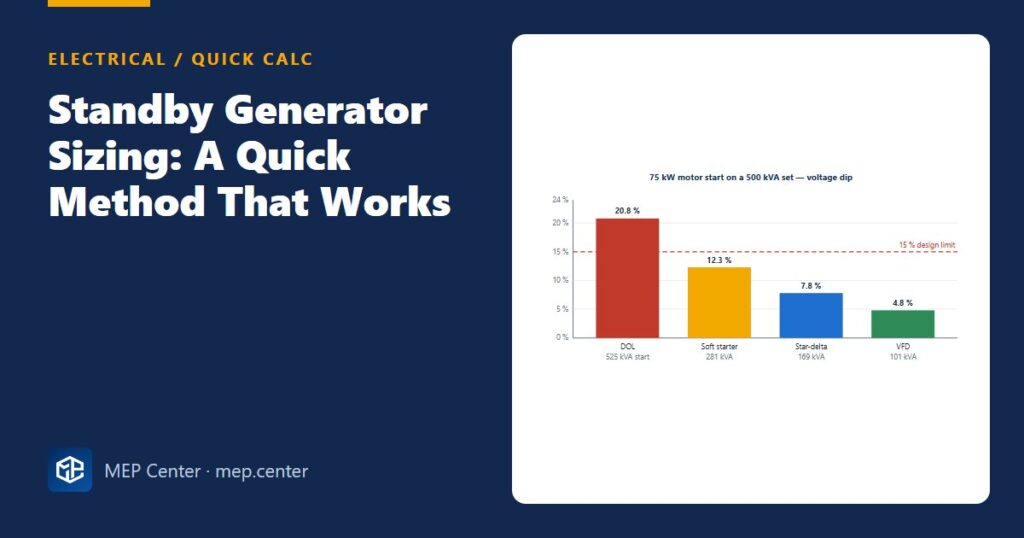
DOL: starting kVA ≈ 7 × 75 = 525 → k = 1.05 → dip = 0.2625 / 1.2625 ≈ 20.8 % — too much.
Soft starter: 3.75 × 75 ≈ 281 kVA → k = 0.562 → dip ≈ 12.3 % — OK.
Star-delta: 2.25 × 75 ≈ 169 kVA → k = 0.338 → dip ≈ 7.8 %.
Result: 500 kVA with a soft starter or star-delta. If the pump must start DOL, k may be at most 0.706 for a 15 % dip → 525 / 0.706 ≈ 744 kVA → an 800 kVA set (dip ≈ 14.1 %). One starter saves about 300 kVA of generator.
Rules of thumb
| Starting method | Starting kVA per motor kW | Generator kVA per kW of largest motor (≈ 15–20 % dip) |
|---|---|---|
| Direct-on-line | 6–7.5 | 3–5 |
| Soft starter (3–4 × In) | 3.5–4 | 2–3 |
| Star-delta | 2–2.5 | 1.5–2 (check the changeover peak) |
| VFD | 1.2–1.5 | 1.5–2 (plus the harmonics check) |
The right-hand column assumes a modern alternator with excitation support (PMG/AREP) and a 15–20 % transient limit. The simple x = 0.25 estimate used above is more conservative (DOL ≈ 7–10 kVA per kW), so confirm borderline cases with the maker’s software.
- UPS and VFDs without active front end: generator kVA ≥ about 2 × the drive or UPS kVA, because alternator reactance makes harmonic distortion much worse than on the transformer.
- Load acceptance: a turbocharged diesel typically accepts 30–40 % of rating in the first step. Sequence the loads and start the largest motors first.
- Lifts that regenerate need braking resistors or enough other load on the set. PFC capacitor banks are switched off on generator.
- Rating type: standby (ESP) is for emergency use only (≤ 200 h/yr, average ≤ 70 %). A set that runs often should be chosen on its prime (PRP) rating, and ESP ≈ 1.1 × PRP.
- Fuel: about 0.21–0.25 L/kWh at 75–100 % load. A 500 kVA (400 kWe) set at 75 % load, 300 kW, uses ≈ 300 × 0.23 ≈ 69 L/h.
Typical values — verify with the edition adopted locally and confirm the final size with the maker’s sizing software.
Fire pumps deserve their own check
Many codes require the set to start and run the fire pump with all other life-safety loads connected, and without overload trips that could open during a long start. Start the pump early in the sequence, use a reduced-voltage starter, and agree the arrangement with the fire-protection designer. See fire pump sizing to NFPA 20. For the generator feeders themselves, use cable sizing and voltage drop. Generator fault currents are low, so check disconnection times in generator mode as well.
Electrical Power Systems Design for Buildings
35 modules from the MV connection to the socket: transformers, short circuit, protection and selectivity, cable sizing, boards, generators, earthing, surge and lightning protection. Includes 50 % off TEKHAT.
Modules 1–3 are free, no account needed · full course €15,00 one-time
FAQ
How do I size a standby generator quickly?
Add the running kW of the loads, divide by 0.8 to get the kWe rating, then by 0.8 again for kVA. Apply site derating, then check that starting the largest motor keeps the voltage dip at or below about 15 %.
Why is a generator oversized for motor starting?
A direct-on-line motor draws six to eight times its rated current at low power factor. An alternator cannot supply this as stiffly as a transformer, so the voltage dips. A soft starter, star-delta starter or VFD usually solves this more cheaply than a larger set.
What load percentage should a standby generator run at?
Size the set so that the running load is no more than about 80 % of its rating. Standby (ESP) ratings also assume an average load of at most about 70 % over the running period.
TEKHAT – Single-Line Diagram & Load Schedule
Draw panel single-line diagrams and load schedules in minutes, with breaker, RCD and cable sizing. Buyers of the Electrical Power Systems Design course get 50 % off.
Free install from the Microsoft Store · 30-day trial · licence 20 € for all your devices or €15 per computer on our site
More Electrical articles
- Emergency Lighting: Quick Design Rules (EN 1838 / NFPA 101)
- Busbar Trunking vs Cables: Selection in Practice
- IEC vs NEC: Earthing, Grounding and Bonding Terms Compared
- UPS Sizing: kVA, kW and Battery Autonomy in Practice
- Lightning Protection Basics: Rolling Sphere and Mesh Method
- TN-S vs TN-C-S vs TT Earthing: Systems Explained (Plus IT)