
UPS sizing goes wrong in two ways. Either the kVA is right but the kW is not, or the UPS is right but the battery runs flat in four minutes instead of ten. Both come from rough shortcuts. Here is a quick method that keeps kVA, kW and battery autonomy apart and checks each one.
The formulas
- UPS rating: S_UPS ≥ 1.2–1.25 × S_load (kVA), and P_UPS ≥ 1.2–1.25 × P_load (kW). Modern UPSs have an output power factor of 0.9–1.0, so kW ≈ 0.9–1.0 × kVA.
- Battery power per cell: W_cell = P_load / (η_inv × N_cells), then × 1.25 (ageing: the battery is replaced at 80 % capacity) × temperature factor (1.0 at 20–25 °C, about 1.1 at 15 °C) × design margin (about 1.1).
- Battery selection: choose the cell or block whose constant-power table gives at least that W_cell for the autonomy, at the end voltage (about 1.67 V/cell for short autonomy, 1.75 V/cell for long).
Worked example: 40 kW server room, 10 minutes
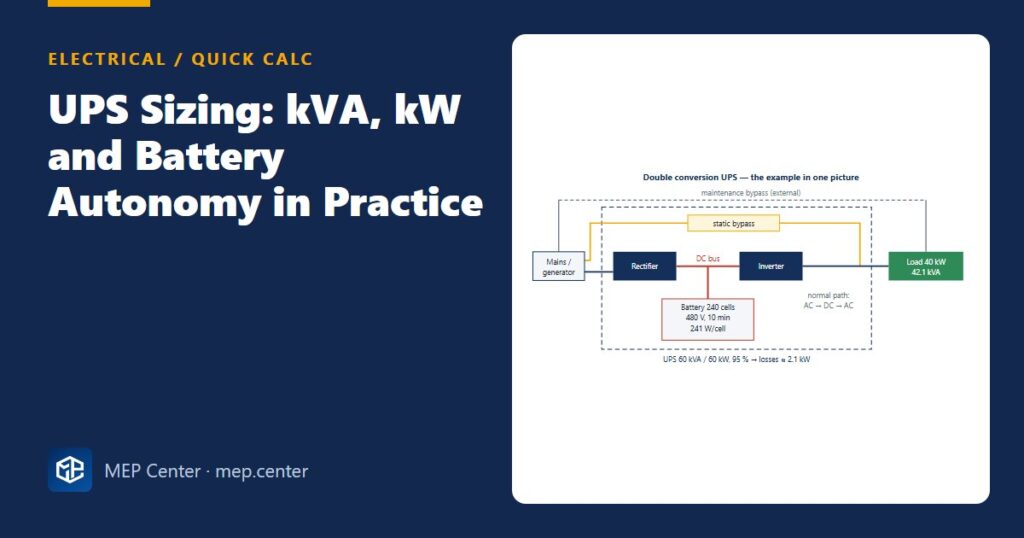
UPS: 42.1 × 1.25 = 52.6 kVA → choose 60 kVA / 60 kW (output pf 1.0). Load at 40 / 60 = 67 %.
Battery: 40 blocks of 12 V = 240 cells, 480 V nominal, inverter efficiency 0.95.
W_cell = 40 000 / (0.95 × 240) = 175 W/cell → × 1.25 ageing × 1.0 temperature × 1.1 margin = 241 W/cell (≈ 1447 W per 12 V block) for 10 min to 1.67 V/cell. Pick the block from the maker’s table that delivers at least this.
Why not Ah? 40 000 × (10/60) / (480 × 0.95) = 14.6 Ah, × 1.25 × 1.1 ≈ 20 Ah. But at a 10-minute rate a lead-acid battery delivers only a fraction of its nominal Ah, so a “20 Ah” choice would run flat early. The constant-power table already includes this effect.
Heat: at 95 % efficiency the UPS loses 40 × (1/0.95 − 1) ≈ 2.1 kW, which the room cooling must remove.
Rules of thumb
| Item | Typical value |
|---|---|
| Sizing margin on load | 1.2–1.25 × (20–25 % spare) |
| Double conversion efficiency | 94–97 % (eco mode 98–99 %) |
| Autonomy — IT with generator backup | 5–15 min |
| Autonomy — offices, critical loads without generator | 10–30 min |
| Emergency lighting central battery | 1 h or 3 h |
| VRLA end voltage | 1.67 V/cell (short), 1.75 V/cell (long) |
| VRLA design life | 5 or 10–12 years; about half the life for every 8–10 °C above 20–25 °C |
| Battery recharge allowance on UPS input | ≈ 10–15 % of rating |
| Generator for an IGBT-rectifier UPS | ≈ 1.25–1.5 × UPS input kVA |
Checks that are often skipped
- Input side: size the UPS input cable and protection for the input current, including recharge, not for the output rating. Use cable sizing and voltage drop.
- Fault current on inverter: an inverter limits its output to about 1.5–3 × In for around 100 ms. Final circuits must still disconnect in time, or the static bypass must be available.
- Battery room: 20–25 °C, ventilation for hydrogen, floor loading (lead-acid racks often exceed 1000 kg/m²) and a DC isolator near the battery.
- Generator: the UPS rectifier is a non-linear load. See the generator sizing method.
- RCDs and earthing on the UPS output follow the same rules as the rest of the installation. See earthing systems explained.
Typical values — verify with the edition adopted locally and with the UPS and battery maker’s data.
Electrical Power Systems Design for Buildings
35 modules from the MV connection to the socket: transformers, short circuit, protection and selectivity, cable sizing, boards, generators, earthing, surge and lightning protection. Includes 50 % off TEKHAT.
Modules 1–3 are free, no account needed · full course €15,00 one-time
FAQ
How do I size a UPS in kVA and kW?
Add up the load in both kW and kVA and multiply each by 1.2–1.25. The UPS must cover both values. Modern UPSs have an output power factor of 0.9–1.0, so kW is usually close to kVA, but check the data sheet.
How do I calculate UPS battery autonomy?
Divide the load power by the inverter efficiency and the number of cells to get watts per cell. Multiply by 1.25 for ageing and by temperature and margin factors. Then read the battery maker’s constant-power table for the autonomy and end voltage you need.
Why is the Ah method wrong for short UPS autonomy?
Battery Ah ratings are given at long discharge times, typically 10 hours. At a 5–15 minute rate the battery delivers much less than its nominal Ah, so simple Ah arithmetic gives a battery that is far too small.
TEKHAT – Single-Line Diagram & Load Schedule
Draw panel single-line diagrams and load schedules in minutes, with breaker, RCD and cable sizing. Buyers of the Electrical Power Systems Design course get 50 % off.
Free install from the Microsoft Store · 30-day trial · licence 20 € for all your devices or €15 per computer on our site
More Electrical articles
- How to Measure Earth Electrode Resistance (Fall-of-Potential)
- Standby Generator Sizing: A Quick Method That Works
- EV Charger Installation: An Electrical Checklist
- MCB Selection and Discrimination: A Practical Design Guide
- IEC vs NEC: Earthing, Grounding and Bonding Terms Compared
- Busbar Trunking vs Cables: Selection in Practice