
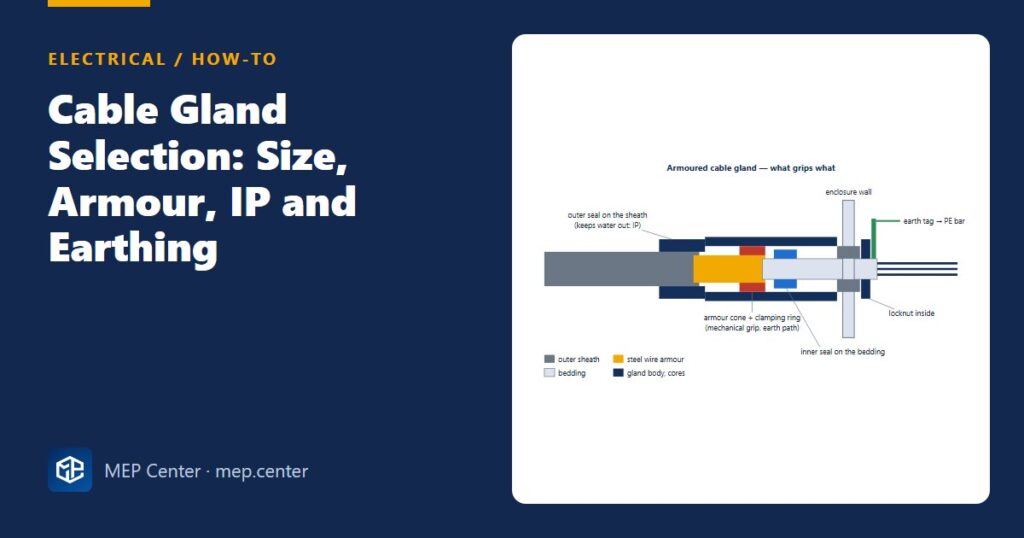
A cable gland is a small part, but a wrong one is costly. It can leak water into an IP65 enclosure, leave the steel armour unearthed or fail to fit the hole in the gland plate. Most of these mistakes come from choosing the gland by “cable size in mm²” instead of the actual cable diameters.
Step by step
- Identify the cable construction. Unarmoured, steel wire armoured (SWA), braided, or screened (EMC). Why: each needs a different gland type. An unarmoured gland on SWA leaves the armour loose and unearthed.
- Take the diameters from the cable data sheet. Note the outer sheath Ø, the inner bedding Ø under the armour, and the armour wire size. Why: two cables of the same mm² from different makers can differ by several millimetres.
- Pick the gland whose ranges contain those diameters. Aim for the middle of the sealing range, not the edges. Why: at the bottom of its range a seal does not grip properly; at the top it will not slide over the cable.
- Read the thread size from the same table row. Metric sizes run M16, M20, M25, M32, M40, M50, M63, M75. Clearance holes are typically about 0.5 mm over the nominal size. Why: the thread follows the gland body, not the cable, so never guess it.
- Check the thread length against the wall or gland plate thickness, and add a locknut (and a sealing washer where IP matters). Why: a short thread in a thick plate leaves the locknut with only one or two turns.
- Match the IP rating. Gland IP (often IP66/IP68 with its seal) must be at least the enclosure’s rating. Seal unused entries with rated plugs. Why: the enclosure is only as tight as its weakest entry.
- Terminate the armour or screen. Clamp SWA in the gland’s armour cone and connect the earth tag to the PE bar. Terminate EMC screens 360° all round. Why: the armour must be earthed, and it may be the circuit protective conductor.
- Choose the material. Polyamide (UV-stabilised outdoors) for light duty, nickel-plated brass for general industrial use, stainless steel for washdown, marine and chemical areas. Why: mixed metals corrode, and nylon degrades in sunlight.
- Hazardous areas: use glands certified for the protection concept (for example Ex d or Ex e), barrier glands where required, and certified stopping plugs. Why: the gland is part of the explosion protection.
Worked example (illustrative values)
Gland table: find the armoured, outdoor (inner + outer seal) type. Look for a row whose outer seal range contains 28 mm, ideally near its middle, whose inner seal range contains 22 mm, and whose armour clamp accepts 1.25 mm wire.
Read across: take the thread size, hole size, thread length and earth tag size from that same row. Check that the thread length exceeds the gland plate thickness plus the locknut.
Result: one gland type and size per cable, entered in the cable schedule beside the cable diameter.
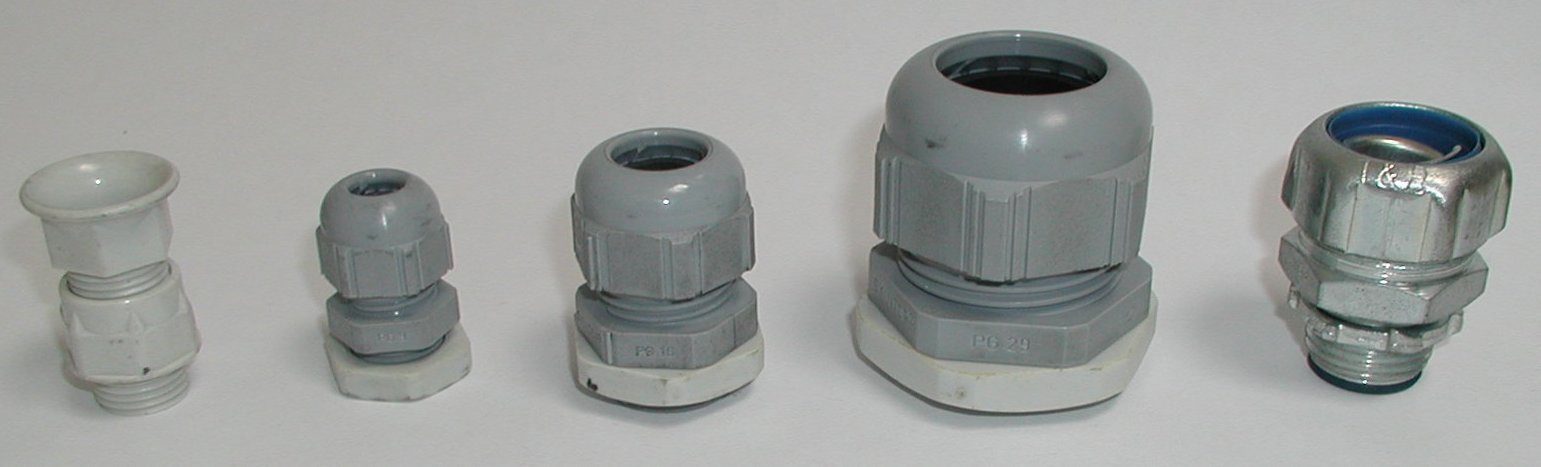
Thread systems you will meet
| Thread | Where | Note |
|---|---|---|
| Metric (M16 … M75, 1.5 mm pitch) | IEC/EN countries, new equipment | Gland standard IEC 62444; nominal size ≈ thread outside diameter |
| PG (PG7 … PG48) | Older European equipment | Not interchangeable with metric; use adaptors or re-drill plates |
| NPT (tapered, inch) | US and US-built packages | Seals on the taper; do not mix with straight threads |
Site details that save rework
- Single-core AC cables must not pass through separate holes in a steel plate. Eddy currents heat the plate, so use a non-magnetic gland plate (aluminium or brass).
- Outdoors, enter from below with a drip loop. Top entries rely entirely on the seal. See IP ratings explained.
- Metal glands in plastic enclosures need an earth tag or an internal earthing plate. Otherwise the armour is not connected to anything.
- Shrouds keep dirt and moisture off the gland body in corrosive areas.
- Allow space for the bending radius in front of the gland plate: about 10–12 × D for armoured LV cable. Plan this with cable tray sizing.
- If the armour is the protective conductor, check it for fault withstand and loop impedance as part of cable sizing.
Typical values — verify with the edition adopted locally and with the gland maker’s tables.
Electrical Power Systems Design for Buildings
35 modules from the MV connection to the socket: transformers, short circuit, protection and selectivity, cable sizing, boards, generators, earthing, surge and lightning protection. Includes 50 % off TEKHAT.
Modules 1–3 are free, no account needed · full course €15,00 one-time
FAQ
How do I choose the right cable gland size?
Take the outer sheath diameter from the cable data sheet, and for armoured cable the diameter under the armour and the armour wire size. Choose the gland whose sealing and clamping ranges contain these values, then read the thread size from the same row of the maker’s table.
Does the cable gland earth the armour?
An armoured gland clamps the steel armour in a cone and ring. The earth tag under the gland, connected to the PE bar, completes the earth path. Without the tag, or in a plastic enclosure without an earthing plate, the armour may be left unearthed.
Can I use a PG gland in a metric hole?
No. PG and metric threads have different diameters and pitches. Use a gland with the matching thread, a certified adaptor, or re-drill the plate.
TEKHAT – Single-Line Diagram & Load Schedule
Draw panel single-line diagrams and load schedules in minutes, with breaker, RCD and cable sizing. Buyers of the Electrical Power Systems Design course get 50 % off.
Free install from the Microsoft Store · 30-day trial · licence 20 € for all your devices or €15 per computer on our site
More Electrical articles
- MCB Selection and Discrimination: A Practical Design Guide
- How to Measure Earth Electrode Resistance (Fall-of-Potential)
- 10 Common Mistakes on Single-Line Diagrams
- RCD Types AC, A, F and B: Which One Where
- UPS Sizing: kVA, kW and Battery Autonomy in Practice
- Cable Sizing for Voltage Drop: Formula, Limits and Worked Example