
A motor started direct-on-line draws six to eight times its rated current for a few seconds. On a stiff transformer supply this rarely matters. On a weak supply, a generator or a long cable it dims the lights, trips other drives and can stall the motor. The starter you pick decides the starting current, the starting torque, the cost and the panel space.
The four methods side by side
| Method | Starting current (× In) | Starting torque | Typical use | Watch out for |
|---|---|---|---|---|
| DOL | 6–8 (high-efficiency motors up to 7–9) | 2–2.5 × rated | Small motors, stiff supply, fire pumps where the rules call for it | Voltage dip, mechanical shock, water hammer |
| Star-delta | 2–2.7 (one third of DOL) | One third of DOL | Fans and pumps that start lightly loaded | Current and torque peak at the open changeover; six motor cables |
| Soft starter | 3–4 (set by the current limit) | Falls with the square of current (≈ 0.25 of DOL at 3.5 × In) | Fixed-speed pumps, fans, compressors, conveyors | Heat in the panel, bypass contactor, weak torque at high current limits |
| VFD | 1–1.5 | 1–1.5 × rated from standstill | Variable flow, generators, high-inertia loads, precise control | Harmonics, EMC cabling, motor cable length, cost |
Worked example: 30 kW pump
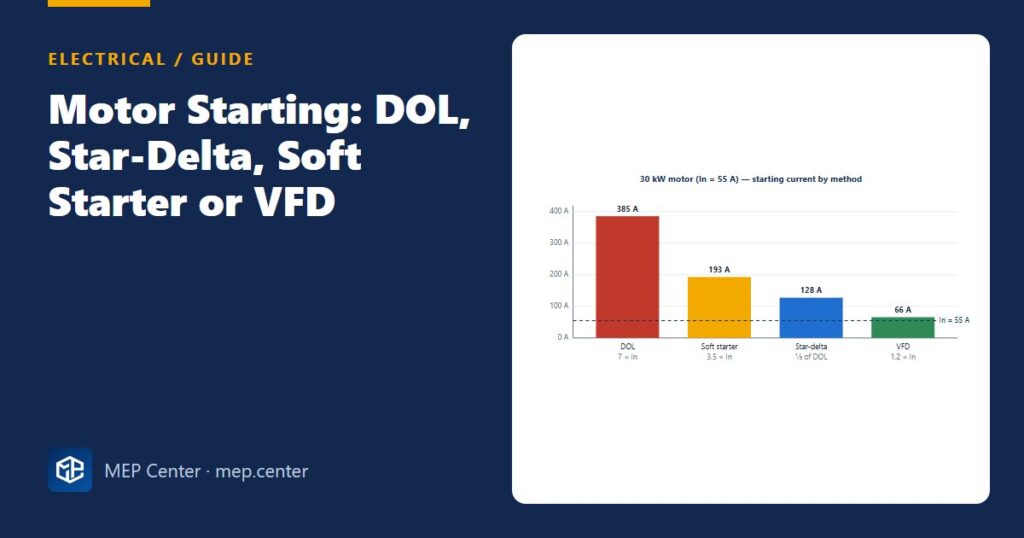
DOL: 7 × 55 = 385 A.
Star-delta: 385 / 3 ≈ 128 A (torque also one third: about 0.7–0.8 × rated).
Soft starter at 3.5 × In: 3.5 × 55 ≈ 193 A (torque ≈ (3.5/7)² = 0.25 of DOL).
VFD at 1.2 × In: ≈ 66 A.
Reading it: a centrifugal pump needs little torque at low speed, so all four can start it. On a 100 kVA generator, DOL would cause a deep dip; a soft starter or VFD is the practical choice.
How to choose in practice
- Check the supply. Ask the utility for the largest motor it allows DOL (often 5.5–7.5 kW on public LV networks). On a private transformer, estimate the dip, and on a generator always check it. Why: the supply, not the motor, usually sets the limit.
- Check the load torque. Fans and centrifugal pumps need little torque at low speed. Loaded conveyors, crushers and positive-displacement compressors need a lot. Why: star-delta and soft starters reduce torque more than they reduce current.
- Ask whether the speed must vary. If flow or pressure should follow demand, a VFD pays for itself in energy on most HVAC pumps and fans. Why: pump and fan power falls roughly with the cube of speed.
- Check the motor terminals. Star-delta on a 400 V network needs a 400/690 V motor (delta at 400 V) with six terminals and six cable cores. Why: a 230/400 V motor connected in delta on 400 V burns out.
- Check mechanical effects. A DOL start of a large pump causes water hammer, and a DOL stop is even worse. Soft starters and VFDs with controlled stopping solve both. Why: pipework damage costs more than the starter.
- Count the panel space and heat. A VFD dissipates about 2–3 % of its power as heat; a soft starter with a bypass contactor dissipates very little while running. Why: a sealed panel may need cooling.
Design details that are easy to miss
- Star-delta overload relay sits in the phase windings and is set to about 0.58 × In. Changeover at about 90 % speed; the timer is usually 3–10 s.
- VFD cabling: use a screened symmetrical motor cable with the screen terminated 360° in EMC glands at both ends. Above about 50–100 m of motor cable, add a dU/dt or sine filter as the maker requires.
- Harmonics: many drives on one board raise THD. Consider drives with chokes, active front ends or filters, and size generators for them.
- RCDs downstream of VFDs need the right type. See RCD types AC, A, F and B.
- Fire pumps have their own controller rules, and the overload must not trip during a fire. See fire pump sizing.
- On generators, the starter changes the set size. See the quick generator sizing method.
Typical values — verify with the edition adopted locally and with the motor and starter maker’s data.
Electrical Power Systems Design for Buildings
35 modules from the MV connection to the socket: transformers, short circuit, protection and selectivity, cable sizing, boards, generators, earthing, surge and lightning protection. Includes 50 % off TEKHAT.
Modules 1–3 are free, no account needed · full course €15,00 one-time
FAQ
What is the maximum motor size for DOL starting?
There is no single limit. Many utilities allow about 5.5–7.5 kW DOL on public LV networks without permission. On a private transformer, much larger motors can start DOL if the voltage dip stays acceptable.
Is a soft starter better than star-delta?
A soft starter gives a smooth start without the changeover peak and allows a controlled stop, which helps against water hammer. Star-delta at 2–2.7 × In draws less current than a soft starter at 3–4 × In, so on a weak supply star-delta can be gentler.
When should I use a VFD instead of a soft starter?
Use a VFD when the speed should vary with demand, when the starting current must be as low as possible, or when a heavy load needs full torque from standstill. If the motor always runs at full speed, a soft starter is cheaper and simpler.
TEKHAT – Single-Line Diagram & Load Schedule
Draw panel single-line diagrams and load schedules in minutes, with breaker, RCD and cable sizing. Buyers of the Electrical Power Systems Design course get 50 % off.
Free install from the Microsoft Store · 30-day trial · licence 20 € for all your devices or €15 per computer on our site
More Electrical articles
- Standby Generator Sizing: A Quick Method That Works
- PV Systems: DC Isolation, Fuses and Earthing Basics
- Lightning Protection Basics: Rolling Sphere and Mesh Method
- MCB Selection and Discrimination: A Practical Design Guide
- Cable Sizing for Voltage Drop: Formula, Limits and Worked Example
- How to Measure Earth Electrode Resistance (Fall-of-Potential)