
An unbalanced distribution board is rarely a code violation on its own, but it costs you: the neutral carries the difference current, the incomer and sub-main are sized for the heaviest phase, and voltage drop is worst on that phase. Balancing L1/L2/L3 at design time takes minutes; fixing it on site means re-terminating circuits in a live board.
This guide shows how to measure unbalance on a panel schedule, why boards drift out of balance, and a minimal-change method that fixes most panels with one or two swaps, with a fully worked example.
- Unbalance (%) = (heaviest phase − average of the three) / average × 100, using the same unit (kVA or A) for every phase.
- A design target of 10 % is common for distribution boards; utilities and generator suppliers often ask for 10–20 % at the main board.
- Three-phase loads are balanced by definition; only single-phase circuits need placing.
- Big single-phase loads (ovens, water heaters, split units) decide the balance, not the lighting circuits.
- For revisions, swap the fewest circuits that meet the target, so circuit numbers and drawings stay put.
- Balance sub-boards first, then check the main board — never the other way round.
How unbalance is measured
Add up the single-phase loads connected to each phase, then add one third of every three-phase load to each phase. Then:
Unbalance % = (Pmax − Pavg) / Pavg × 100
Pmax is the load on the heaviest phase and Pavg the average of the three phase loads, both in kVA (or in amps — the result is the same if the voltage is the same). Use the demand values from the schedule, after diversity, because that is what the incomer actually sees. Where power factors differ a lot between circuits, balance in kVA rather than kW.
Phases are named L1/L2/L3 in IEC practice; you will also see R/S/T or A/B/C on drawings. The method is identical.
The 10 % board target, the 10–20 % main-board range and the load values in this article are typical — verify with the edition adopted locally, the utility’s connection conditions and the project specification.
What the neutral sees
In a three-phase four-wire board the neutral carries the phasor sum of the three phase currents. If all phases carry the same current at the same power factor, the sum is zero. With unbalance, for loads of similar power factor:
IN = √(I1² + I2² + I3² − I1I2 − I2I3 − I3I1)
I1, I2, I3 are the single-phase load currents on each phase (A); three-phase loads add nothing to the neutral and can be left out. Harmonic-rich loads (LED drivers, IT equipment) add triplen harmonics to the neutral on top of this, which is a separate check.
Why boards drift out of balance
- Habit numbering: circuits are listed in the order they were drawn and phases assigned L1, L2, L3, L1, L2, L3… If the big loads happen to fall on every third line, they all land on one phase.
- A few large loads dominate: an oven, a water heater and a split unit at 2–3 kVA each swing a board more than a dozen lighting circuits at under 1 kVA.
- Late changes: a heater added to “the next spare way” at the end of the project is almost never rebalanced.
- Copying a typical board: a typical apartment or floor board copied to every level repeats the same unbalance on every floor, and it adds up at the main board.
Two ways to balance a board
Greedy method (new design)
- Freeze the three-phase loads; they are balanced already.
- Sort the single-phase circuits by load, largest first.
- Give each circuit to the phase with the lowest running total.
- Check the result. If one load still dominates, split it into two circuits or feed it three-phase.
This gets most boards within a few percent in one pass. The catch: it reassigns almost every circuit, which is fine on a fresh schedule but painful once plans, schedules and single-line diagrams exist.
Minimal-change method (revisions)
Instead of reassigning everything, look for the smallest set of swaps that brings the board under target. Find the heaviest and the lightest phase, compute the excess on the heaviest phase, and look for a pair of circuits (one on each phase) whose difference in load is close to that excess. Swap their phase letters. One or two swaps usually suffice, circuit numbers stay the same, and only those rows change on the schedule.
Worked example: a 12-way kitchen and plant board
Inputs — 400/230 V three-phase board, demand loads in kVA, phases assigned by habit in drawing order (L1, L2, L3, L1…), plus a 6.0 kVA three-phase heat pump.
| Circuit | Load | kVA | Phase (as drawn) | Phase (after fix) |
|---|---|---|---|---|
| C1 | Lighting | 1.2 | L1 | L1 |
| C2 | Lighting | 0.9 | L2 | L1 |
| C3 | Lighting | 0.8 | L3 | L3 |
| C4 | Oven | 3.0 | L1 | L1 |
| C5 | Sockets | 1.8 | L2 | L2 |
| C6 | Sockets | 1.5 | L3 | L3 |
| C7 | Water heater | 2.5 | L1 | L1 |
| C8 | Sockets | 1.5 | L2 | L2 |
| C9 | Dishwasher | 2.2 | L3 | L3 |
| C10 | Split unit | 2.0 | L1 | L2 |
| C11 | Washing machine | 2.2 | L2 | L2 |
| C12 | Split unit | 2.0 | L3 | L3 |
| C13 | Heat pump (3-phase) | 6.0 | L1+L2+L3 | L1+L2+L3 |
Step 1 — single-phase totals as drawn
L1 = 1.2 + 3.0 + 2.5 + 2.0 = 8.7 kVA
L2 = 0.9 + 1.8 + 1.5 + 2.2 = 6.4 kVA
L3 = 0.8 + 1.5 + 2.2 + 2.0 = 6.5 kVA
Step 2 — add the three-phase load (6.0 / 3 = 2.0 kVA per phase)
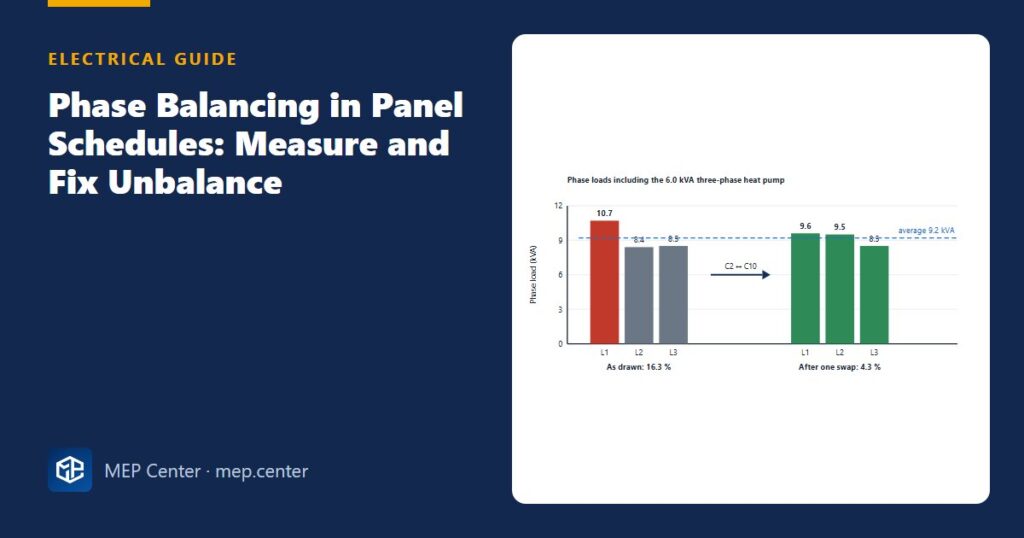
L1 = 10.7, L2 = 8.4, L3 = 8.5 kVA; total 27.6 kVA; average 9.2 kVA.
Step 3 — unbalance
(10.7 − 9.2) / 9.2 × 100 = 16.3 % → over the 10 % target.
Phase currents: 10 700 / 230 = 46.5 A, 8 400 / 230 = 36.5 A, 8 500 / 230 = 37.0 A.
Step 4 — neutral current (single-phase loads only: 8.7, 6.4, 6.5 kVA → 37.8, 27.8, 28.3 A)
IN = √(37.8² + 27.8² + 28.3² − 37.8×27.8 − 27.8×28.3 − 28.3×37.8) ≈ 9.8 A.
Step 5 — find one swap
L1 is 1.5 kVA above average; L2 is the lightest phase. Ideal swap: a pair (L1 circuit, L2 circuit) whose difference is about 1.0–1.2 kVA. C10 split unit (2.0, L1) ↔ C2 lighting (0.9, L2) gives a difference of 1.1 kVA. Swap them.
Step 6 — result
Single-phase: L1 = 8.7 − 2.0 + 0.9 = 7.6; L2 = 6.4 + 2.0 − 0.9 = 7.5; L3 = 6.5 kVA.
With heat pump: L1 = 9.6, L2 = 9.5, L3 = 8.5 kVA; average still 9.2 kVA.
Unbalance = (9.6 − 9.2) / 9.2 × 100 = 4.3 % ✓ (target 10 %).
Heaviest phase current drops from 46.5 A to 9 600 / 230 = 41.7 A; neutral from 9.8 A to ≈ 4.6 A.
Sanity check
The total is unchanged (9.6 + 9.5 + 8.5 = 27.6 kVA) — a swap moves load, it never creates or removes it. For comparison, the greedy method gives 7.3 / 7.2 / 7.1 kVA single-phase, slightly better, but in our run it moved 10 of the 12 circuits. One swap meets the target and changes two rows.
Main distribution boards
The phase loads of a main board are the sums of its sub-boards (plus any loads fed directly). Do not try to balance an MDB by moving its own outgoing ways around — balance every sub-board first, then check the MDB. If the MDB is still out, the fix is in the sub-board that contributes most to the heavy phase.
A useful trick on multi-storey residential and office buildings: rotate the phase sequence of single-phase sub-boards between floors (floor 1 on L1, floor 2 on L2, floor 3 on L3). It keeps the riser balanced even when every floor board is identical.
After balancing, re-run the sub-main checks. The heaviest phase current is what sets the incomer, the cable and the voltage drop; see our guide to cable sizing for voltage drop.
How it looks on the drawing
- The panel schedule shows a phase column (L1/L2/L3) and a totals row per phase, plus the unbalance % and the incomer current of the heaviest phase.
- The single-line diagram shows the same phase letter at each outgoing way; reviewers compare the two.
- Three-phase ways are marked “3P” or “L1+L2+L3” and counted once in each phase column.
- Any board left above target carries a note: for example “dominated by 7 kVA single-phase load — feed three-phase or accept”.
Keeping schedules and diagrams in step is easiest when both come from one list. Our TEKHAT program corrects panels this way: it reports the unbalance per board, proposes the fewest swaps, and writes the new phase letters back to the workbook, while leaving single-phase boards and boards dominated by one large load flagged for a human decision. Breaker ratings are unaffected by a swap, but if you split a dominant load into two circuits, check its protection again with our MCB selection guide.
Common mistakes
- Balancing on connected load instead of demand load, so the board is balanced on paper but not in operation.
- Counting a three-phase load on one phase only, or forgetting to split it into thirds.
- Balancing the main board by moving its outgoing ways while the sub-boards stay unbalanced.
- Re-lettering every circuit in a late revision, which breaks the match between plans, schedule and single-line diagram.
- Assuming a balanced neutral is a lightly loaded neutral where LED drivers and IT loads add triplen harmonics.
- Ignoring a single dominant load: no swap can fix a board where one circuit alone is well above the average phase load.
Quick checklist
- Demand kVA per circuit on the schedule; three-phase loads split into thirds.
- Per-phase totals and unbalance % shown for every board.
- Boards over 10 % (or the project target) fixed with the fewest swaps, or justified in a note.
- Main board checked after all sub-boards are balanced.
- Incomer and sub-main sized on the heaviest phase; voltage drop re-checked.
- Phase letters identical on schedule, single-line diagram and board labels.
Electrical Power Systems Design for Buildings
35 modules from the MV connection to the socket: transformers, short circuit, protection and selectivity, cable sizing, boards, generators, earthing, surge and lightning protection. Includes 50 % off TEKHAT.
Modules 1–3 are free, no account needed · full course €15,00 one-time
FAQ
What is an acceptable phase unbalance in a distribution board?
A design target of about 10 % is common for distribution boards, calculated as the heaviest phase minus the average, divided by the average. Utilities and generator suppliers often ask for 10–20 % at the main board. Check the project specification and the utility’s connection conditions.
Should I balance using kW, kVA or amps?
Use demand kVA or amps, which give the same result at one voltage. Kilowatts are fine when all loads have a similar power factor, but kVA is safer when motors, drivers and resistive loads are mixed.
Do three-phase loads affect phase balance?
A balanced three-phase load adds the same load to each phase and nothing to the neutral. Include one third of it in each phase total, because it raises the average and so lowers the percentage unbalance.
Why not just re-letter all circuits with a sorting method?
On a new schedule you can. On a revision, re-lettering everything breaks the match between plans, schedules, single-line diagrams and board labels. A minimal-change search usually meets the target with one or two swaps.
What if one large single-phase load makes the board impossible to balance?
Feed it three-phase if the equipment allows, split it into two circuits on different phases, or move it to another board. If none is possible, accept the unbalance and note the reason on the schedule.
TEKHAT – Single-Line Diagram & Load Schedule
Draw panel single-line diagrams and load schedules in minutes, with breaker, RCD and cable sizing. Buyers of the Electrical Power Systems Design course get 50 % off.
Free install from the Microsoft Store · 30-day trial · licence 20 € for all your devices or €15 per computer on our site
More Electrical articles
- Cable Sizing for Voltage Drop: Formula, Limits and Worked Example
- Cable Tray Sizing: Fill, Spacing and Derating in Practice
- EV Charger Installation: An Electrical Checklist
- PV Systems: DC Isolation, Fuses and Earthing Basics
- TN-S vs TN-C-S vs TT Earthing: Systems Explained (Plus IT)
- Lightning Protection Basics: Rolling Sphere and Mesh Method