
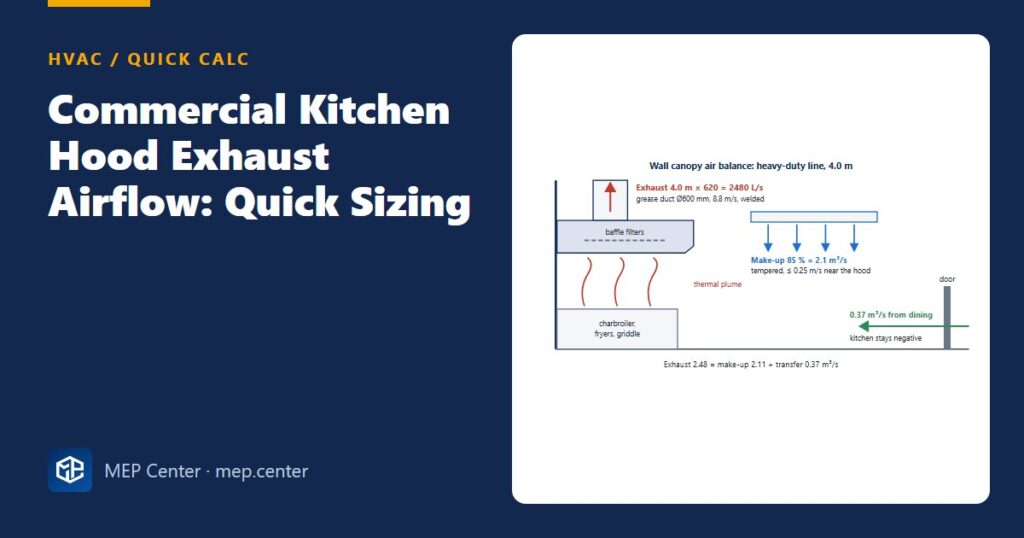
Kitchen hoods fail in two ways: the exhaust rate is too low and smoke rolls out of the canopy into the kitchen, or the make-up air is forgotten and the kitchen doors whistle. Both are avoidable with a short calculation done before the hood supplier’s drawings arrive.
The formula
Qexhaust = Lhood × qduty
where Q is in L/s, Lhood is the canopy length in m and qduty the rate per metre for the heaviest appliance duty under that hood. Island canopies (open on four sides) need noticeably more than wall canopies; proximity (back-shelf) hoods can need less for suitable appliances. A hood tested and listed by its manufacturer may be used at its listed, often lower, airflow if the authority accepts it.
| Appliance duty | Typical appliances | Wall canopy L/s per m | cfm per ft |
|---|---|---|---|
| Light | Ovens, steamers | 310 | 200 |
| Medium | Ranges, fryers, griddles | 460 | 300 |
| Heavy | Charbroilers, broilers, wok ranges | 620 | 400 |
| Extra-heavy | Solid-fuel appliances | 850 | 550 |
Use the duty of the worst appliance for the whole canopy, or split the canopy into sections if the line mixes duties. Hoods over dishwashers and steam equipment without grease are a different category (condensate or Type II hoods) and need no grease duct.
Worked example
Data: restaurant kitchen, wall canopy 4.0 m long × 1.2 m deep over a charbroiler, two fryers and a griddle (heavy duty: the charbroiler sets the duty).
- Exhaust by length: 4.0 × 620 = 2480 L/s ≈ 2.5 m³/s (5250 cfm).
- Cross-check by face velocity: 4.0 × 1.2 = 4.8 m² × 0.4 m/s = 1.9 m³/s. Lower than the code method, so the code minimum governs.
- Make-up air at 85 %: 0.85 × 2.48 = 2.1 m³/s, tempered; the remaining ≈ 0.37 m³/s is transferred from the dining room, whose own supply must be increased by that amount.
- Winter make-up heating, −5 → 18 °C: 2.1 × 1.2 × 23 ≈ 58 kW. A kitchen can need more heat than the dining room it serves.
- Grease duct at about 9 m/s: A = 2.48 / 9 = 0.276 m² → Ø600 mm, giving 2.48 / 0.283 = 8.8 m/s.
Sanity check: 2480 L/s over a 4.8 m² canopy is about 0.52 m/s across the opening, just above the 0.25–0.5 m/s of the older face-velocity method, as expected for a heavy-duty line.
Make-up air rules that keep the hood working
- Bring make-up air in at low velocity, about 0.25 m/s or less at 0.5 m from the hood edge: perforated ceiling plenums, low-velocity displacement units or plenums designed with the hood.
- Avoid jets from ceiling diffusers or door drafts across the canopy face; they pull smoke out.
- Short-circuit hoods that dump untempered air inside the canopy rarely save energy and often reduce capture.
- Interlock exhaust and make-up fans, and stop the make-up fan if the exhaust fan fails.
Grease duct basics
The exhaust from a grease hood is not ordinary ductwork. Keep at least about 2.5 m/s to move grease (design 7–11 m/s), use liquid-tight welded steel or a listed factory-built duct, fall back towards the hood, give cleanouts at changes of direction, enclose it in a fire-rated shaft through floors and never fit fire dampers in it. Discharge well above the roof and away from air intakes. Fire suppression in hood and duct, with fuel shut-off, is part of the same package.
For the rest of the ventilation design, see duct sizing guide and common duct design mistakes.
Typical values — verify with the edition adopted locally.
HVAC Systems Design — Heating, Cooling & Ventilation
28 modules from heat loss to plant room: boilers, heat pumps, cooling loads, psychrometrics, AHUs and ductwork. The VRF course is included.
Modules 1–3 are free, no account needed · full course €15,00 one-time
FAQ
How much exhaust does a commercial kitchen hood need?
For a wall canopy, about 310, 460, 620 or 850 L/s per metre of hood for light, medium, heavy and extra-heavy duty appliances. A 4 m heavy-duty canopy, for example with a charbroiler in the line, needs about 2480 L/s.
How much make-up air does a kitchen hood need?
Typically about 85 % of the exhaust as tempered make-up air, with the remaining 15 % drawn from the dining area so the kitchen stays at negative pressure and odours do not spread.
What velocity should a kitchen grease duct have?
At least about 2.5 m/s to keep grease moving, with design velocities typically 7–11 m/s. A 2480 L/s hood in a Ø600 mm duct runs at about 8.8 m/s.