
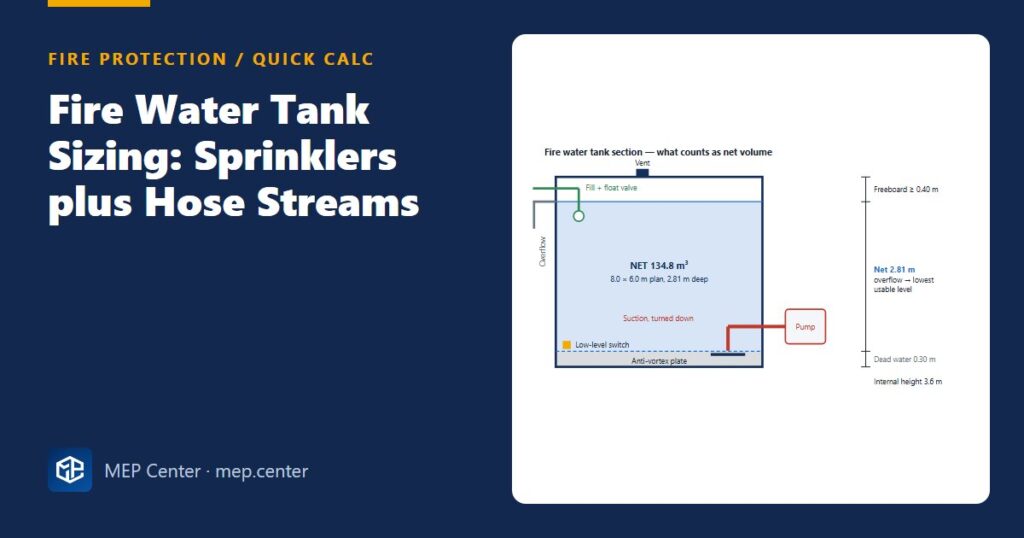
The fire water tank is usually one of the largest and most expensive single items in a sprinkler job, and its size is set early, often before the hydraulic calculation is finished. Get the volume wrong and you either waste a basement or fail the review. The method itself is short: flow × time, plus the volume you cannot use.
The formula
Vnet = (Qspr + Qhose) × t
- Qspr = sprinkler demand from the hydraulic calculation, L/min (gpm). Density × design area gives the minimum; the real figure is usually 10–20 % higher because heads near the riser flow more than the remote head.
- Qhose = hose stream allowance for the hazard (inside + outside hose).
- t = duration, min. The lower value of each range applies only where waterflow and supervisory signals are monitored at a constantly attended location.
- Vgross = Vnet + dead water below the lowest usable level + freeboard + any volume for other uses.
Where standpipes or other systems draw from the same tank, the largest demand that the codes treat as simultaneous governs, not the sum of every system. In a building sprinklered throughout, the NFPA 14 standpipe demand generally includes the sprinkler demand. Run both cases and keep the larger volume.
Design: 0.20 gpm/ft² over 1500 ft² (8.1 mm/min over 139 m²).
1. Minimum sprinkler flow: 0.20 × 1500 = 300 gpm (1136 L/min).
2. Hydraulic calculation result (with overdischarge): Qspr = 1300 L/min (343 gpm), about 14 % above the minimum.
3. Hose allowance OH: 946 L/min (250 gpm). Total = 1300 + 946 = 2246 L/min.
4. Duration: alarms monitored at an attended location → 60 min. Vnet = 2246 × 60 = 134 760 L = 134.8 m³. Without monitoring (90 min) it would be 202.1 m³.
5. Standpipe check: Class I demand 1893 L/min (500 gpm) × 30 min = 56.8 m³ — smaller, so the sprinkler case governs.
6. Tank plan 8.0 × 6.0 m = 48 m² → net depth 134.8 / 48 = 2.81 m. Add 0.30 m dead water and 0.40 m freeboard → 3.51 m, take 3.6 m internal height.
7. Refill within 8 h: 134.8 / 8 = 16.9 m³/h = 281 L/min — size the make-up line for this.
Sanity check: 2246 L/min is 37.4 L/s; for an hour that is 135 m³ ✔
Rule-of-thumb volumes (minimum basis)
Density × design area + hose, before overdischarge. Your calculated sprinkler flow will be higher, so treat these as the floor, not the answer.
| Hazard | Sprinkler min. + hose | Duration | Net volume |
|---|---|---|---|
| LH (0.10 / 1500 ft²) | 150 + 100 = 250 gpm (946 L/min) | 30 min | 28.4 m³ |
| OH1 (0.15 / 1500 ft²) | 225 + 250 = 475 gpm (1798 L/min) | 60 / 90 min | 107.9 / 161.8 m³ |
| OH2 (0.20 / 1500 ft²) | 300 + 250 = 550 gpm (2082 L/min) | 60 / 90 min | 124.9 / 187.4 m³ |
| EH1 (0.30 / 2500 ft²) | 750 + 500 = 1250 gpm (4731 L/min) | 90 / 120 min | 425.9 / 567.8 m³ |
| EH2 (0.40 / 2500 ft²) | 1000 + 500 = 1500 gpm (5678 L/min) | 90 / 120 min | 511.0 / 681.4 m³ |
| ESFR K25.2, 12 heads at 40 psi | 1913 + 250 = 2163 gpm (8188 L/min) | 60 min | 491 m³ |
Typical values based on NFPA 13 (2022) and NFPA 22 — verify with the edition adopted locally. Dry and double-interlock preaction systems use a 30 % larger design area, which raises the volume.
Things that change the volume
- Size on demand, not on the pump. A 750 gpm pump on a 550 gpm demand still empties the tank at the demand flow. Some specifications ask for 150 % of pump rating for a stated time; that is a project rule, not NFPA 13.
- Dry and preaction. +30 % design area, density unchanged. See dry pipe vs preaction.
- Refill credit. A reliable make-up supply can sometimes reduce the tank, but only with the authority’s approval. Treat it as an exception.
- Domestic water in the same tank. Only if the domestic draw-off is above the fire reserve, so the fire volume is always kept.
- Divided tank. Two compartments let you clean one half while the other stays in service. Good practice for single-tank sites.
The tank and the pump are sized together. Our fire pump sizing guide and the fire pump room checklist cover the next step, and the hazard classification guide sets the density you start from.
Fire Protection & Suppression Systems Design (NFPA)
20 narrated modules with animated diagrams, two complete worked projects (DWG + DXF), the Fire Calc Workbook and an online calculator.
Modules 1–3 are free, no account needed · full course €15,00 one-time
FAQ
How long must a fire water tank last?
Under NFPA 13 it depends on the hazard: 30 minutes for light hazard, 60–90 minutes for ordinary hazard and 90–120 minutes for extra hazard. The lower figure applies only where alarms are monitored at a constantly attended location. ESFR is typically 60 minutes.
Do I add hose streams to the tank volume?
Yes. The hose allowance (inside plus outside hose) is part of the total demand, so it is multiplied by the duration together with the sprinkler flow.
How fast must a fire tank refill?
NFPA 22 requires automatic refill within 8 hours. Divide the net volume by 8 hours to size the make-up line, for example 134.8 m³ / 8 h = 16.9 m³/h.
Is the whole tank volume usable?
No. Water below the lowest usable level, set by the suction outlet and its anti-vortex plate, does not count, and the air space above the overflow is extra. Add both to the net volume.