
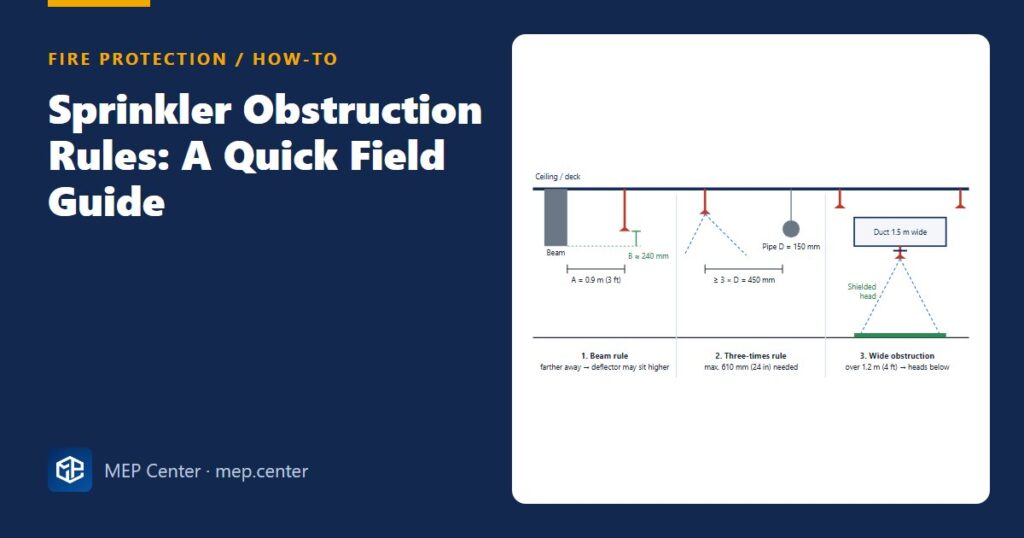
Most sprinkler layouts look fine on the architectural plan and fail once the ducts, cable trays, lights and beams arrive in the coordination model. A pipe 300 mm from a head, a duct 1.5 m wide with nothing underneath, a head pushed too high next to a beam: each one leaves a dry patch on the floor. Here is the short field method to check them.
The field check, step by step
- Collect every object near the heads. In the coordination model, list everything within 18 in (457 mm) below deflector level: beams, ducts, cable trays, pipes, lights, columns, hangers. Why: that is the zone where the spray pattern is still forming.
- Check deflector distance first. Unobstructed ceilings: deflector 1–12 in (25–305 mm) below the ceiling. Obstructed construction: 1–6 in (25–152 mm) below the structural members and not more than 22 in (559 mm) below the deck. Why: moving the head down to clear an obstruction is only allowed inside these limits.
- Apply the three-times rule to small objects. Distance from sprinkler to obstruction ≥ 3 × D, where D is its largest dimension, but never more than 24 in (610 mm). Why: pipes, columns and lights throw a dry “shadow” that shrinks quickly with distance.
- Apply the beam rule to continuous obstructions. Measure A, the horizontal distance from the sprinkler to the side of the beam or duct, and check B, how far the deflector sits above its bottom. Less than 1 ft (0.3 m) away → B = 0; around 3 ft (0.9 m) → about 9.5 in (241 mm); 5 ft (1.5 m) or more → up to 18 in (457 mm). Why: close to a beam, the spray hits its side.
- Find the wide obstructions. Anything fixed and wider than 4 ft (1.2 m) — ducts, tray banks, platforms, open grating, overhead doors when open — gets sprinklers below it. Add up side-by-side items: two 700 mm ducts with a 100 mm gap act as one 1.5 m obstruction. Why: the ceiling heads cannot reach the floor underneath.
- Use shielded heads where needed. Heads under a duct can be wetted by the ceiling heads above and fail to open in time. Use intermediate-level (shielded) sprinklers or heads listed for that position. Why: a cold-soldered head does not operate.
- Check exemptions before relying on them. The sprinkler system’s own branch piping below a stated size (under 3 in / 80 mm in recent editions) is exempt from the three-times rule. Why: exemptions change between editions.
- Re-check after fit-out changes. Ducts get wider with insulation, lights move, tenants add platforms. Why: obstruction compliance is lost after handover more often than at design.
Quick reference: three-times rule
| Obstruction | D (largest dimension) | Minimum distance |
|---|---|---|
| 50 mm conduit | 50 mm | 150 mm |
| 150 mm pipe or duct branch | 150 mm | 450 mm |
| 250 mm column | 250 mm | 750 mm → 610 mm (cap) |
| 300 × 600 mm light fitting | 600 mm | 1800 mm → 610 mm (cap) |
Typical values for standard spray upright and pendent sprinklers based on NFPA 13 (2022) — verify with the edition adopted locally; use its beam rule table for design, not the illustrative points above. Sidewall, extended coverage and ESFR heads have their own, stricter rules.
When the rule cannot be met
- Add a head on the other side of the column or beam, so the shadow is covered from both sides.
- Lower the head within the permitted deflector distance for obstructed construction.
- Move the service — at coordination stage this is often the cheapest fix.
- Treat deep beam pockets as separate bays. Where beams create separate pockets, lay out each bay as its own area for spacing. See sprinkler spacing and location rules.
Extra heads under wide ducts add flow, so check the hydraulic calculation again. Warehouses with ESFR heads need stricter checks: see ESFR quick rules. More layout errors to avoid are in sprinkler design common mistakes.
Fire Protection & Suppression Systems Design (NFPA)
20 narrated modules with animated diagrams, two complete worked projects (DWG + DXF), the Fire Calc Workbook and an online calculator.
Modules 1–3 are free, no account needed · full course €15,00 one-time
FAQ
What is the three-times rule for sprinklers?
For obstructions within 18 in (457 mm) below the deflector, the sprinkler must be at least three times the obstruction’s largest dimension away from it. For standard spray upright and pendent heads the distance never needs to exceed 24 in (610 mm).
When do I need sprinklers under a duct?
When the duct, or several ducts and trays side by side, is wider than 4 ft (1.2 m). Sprinklers are installed below it, usually shielded intermediate-level heads if they could be wetted by the ceiling heads.
How close can a sprinkler be to a beam?
It can be close, but then the deflector must be lower. Less than 1 ft (0.3 m) from the side of the beam, the deflector must be at or below the beam bottom. The further away, the higher it may sit, up to 18 in (457 mm) above the beam bottom at 5 ft (1.5 m) or more.
Are sprinkler pipes an obstruction to other sprinklers?
The system’s own branch piping below a stated size, under 3 in (80 mm) in recent editions, is exempt from the three-times rule. Larger mains and other services are not. Check the exemption list of your edition.
More Fire Protection (Sprinklers, NFPA) articles
- Dry Pipe vs Preaction: Choosing the Sprinkler System Type
- Fire Water Tank Sizing: Sprinklers plus Hose Streams
- Kitchen Hood Wet Chemical Systems: Design Basics
- Sprinkler Hazard Classification: LH, OH1, OH2, EH1 and EH2 Explained
- Wet Riser vs Dry Riser: Which Building Needs Which
- Backflow Preventers on Fire Lines: Losses and Layout