
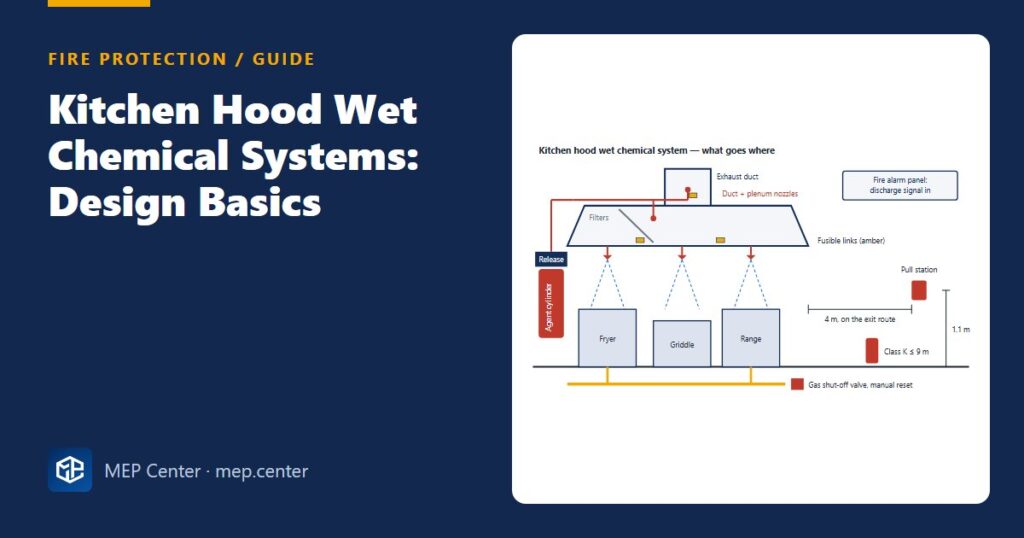
Commercial kitchen fires start in the fryer and race up the exhaust duct, and building sprinklers alone are not designed to deal with burning cooking oil. That is why a kitchen hood gets its own wet chemical system. As the MEP designer you rarely size the nozzles yourself, but you do own everything around them: gas valves, power cut-off, fire alarm signals, the pull station and coordination with the hood.
How the system works
Wet chemical agent, typically a potassium salt solution, reacts with hot cooking oil and forms a soapy layer on its surface. This is called saponification. The layer seals the oil from air and cools it, so the fire does not flash back. Modern fryers with vegetable oils run at very high temperatures and are hard to extinguish, which is why the cooking fire test standards were made tougher and older dry chemical kitchen systems are generally no longer accepted.
Design essentials
| Item | Typical NFPA 96 / 17A practice | Your job as MEP designer |
|---|---|---|
| Appliance coverage | Nozzles listed per appliance type and size; appliance-specific or overlapping coverage | Freeze the cooking line layout before the system is designed |
| Hood and duct | Plenum nozzles behind the filters, duct nozzle at the duct entry | Coordinate access panels and hood details with the kitchen supplier |
| Detection | Fusible links or electronic detectors over appliances and at the duct entry | Agree the detector type with the system supplier |
| Fuel and power shut-off | All gas and electric supply to protected appliances off on discharge; manual reset only | Gas valve on the line serving every appliance under the hood; contactor for electric appliances |
| Manual release | Pull station 10–20 ft (3–6 m) from the hood, in the path of egress, 42–48 in (1.07–1.22 m) high | Show it on the plans next to the kitchen exit |
| Fans | Exhaust fan and make-up air as the system listing states | Write the fan logic into the cause-and-effect matrix |
| Portable extinguisher | Class K within 30 ft (9 m) of the cooking appliances, with a placard: use the fixed system first | Add to the extinguisher layout |
| Servicing | Every six months by a qualified person; fusible links replaced at least semi-annually in current editions | Put it in the O&M manual |
Typical values based on NFPA 96 and NFPA 17A — verify with the edition adopted locally and the listing of the chosen system. In European projects, kitchen fire protection systems are covered by EN 17446 and national rules; the same interfaces apply.
Interfaces that are easy to miss
- Fire alarm. System discharge should signal the building fire alarm panel and, where the building has one, shut down make-up air as programmed. Write the signals into the cause-and-effect matrix.
- Gas valve placement. A gas appliance outside the hood but on the same gas branch is a common miss. Either it is on its own branch, or it shuts off too.
- Sprinklers stay. Kitchen sprinklers still follow NFPA 13; the hood system does not replace them. See the hazard classification guide for the room itself.
- Exhaust design. Hood size, capture velocity and duct construction belong to the mechanical designer, but nozzle positions depend on them. Our kitchen hood exhaust airflow guide covers the air side.
Common mistakes
- Cooking line changed after commissioning. A fryer swapped with a griddle can leave nozzles aimed at the wrong appliance. Any change needs the system supplier.
- Pull station behind the cooking line or too close to the hood. Nobody can reach it once the fryer is burning.
- No manual reset on the gas valve. Gas must not return automatically after a discharge.
- Using a water extinguisher on the fryer. Water on burning oil erupts. Only the fixed system and the Class K extinguisher.
- Missed servicing. Links that are not replaced, and nozzles blocked with grease, are the usual causes of failure.
Fire Protection & Suppression Systems Design (NFPA)
20 narrated modules with animated diagrams, two complete worked projects (DWG + DXF), the Fire Calc Workbook and an online calculator.
Modules 1–3 are free, no account needed · full course €15,00 one-time
FAQ
Does a commercial kitchen hood need a fire suppression system?
Under NFPA 96, yes, where the cooking appliances produce grease-laden vapours. The system must protect the appliances, the hood plenum and the exhaust duct entry. Many national codes have the same requirement.
Where should the kitchen suppression pull station be?
In the path of egress, typically 10–20 ft (3–6 m) from the hood and 42–48 in (1.07–1.22 m) above the floor, so it can be operated safely while leaving the kitchen.
Why wet chemical and not dry chemical in kitchens?
Wet chemical reacts with hot cooking oil to form a soapy layer that seals and cools it, so the fire does not flash back. Older dry chemical systems often fail the current cooking fire tests with modern high-temperature fryers.
How often must a kitchen hood suppression system be serviced?
Every six months by a qualified person under NFPA 96 and NFPA 17A. Current editions also require fusible links to be replaced at least semi-annually.
More Fire Protection (Sprinklers, NFPA) articles
- ESFR Sprinklers: Quick Rules Before You Specify Them
- 12 Common Sprinkler Design Mistakes Reviewers Reject
- Sprinkler Obstruction Rules: A Quick Field Guide
- Fire Water Tank Sizing: Sprinklers plus Hose Streams
- Fire Hydrant Connection to the Fire Main (NFPA 24 Practice)
- Sprinkler Hydraulic Calculation: A Step-by-Step Worked Example