
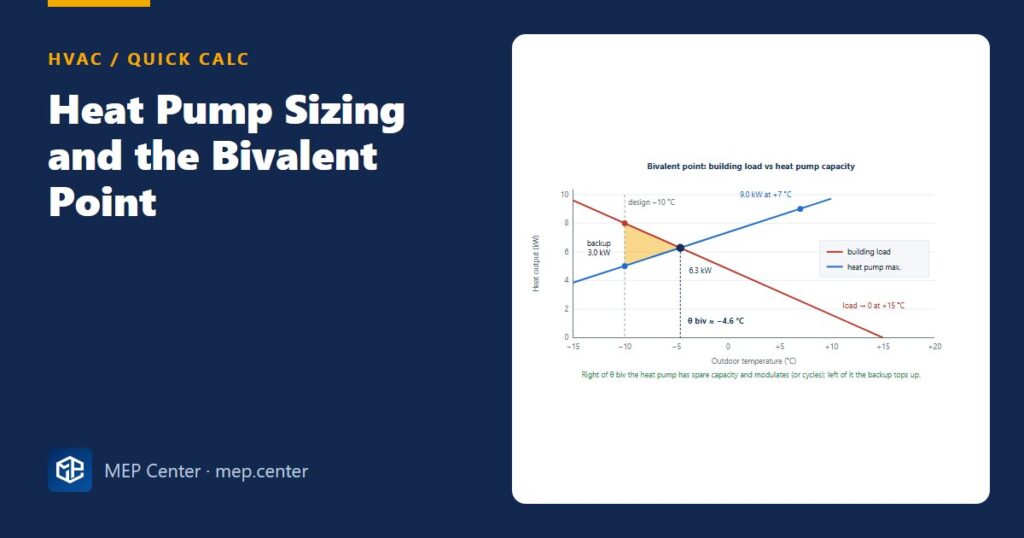
Most disappointing heat pump installations fail on one of two opposite errors: the unit was chosen from its mild-weather headline capacity and cannot cope on cold days, or margin was piled on margin until it cycles on and off all winter. The bivalent point is the quick check that puts the unit between those two errors.
The formula
Building load line (θ in °C):
Φload(θ) = Φdes × (θlim − θ) / (θlim − θe)
Φdes = design heat loss (kW) at the design outdoor temperature θe; θlim = heating limit temperature, the outdoor temperature at which heating is no longer needed (internal and solar gains cover the loss).
Heat pump capacity line from two catalogue points at the design flow temperature (for example A−10/W45 and A7/W45):
ΦHP(θ) = Φ1 + (Φ2 − Φ1) × (θ − θ1) / (θ2 − θ1)
Set Φload = ΦHP and solve for θ: that is the bivalent point θbiv. The backup capacity is Φdes − ΦHP(θe). Use the integrated capacities (those that include defrost losses), not the instantaneous peak values.
Worked example: a house with an 8 kW heat loss
Load line: Φload = 8.0 × (15 − θ) / 25 = 0.32 × (15 − θ) kW.
Capacity line: ΦHP = 5.0 + (9.0 − 5.0)/17 × (θ + 10) = 5.0 + 0.2353 × (θ + 10) kW.
Intersection: 4.80 − 0.32 θ = 7.353 + 0.2353 θ → −2.553 = 0.5553 θ → θbiv ≈ −4.6 °C (load there ≈ 6.3 kW).
Backup at design: 8.0 − 5.0 = 3.0 kW, e.g. a stepped electric heater (mono-energetic operation).
Sanity check: the backup supplies 37 % of the peak capacity but only a few percent of the annual energy, because few hours of the year are colder than −4.6 °C.
Adjustments before you pick a unit
- Blocking periods. If the tariff lets the utility switch the heat pump off for 2 × 2 h a day, the daily energy must be delivered in 20 h: 8.0 × 24 / 20 = 9.6 kW. Why: otherwise the house cools down during every block. Apply it only where blocking really exists.
- Domestic hot water. Where the cylinder is reheated in short periods, the unit’s surplus outside the coldest hours usually covers it; a common allowance where needed is 0.2–0.25 kW per person. Why: DHW priority takes the unit away from space heating.
- Read capacity at the real flow temperature. With the 9.6 kW load and a unit giving 6.2 kW at A−10/W45 and 10.1 kW at A7/W45, θbiv ≈ −4.5 °C and the backup is 9.6 − 6.2 = 3.4 kW. Why: W35 figures overstate what a W45 radiator system will get.
- Check the minimum output. At +10 °C the 9.6 kW house needs 9.6 × 5/25 ≈ 1.9 kW; if the unit cannot modulate below about 3 kW, it will cycle. Why: cycling wears the compressor and needs system volume (see below).
- Check every emitter at the chosen flow temperature, especially bathrooms; see radiator sizing correction factors and underfloor heating quick design. Why: one undersized room forces the whole system to a higher flow temperature.
Rules of thumb
| Item | Typical value | Note |
|---|---|---|
| Bivalent point, −10 °C climate | about −5 °C | Heat pump covers ≈ 95–98 % of annual energy in parallel mode |
| Moving θbiv to the design temperature | gains the last 2–5 % of energy | Large, costly unit that cycles in mild weather |
| COP penalty of flow temperature | ≈ 2–3 % per K | 55 → 35 °C is worth roughly +40–60 % seasonal |
| Defrost volume | 5 kW × 3 min, 5 K drop → 43 L | Water that stays connected during defrost |
| Anti-cycling volume | 3 kW × 6 min, 5 K → 52 L | Product rules often 10–20 L/kW |
| Heat pump flow at 5 K | 4 × the flow of a 20 K boiler | 9.6 kW → 1.65 m³/h; size pipes for it |
Start from a proper room-by-room load: heat loss calculation step by step. The pipework then follows hydronic heating pipe sizing.
Typical values — verify with the edition adopted locally and with the manufacturer’s certified capacity tables.
HVAC Systems Design — Heating, Cooling & Ventilation
28 modules from heat loss to plant room: boilers, heat pumps, cooling loads, psychrometrics, AHUs and ductwork. The VRF course is included.
Modules 1–3 are free, no account needed · full course €15,00 one-time
FAQ
What is the bivalent point of a heat pump?
It is the outdoor temperature at which the heat pump’s maximum capacity equals the building’s heat load. Below it a second heat source, usually an electric backup heater or a boiler, has to cover the difference.
Should a heat pump cover 100 % of the design load?
Usually not. With the bivalent point around −5 °C in a −10 °C climate the heat pump still supplies about 95–98 % of the annual energy. Sizing for the full design load gives a larger unit that cycles in mild weather.
Which capacity figure should I use from the catalogue?
Use the integrated capacity, which includes defrost, at the design outdoor temperature and at your real design flow temperature, for example A−10/W45. The A7/W35 headline figure overstates what the unit delivers on a cold day.