
An undersized expansion vessel shows up as a safety valve that drips every afternoon; a vessel with the wrong pre-charge shows up as air gurgling in the top-floor radiators. Both come from skipping a five-line calculation that needs only the system volume, the temperature and three pressures.
The inputs
- System volume Vs: calculate it from pipe lengths, emitters, boiler and buffer tanks. For early estimates, radiator systems hold about 10 L per kW.
- Expansion factor e: from the fill temperature (10 °C) to the maximum flow temperature. Glycol mixtures expand more than water.
- Static pressure pst: height of the highest point above the vessel × 0.098 bar/m.
- Safety valve psv: the lowest-rated safety valve protecting the system, usually at the boiler.
| Max. water temperature | 40 °C | 50 °C | 60 °C | 70 °C | 80 °C | 90 °C |
|---|---|---|---|---|---|---|
| Expansion from 10 °C | 0.75 % | 1.18 % | 1.68 % | 2.24 % | 2.87 % | 3.55 % |
The calculation in five steps
- Expansion volume: Ve = e × Vs. Why: this is the water the system pushes out as it heats up.
- Water reserve: Vwr = 0.5 % of Vs, at least 3 L. Why: it covers small losses from venting so the pressure never falls below minimum.
- Pre-charge: p0 = pst + 0.2 bar. Why: it keeps the highest point of the system above atmospheric pressure, so air cannot get in.
- Final pressure: pe = psv − 0.5 bar (for psv ≤ 5 bar) or 0.9 × psv (above 5 bar). Why: the safety valve needs a closing margin or it weeps.
- Nominal volume: Vn = (Ve + Vwr) × (pe + 1) / (pe − p0), then pick the next size up. Why: the gas cushion only uses the fraction of the vessel between the two absolute pressures.
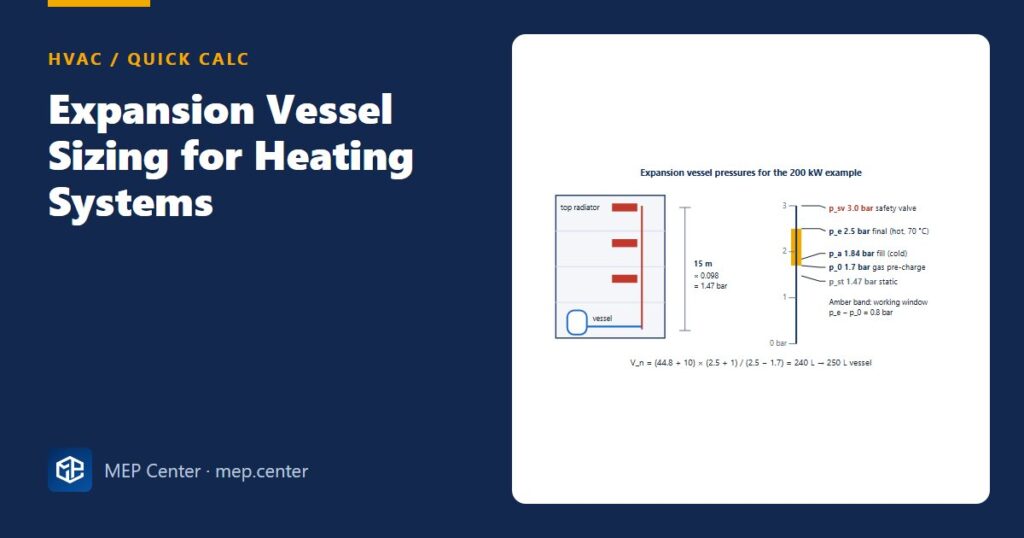
Worked example: 200 kW radiator system, Vs = 2 000 L, maximum 70 °C, highest point 15 m above the vessel, safety valve 3.0 bar.
- Ve = 0.0224 × 2 000 = 44.8 L
- Vwr = 0.005 × 2 000 = 10 L
- pst = 15 × 0.098 = 1.47 ≈ 1.5 bar → p0 = 1.7 bar
- pe = 3.0 − 0.5 = 2.5 bar
- Vn = 54.8 × 3.5 / (2.5 − 1.7) = 54.8 × 4.375 = 240 L → select 250 L
Cold fill pressure for the 250 L vessel: pa = 3.5 / [1 + 44.8 × 3.5 / (250 × 2.7)] − 1 = 1.84 bar. Check: the vessel then holds 250 × (1 − 2.7/2.84) = 12.3 L of reserve, more than the 10 L needed ✓.
Sensitivity: with a 6 bar safety valve, pe = 0.9 × 6 = 5.4 bar and Vn = 54.8 × 6.4 / 3.7 = 95 L. The narrower the pressure window, the bigger the vessel.
Quick check for a house
25 kW radiator system, about 250 L, maximum 70 °C, highest radiator 6 m above the vessel, safety valve 3.0 bar.
Ve = 0.0224 × 250 = 5.6 L; Vwr = 0.5 % = 1.25 L → minimum 3 L; p0 = 6 × 0.098 + 0.2 = 0.79 ≈ 0.8 bar; pe = 2.5 bar.
Vn = 8.6 × 3.5 / (2.5 − 0.8) = 17.7 L → 18 L vessel. If the boiler has a built-in vessel, check its size against this number before you rely on it.
On site and on the drawing
- Set the pre-charge before connecting the vessel. A vessel left at its factory pre-charge is one of the commonest commissioning faults.
- Connect on the pump suction side, usually the common return near the heat source, so the pump adds pressure to the system instead of pulling parts of it below atmospheric.
- Use a lockable isolating valve with drain on the connection, so the vessel can be checked without draining the system.
- Above about 300–500 kW or 30–40 m, pressurisation units with degassing usually replace static vessels.
- Domestic hot water needs its own potable-water vessel, sized with the water-supply pressures, not the heating vessel.
The system volume comes from the pipe network; see hydronic heating pipe sizing, and start from the loads in heat loss calculation step by step.
Typical values — verify with the edition adopted locally.
HVAC Systems Design — Heating, Cooling & Ventilation
28 modules from heat loss to plant room: boilers, heat pumps, cooling loads, psychrometrics, AHUs and ductwork. The VRF course is included.
Modules 1–3 are free, no account needed · full course €15,00 one-time
FAQ
What pre-charge pressure should a heating expansion vessel have?
The static height above the vessel times 0.098 bar/m plus about 0.2 bar. For a highest point 15 m above the vessel that is 1.47 + 0.2 ≈ 1.7 bar, set before the vessel is connected.
How big an expansion vessel does a 200 kW heating system need?
With about 2 000 L of water, 70 °C maximum, 15 m static height and a 3 bar safety valve, the calculation gives 240 L, so a 250 L vessel. A 6 bar safety valve would bring it down to about 95 L.
Why does my heating safety valve drip when the system is hot?
Usually the vessel is too small, has lost its gas pre-charge, or the system was filled cold to too high a pressure. The final hot pressure then reaches the valve setting.