
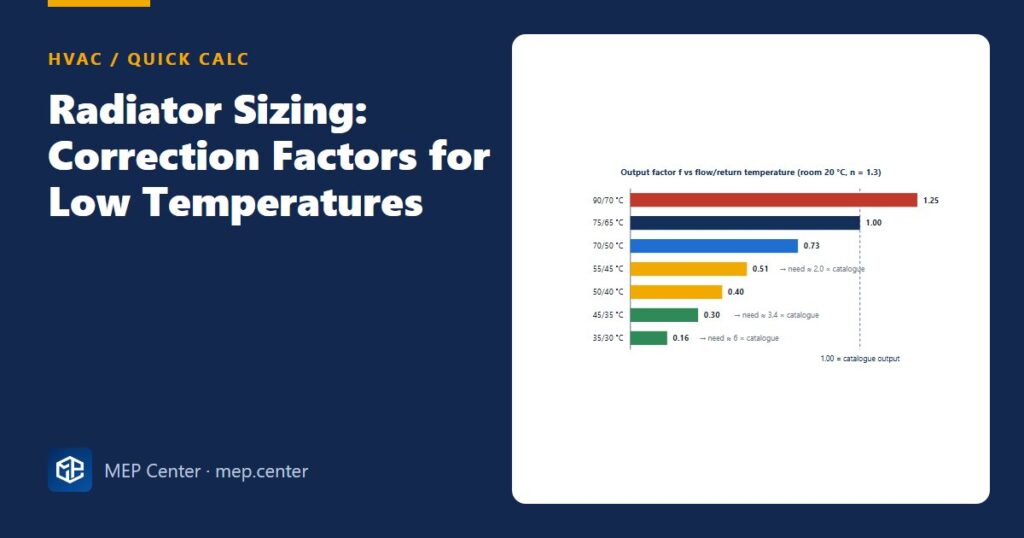
Radiator catalogues quote output at 75/65/20 °C, but heat pumps and condensing boilers want 55/45 or lower. Pick a radiator from the catalogue column without correcting it and the room ends up with about half the heat it needs.
The formula
Φ = Φ50 × (ΔT / 50)n → required Φ50 = Φroom / f
ΔTln = (θf − θr) / ln[(θf − θi) / (θr − θi)]
Φ50 = catalogue output at the EN 442 standard condition 75/65/20 °C (nominal ΔT 50 K); θf, θr = flow and return water temperature; θi = room temperature; n = radiator exponent from the catalogue: panels 1.25–1.35 (1.30 typical), column radiators 1.30–1.35, convectors 1.35–1.50.
You may use the simple arithmetic mean instead of the log mean only while (θr − θi) / (θf − θi) ≥ 0.7. At low temperatures that ratio is usually below 0.7 (45/35/20 gives 0.6), so use the log mean.
Correction factors at a glance
| Flow/return (room 20 °C) | ΔTln (K) | Factor f (n 1.3) | Typical heat source |
|---|---|---|---|
| 90/70 | 59.44 | 1.25 | Old non-condensing boiler |
| 80/60 | 49.33 | 0.98 | Older design standard |
| 75/65 | 49.83 | 1.00 | EN 442 catalogue condition |
| 70/50 | 39.15 | 0.73 | Condensing boiler, conservative |
| 55/45 | 29.72 | 0.51 | Condensing boiler, heat pump (high-temp.) |
| 50/40 | 24.66 | 0.40 | Heat pump |
| 45/35 | 19.58 | 0.30 | Heat pump, efficient |
| 35/30 | 12.33 | 0.16 | Underfloor range — radiators impractical |
Room temperature matters too: a bathroom at 24 °C on 55/45 water gets f ≈ 0.42 instead of 0.51.
Worked example: living room at 55/45 °C
Step 1 — ΔTln: (55 − 45) / ln(35/25) = 10 / 0.3365 = 29.72 K.
Step 2 — factor: f = (29.72/50)1.3 = 0.5085.
Step 3 — required catalogue output: 904 / 0.5085 = 1 778 W.
Step 4 — length: 1 778 / 1 690 = 1.05 m → two radiators under the window, 700 + 500 mm = 1.2 m → 2 028 W nominal → 2 028 × 0.5085 = 1 031 W (+14 %).
Step 5 — water flow: 860 × 0.904 / 10 = 78 L/h.
Sanity check: 1 031 W is about half of 2 028 W, as f says. At 45/40 °C the same room would need ≈ 2 570 W nominal (f 0.352) and 155 L/h, twice the flow, because the water spread is 5 K instead of 10 K.
Panel type multipliers
| Panel type | Relative output per metre (type 22 = 1.00) |
|---|---|
| 10 (single panel, no fins) | 0.45 |
| 11 (single panel, one fin row) | 0.60 |
| 21 | 0.80 |
| 22 | 1.00 |
| 33 | 1.40 |
Practical checks
- Take n from the catalogue. At low ΔT a higher n reduces output further; convectors (n up to 1.5) suffer most.
- Retrofit to a heat pump: multiply each existing radiator’s Φ50 by f at the new temperatures and compare with the room load. Where one room fails, upgrade that radiator (for example type 22 → 33) instead of raising the whole system’s flow temperature.
- Connect cross-wise: flow at the top of one end, return at the bottom of the opposite end. Why: the water then sweeps the whole panel; same-end or bottom-bottom connections lose output, more so on long radiators.
- Length: aim for at least 70–75 % of the window width; clearances about 100 mm above the floor, at least 100 mm below the sill, 25–50 mm from the wall.
- Every kelvin counts: a heat pump runs about 2–3 % more efficiently per K of lower flow temperature, so 45 °C instead of 55 °C saves roughly 20–30 %.
Room loads come from heat loss calculation step by step; the heat source check is in heat pump sizing and the bivalent point, and pipe sizes in hydronic heating pipe sizing.
Typical values — verify with the edition adopted locally and with the manufacturer’s tested data.
HVAC Systems Design — Heating, Cooling & Ventilation
28 modules from heat loss to plant room: boilers, heat pumps, cooling loads, psychrometrics, AHUs and ductwork. The VRF course is included.
Modules 1–3 are free, no account needed · full course €15,00 one-time
FAQ
How do I convert radiator output from ΔT 50 to a lower temperature?
Multiply the catalogue output by f = (ΔT / 50)^n, using the log-mean temperature difference and the radiator exponent n (about 1.3 for panels). At 55/45/20 °C the factor is about 0.51.
How much bigger must radiators be for a heat pump?
At 55/45 °C about twice the catalogue output of the room load, at 45/35 °C about 3.4 times. Below about 35 °C flow, radiators become impractical and underfloor heating or fan-assisted emitters fit better.
Can I use the arithmetic mean temperature difference?
Only while (return − room) / (flow − room) is at least 0.7. At typical heat pump temperatures it is lower, so use the logarithmic mean.