
MEP Center Academy · NFPA 13 · 14 · 20 · 22 · 24 · 15 · 750 · 2001 · 25
Design fire protection systems the way an experienced engineer does
From the hazard on the floor to the pump in the basement, with every number checked: sprinklers, hydraulic calculations, fire pumps, tanks, standpipes, hydrants, ESFR storage, water spray, water mist and clean agent systems.
Modules 1–3 are free. No account needed. Start now, and buy the full course only when you are sure.
See what happens inside the equipment
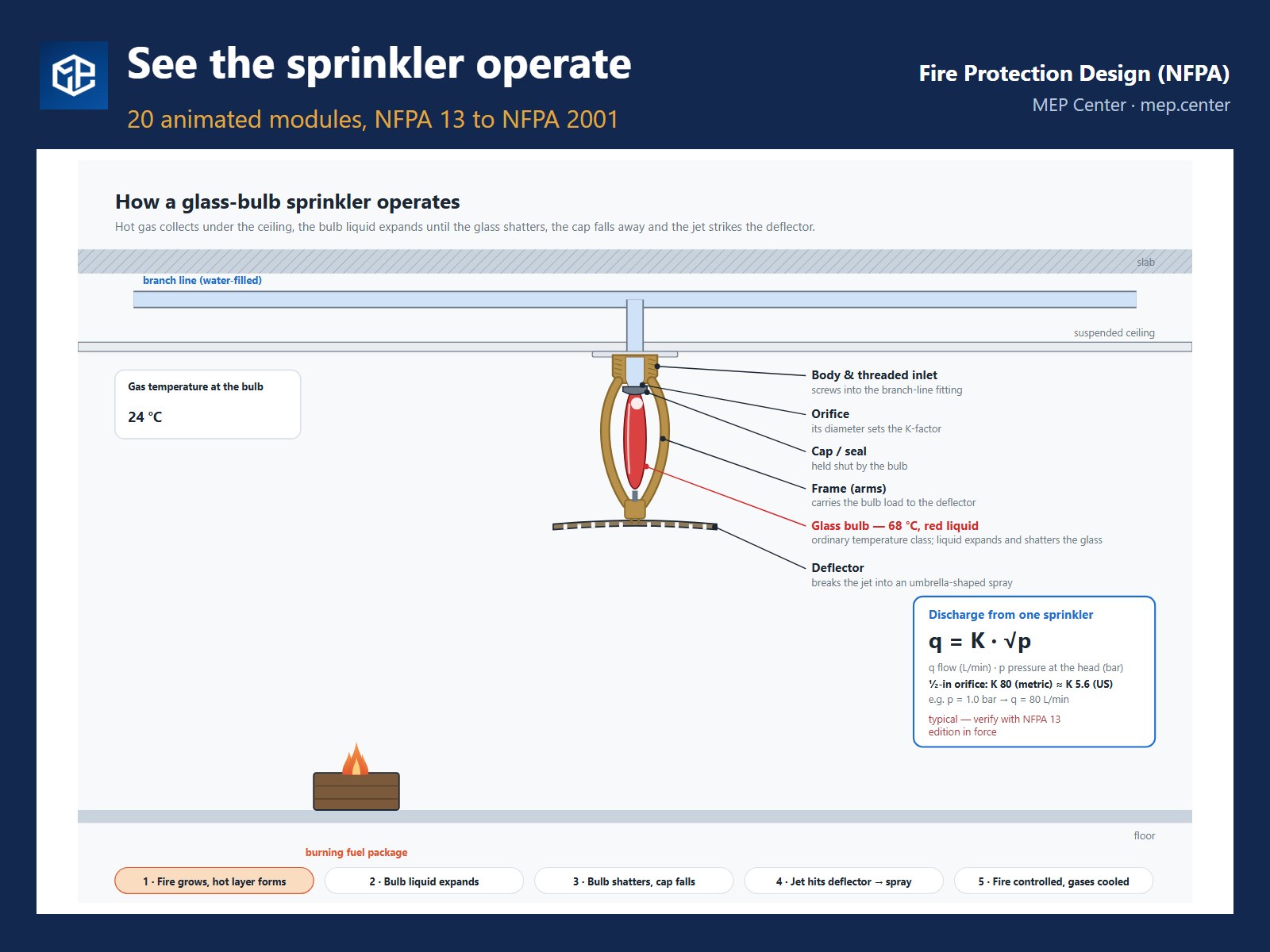
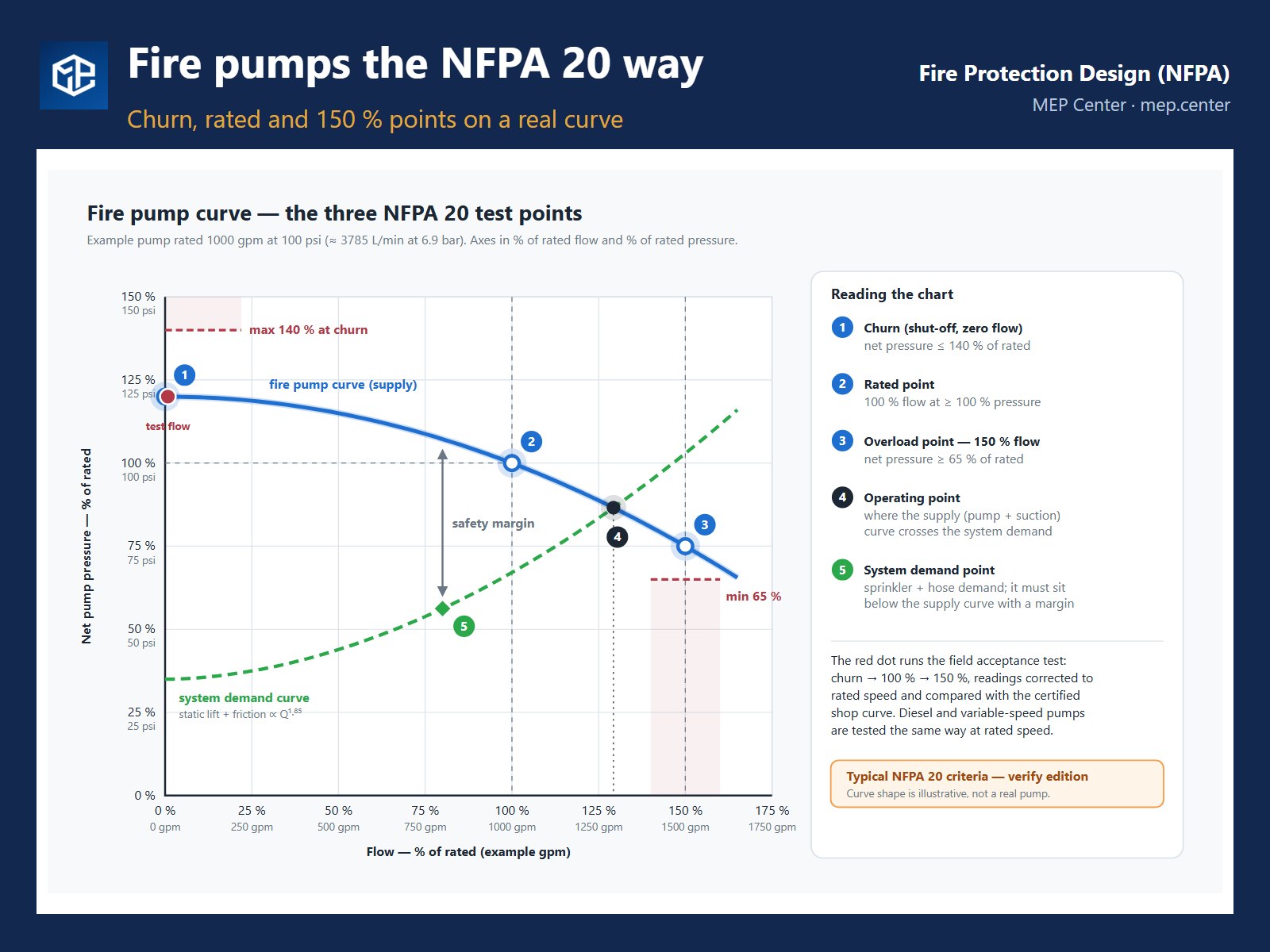
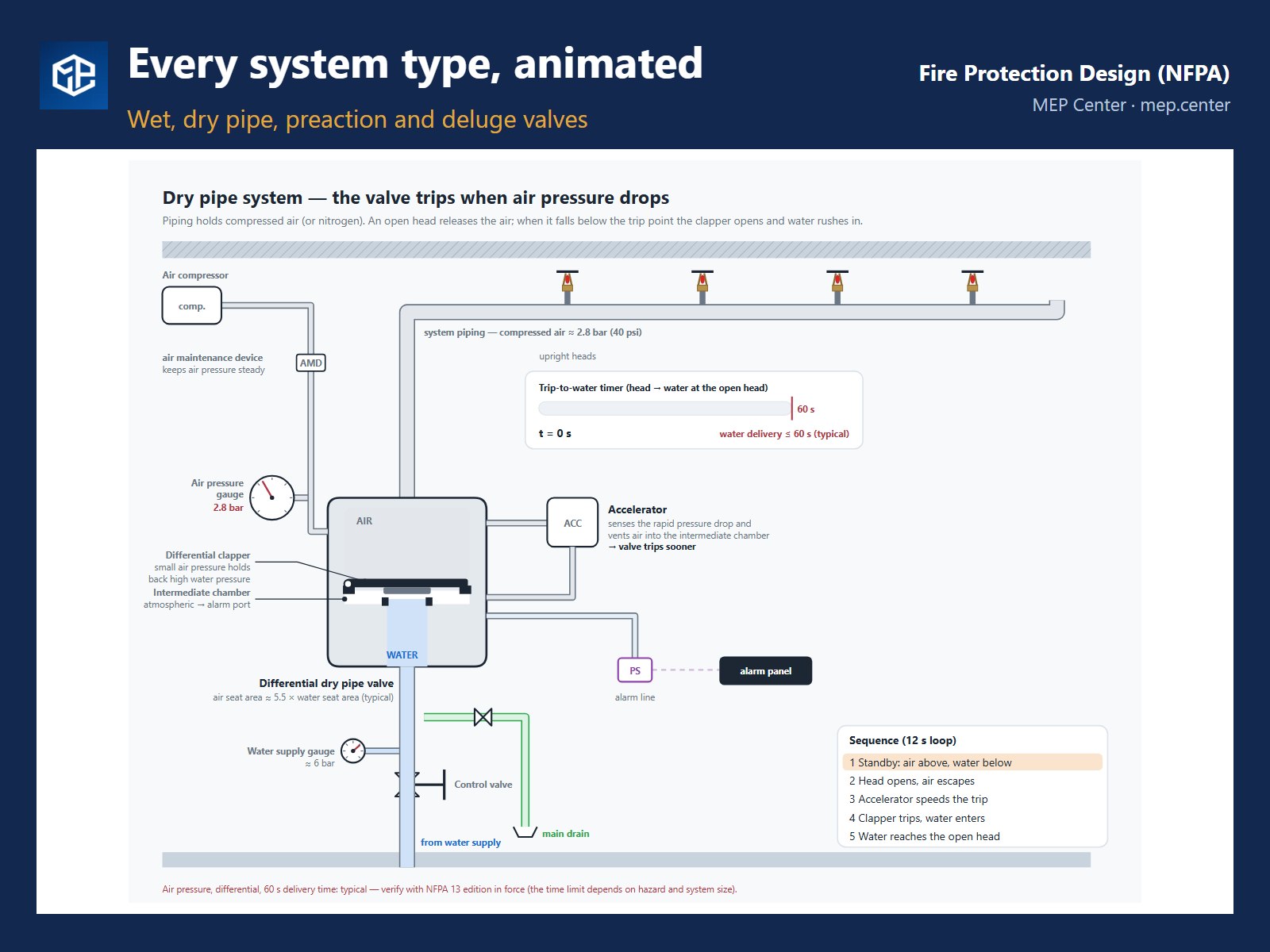
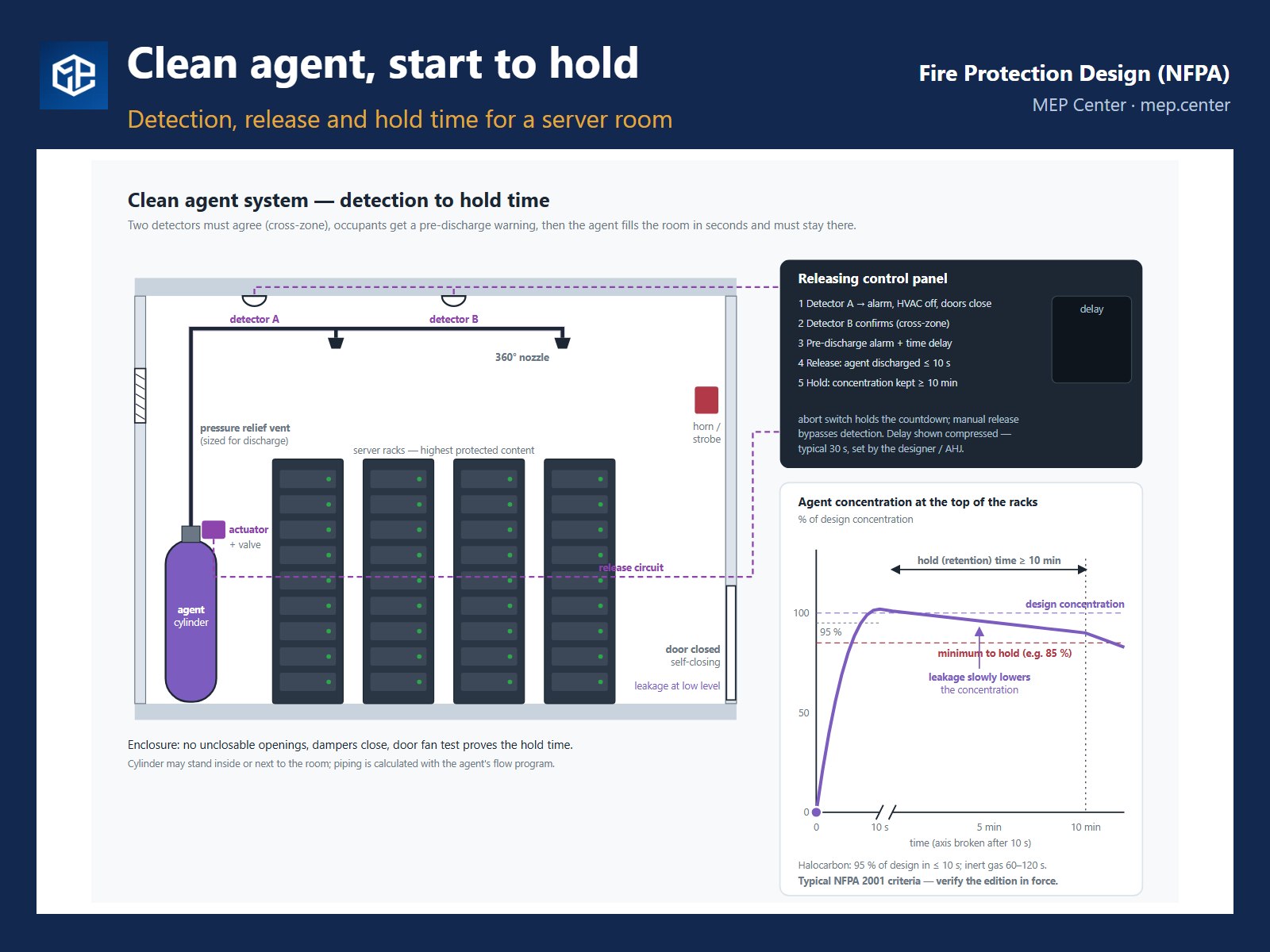
Most fire protection training is a list of rules. Here every topic is animated. You watch a glass bulb shatter and the water form its umbrella. A dry pipe valve trips as the air pressure falls. A fire pump runs along its curve to churn and to 150 %. A clean agent fills a server room and holds. Every topic then follows the same rhythm: the physics → the rule and the numbers → a worked example → what it looks like on the drawing → the classic mistakes → a checklist.
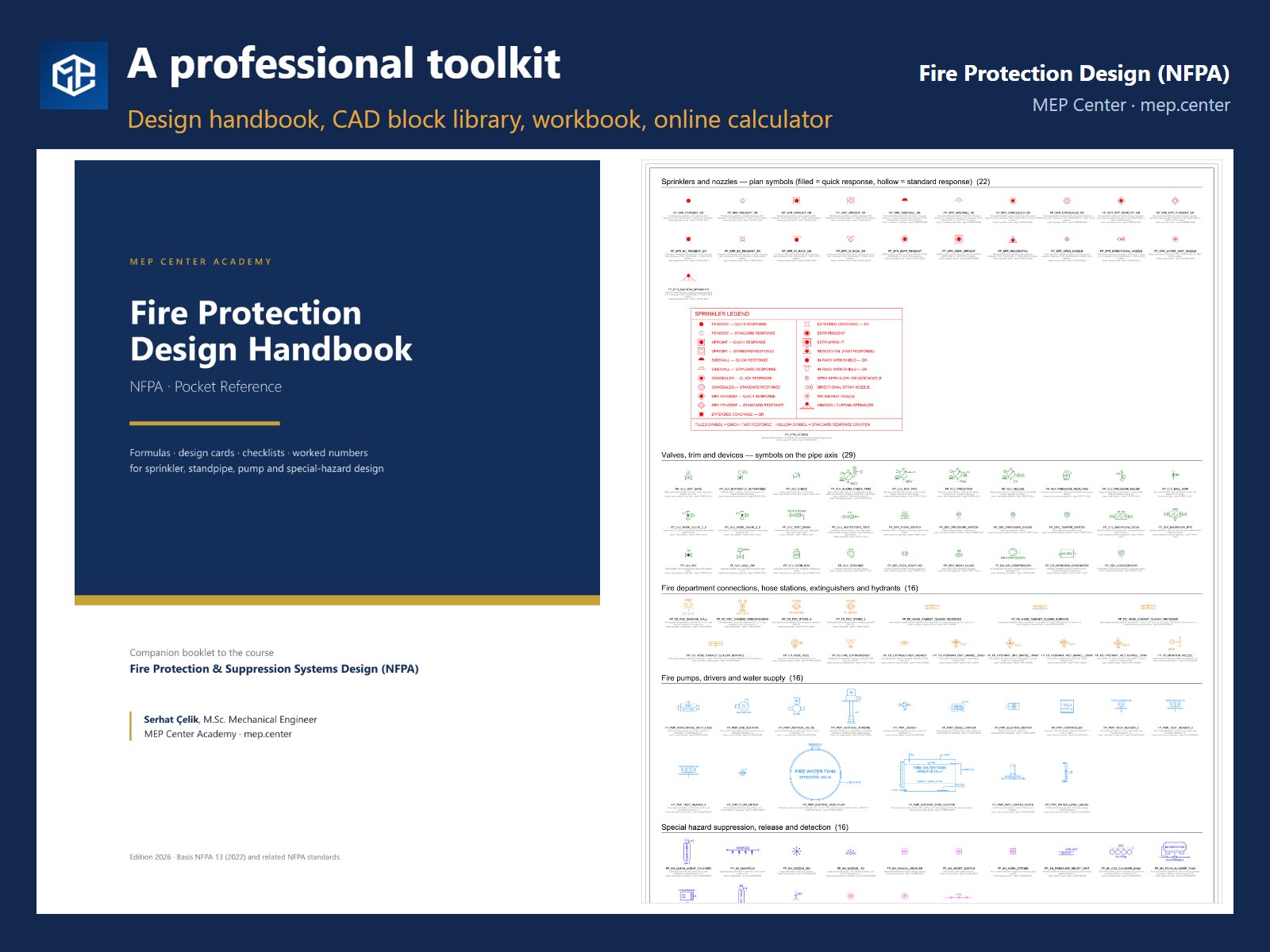
Your professional toolkit, included with the full course
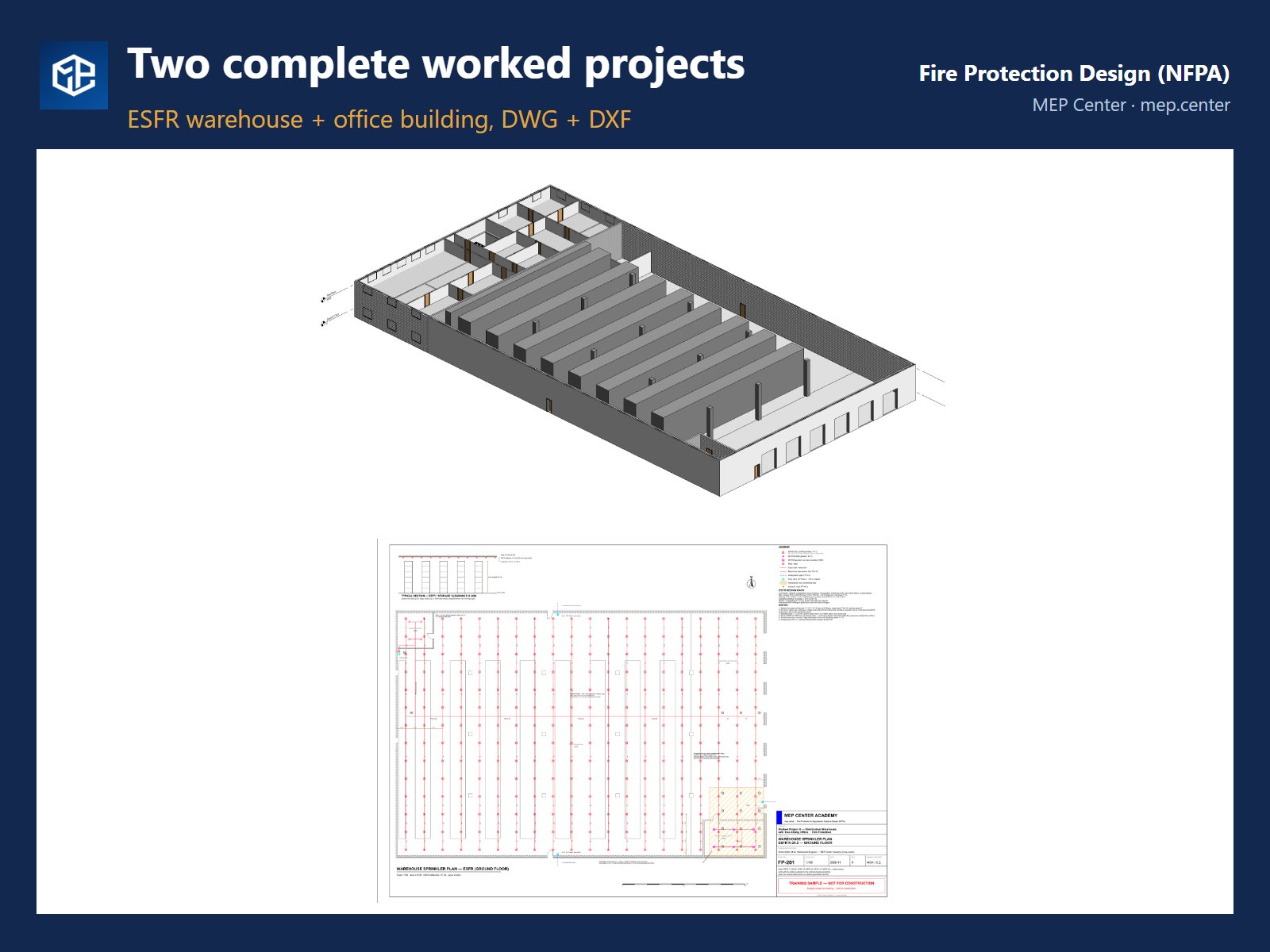
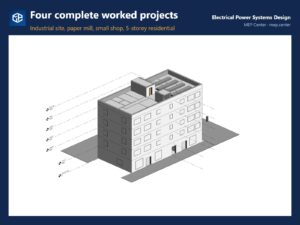
Two complete worked projects
Project A: Distribution warehouse + two-storey office. ESFR K-25.2 under a 12 m roof, rack storage, fire pumps, a 550 m³ suction tank, the private fire main and hydrants, the FDC and riser room.
Project B: Three-storey office building. Light-hazard quick-response sprinklers, standpipes and hose valves, a clean agent server room, and the pump and tank.
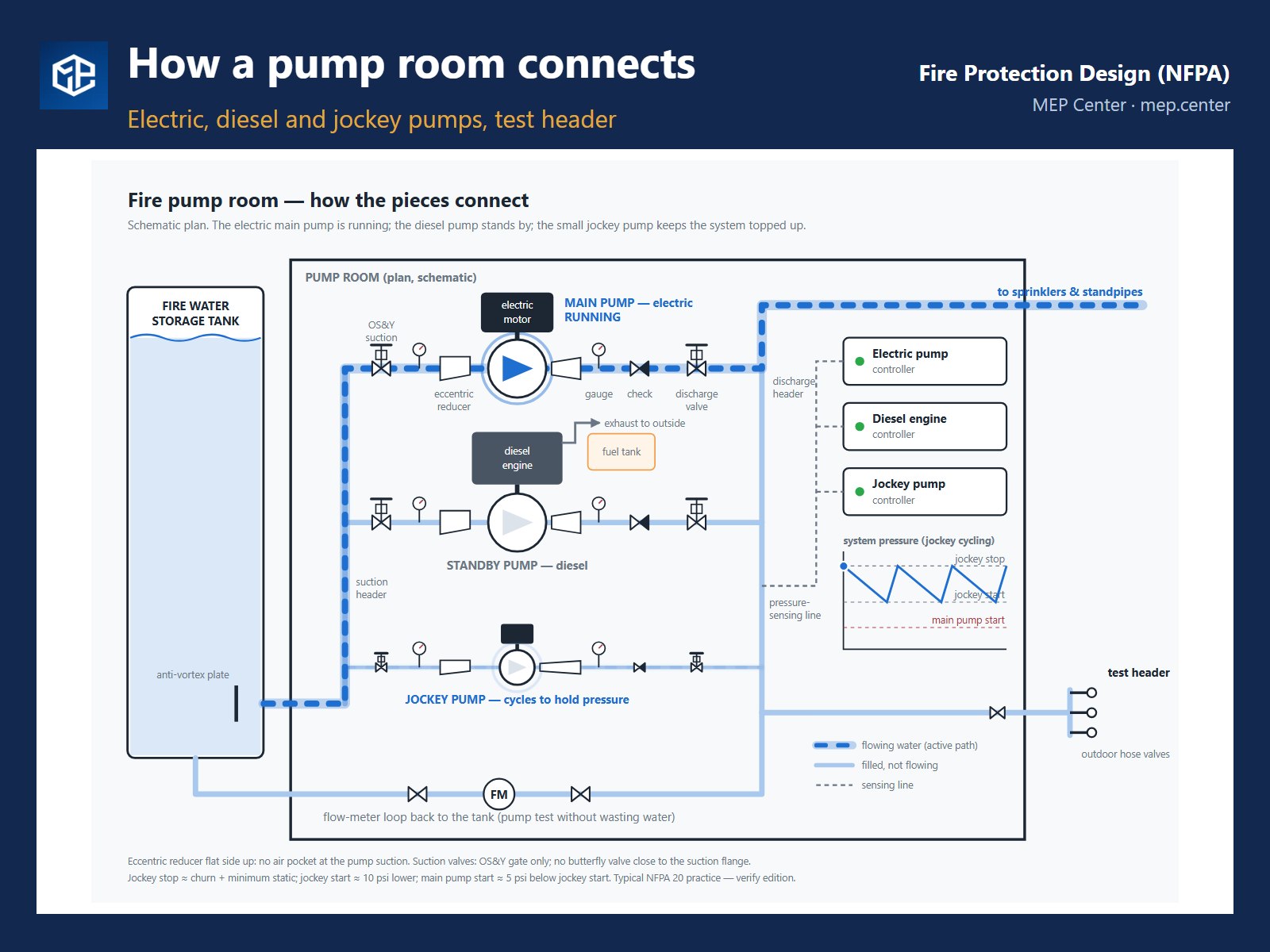
The architecture is modelled in Revit. The fire protection sheets come as DWG + DXF: site plan, sprinkler plans, riser and pump room schematics, the hydraulic node diagram and the full hand calculation.
Fire Calc Workbook (Excel)
A working calculation program built on the course method:
- design basis and area modifiers
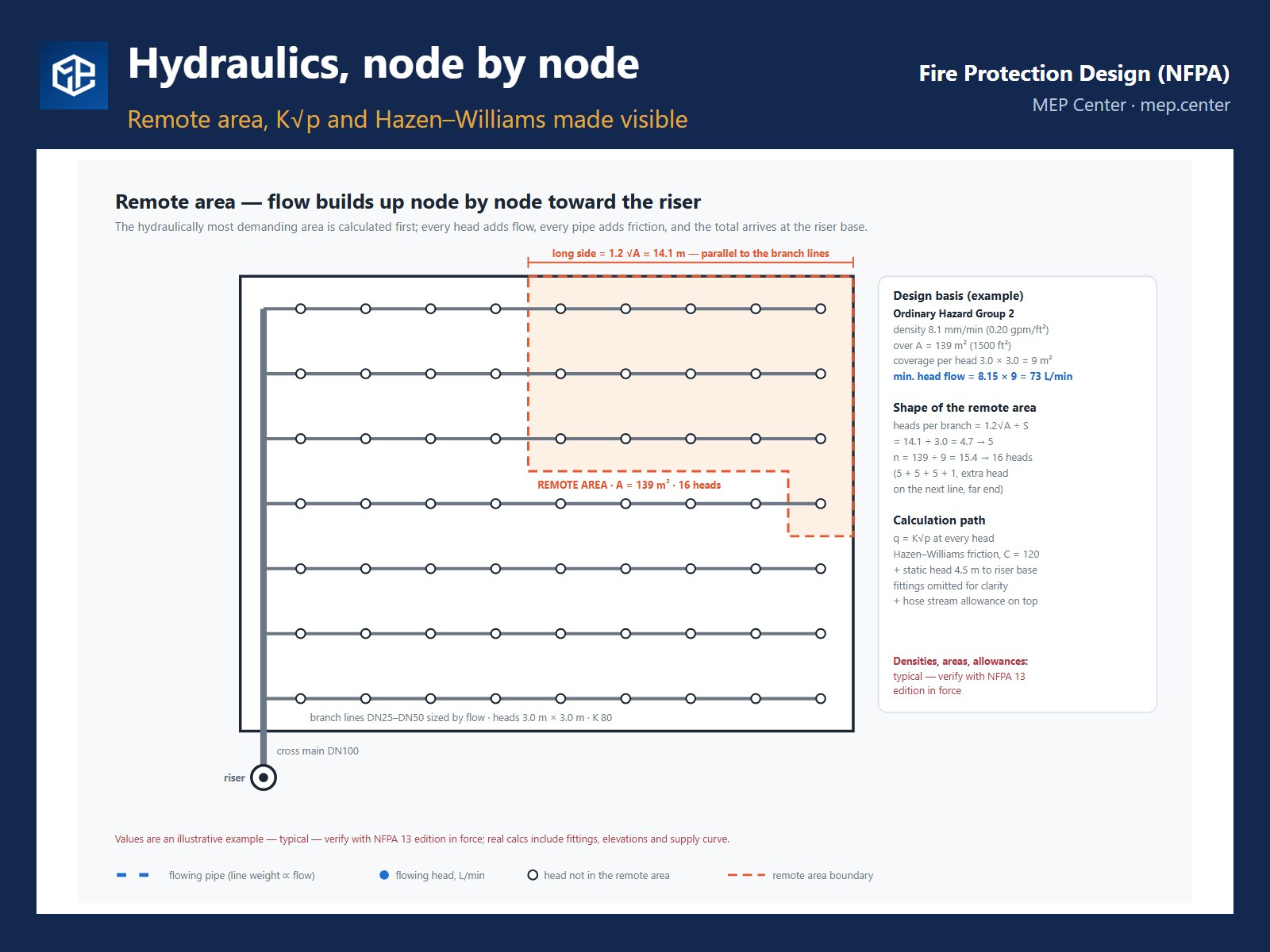
- node-by-node sprinkler hydraulics (K√p, Hazen–Williams, balancing)
- supply curve and flow test
- fire pump selection with the NFPA 20 checks
- suction tank and standpipe demand
- ESFR demand
- clean agent quantity (halocarbon and inert)
Dual units throughout.
Fire Protection Design Handbook (PDF, 44 pages)
A pocket reference to keep beside your drawing:
- formula cards
- hazard and sprinkler selection guides
- spacing cards
- hand-calculation sheets
- pump, standpipe and hydrant checklists
- the top-30 reviewer rejections
- an NFPA 25 inspection, testing and maintenance summary
- a glossary
Fire protection CAD block library
DWG + DXF symbols, all brand-neutral and ready for your own templates:
- sprinklers (standard, ESFR, sidewall, dry, in-rack, nozzles)
- valves and trim
- FDCs and hose valves
- hydrants
- pumps and test headers
- clean agent and CO₂ equipment
- annotation tags
- typical details
Online calculator for course participants
The same calculation method in your browser, with nothing to install:
- sprinkler hydraulics node by node
- fire pump and suction tank sizing
- standpipe and clean agent checks
Opens with your course access after purchase.
What you will be able to do
- Classify hazards and commodities, and choose the right protection: sprinklers, water spray, water mist, clean agent, CO₂, foam or wet chemical
- Select sprinklers by K-factor, response, temperature and orientation, and place them correctly around beams, ducts and walls
- Choose between wet, dry, preaction and deluge systems, and specify the valves and trim
- Run a complete hydraulic calculation by hand: K√p, Hazen–Williams, balancing, supply curve
- Size water supplies, tanks and fire pumps, and read a pump curve the NFPA 20 way
- Design standpipes, hose valves, hydrants and private fire service mains
- Protect high-piled storage with control-mode and ESFR sprinklers
- Calculate clean agent systems for server rooms: agent mass, discharge, hold time, venting and safety
- Prepare drawings and submittals that pass review, and plan inspection, testing and maintenance to NFPA 25
Syllabus
- Fire protection in one picture FREE
- Hazard classification and commodity classes FREE
- The sprinkler: K-factor, response, temperature, types FREE
- Sprinkler system types: wet, dry, preaction, deluge
- Sprinkler spacing, location and obstructions
- Hydraulic design basis
- Hydraulic calculation, step by step
- Water supplies and flow tests
- Fire pumps
- Piping, valves, hangers and the FDC
- Standpipes and hose systems
- Hydrants and private fire service mains
- Storage protection and ESFR
- Water spray and deluge systems
- Water mist systems
- Clean agent (gaseous) systems
- CO₂, foam, kitchen and dry chemical systems
- Inspection, testing, maintenance and drawings
- Worked project A: warehouse + office
- Worked project B: three-storey office building
Each module ends with check questions. The course ends with the final exam and your certificate.
Exam and certificate
Take the final exam as often as you need. Every attempt draws new questions from a large question bank. Pass, and you receive a PDF certificate with a QR verification code, signed by Serhat Çelik, M.Sc. Mechanical Engineer.
Who it is for
Fire protection and MEP design engineers in their first years. Engineers moving into fire protection from HVAC or plumbing. Reviewers who check sprinkler and suppression submittals. Contractors’ design teams who want to understand the “why” behind NFPA.
How it works
- Start free: open Modules 1–3 right now, with no account and no card.
- Buy once, as a guest or a member: you don’t need to create an account. Your order email and the order page give you a “Start the course” link that unlocks everything.
- Learn at your pace: the course works on desktop and mobile, and your progress is saved on your device.
- Download your toolkit: worked projects, the workbook, the handbook and the block library are available to buyers only.
FAQ
Which NFPA editions does the course follow?
Recent editions, with edition changes flagged where they matter (for example, car parks moving from OH1 to OH2). Always design to the editions adopted by your authority having jurisdiction.
Do I need software?
No. Every calculation is done by hand and in the included Excel workbook. To open the drawings you need AutoCAD or any DWG/DXF viewer.
Is the course brand-specific?
No. It is not a manufacturer training. Product values are described generically, and you are told when to use the listing data of the product you select.
Does it reproduce the NFPA standards?
No. It summarises the design rules in its own words and its own tables. It does not replace the standards.
Start with the free modules today
Full course, worked projects, workbook, handbook, block library, exam and certificate: EUR 20, one-time payment.
Reviews
There are no reviews yet.