
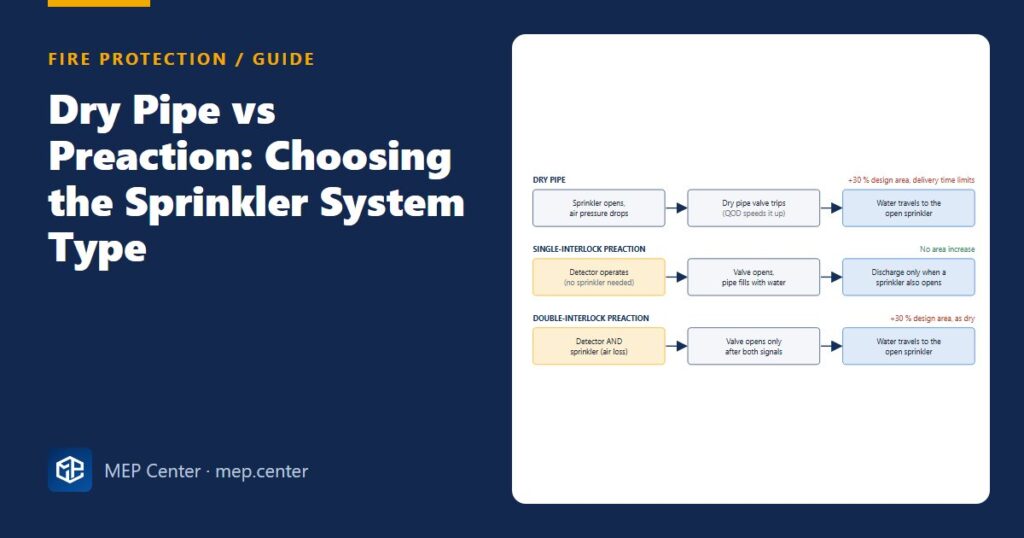
Both systems keep the sprinkler pipe empty of water until something happens. That is why they get confused, and why engineers end up with a double-interlock preaction system in an office server room, or a dry system where a single-interlock preaction would have been faster and cheaper. The real question is why you need the pipe dry: freezing, or water damage.
How each system decides to release water
Dry pipe. The pipe is filled with compressed air or nitrogen. The dry pipe valve sits in a heated room and holds back the water. When a sprinkler opens, air escapes and the pressure drops, the valve trips, and water travels through the pipe to the open head. Nothing else is needed: no detectors and no releasing panel.
Preaction. The pipe holds low-pressure supervisory air. A separate detection system to NFPA 72, with smoke or heat detectors and a releasing panel, opens the preaction valve. The variants differ in what must happen first:
- Single interlock: detection alone opens the valve and fills the pipe. Water discharges only when a sprinkler also opens.
- Double interlock: the valve opens only when detection and a sprinkler operation (loss of air) have both occurred.
- Non-interlock: either detection or sprinkler operation opens the valve.
Side by side
| Feature | Dry pipe | Preaction, single interlock | Preaction, double interlock |
|---|---|---|---|
| Main reason to use | Freezing | Water damage risk | Freezers and cold stores |
| Detection system | No | Yes (NFPA 72, releasing panel) | Yes |
| Design area | +30 % | No increase | +30 % |
| Water delivery time rules | Yes | No | Yes, as dry |
| Gridded piping | Not permitted | Not excluded by type (check edition) | Not permitted |
| Damaged head or pipe leak | Valve trips, water flows | Air escapes only, supervisory alarm | Air escapes only, supervisory alarm |
| False detector alarm | No effect | Pipe fills, no discharge | No effect |
| Hazen–Williams C (steel) | 100 | 100 | 100 |
Design numbers you will need
- Valve room heated to at least 4 °C (40 °F), lit and accessible.
- Dry valve air is set by the valve maker, or about 1.4 bar (20 psi) above the trip pressure. The compressor must restore pressure within 30 minutes.
- Dry system capacity: up to 1893 L (500 gal) without a quick-opening device, or up to 2839 L (750 gal) with one, needs no delivery test. Above that, water must reach the inspector’s test connection within 60 s, or meet the hazard-based delivery times: LH 1 head in 60 s, OH 2 heads in 50 s, EH 4 heads in 45 s.
- Preaction: not more than 1000 closed sprinklers per valve, and the pipe and detection must be supervised when there are more than 20 sprinklers.
- Pitch to drains: about 4 mm/m (½ in per 10 ft) on branch lines and 2 mm/m (¼ in per 10 ft) on mains. Fit a drum drip on any trapped section over 19 L (5 gal). Pendent heads on dry pipe must be dry pendents.
What the 30 % costs: an Ordinary Hazard Group 2 area at 8.1 mm/min (0.20 gpm/ft²) over 139 m² (1500 ft²) needs at least 139 × 8.1 = 1126 L/min from the sprinklers. As a dry system the area becomes 181 m² (1950 ft²): 181 × 8.1 = 1466 L/min, about 30 % more water, pump and pipe, before hose allowance.
Typical values — verify with the edition adopted locally.
How to choose in four questions
- Can the space be kept above 4 °C? Then use a wet system. A heated space never needs either system for freezing.
- Is the unheated area small, such as a canopy or a few heads? Use dry sprinklers off the wet system, or a listed antifreeze section, before a whole dry valve.
- Is the unheated area large? Use dry pipe, split into valves small enough to meet the delivery time.
- Is the worry water damage, not frost? Use single-interlock preaction. Keep double interlock for refrigerated spaces, with dry air or nitrogen.
Two practical notes. Galvanised pipe performs poorly in dry systems, and nitrogen at 98 % purity or more greatly slows corrosion in both types. In a room that also has a gaseous system, define the release order of the preaction valve and the agent. See clean agent fire suppression for server rooms.
The class of the area sets the density you multiply. See the sprinkler hazard classification guide, then run the enlarged area through the sprinkler hydraulic calculation.
Fire Protection & Suppression Systems Design (NFPA)
20 narrated modules with animated diagrams, two complete worked projects (DWG + DXF), the Fire Calc Workbook and an online calculator.
Modules 1–3 are free, no account needed · full course €15,00 one-time
FAQ
What is the difference between a dry pipe and a preaction system?
A dry pipe valve opens when a sprinkler opens and air pressure drops, with no detectors. A preaction valve is opened by a separate detection system, either alone (single interlock) or together with a sprinkler operation (double interlock).
Does a preaction system need a 30 % larger design area?
Only the double-interlock type, which behaves like a dry system. Single-interlock and non-interlock preaction systems use the same design area as a wet system.
Which system is best for a server room?
Usually single-interlock preaction. A damaged head or a leak releases only air, and a false detector alarm fills the pipe without discharging water. Double interlock adds delay and design area without benefit unless freezing is a risk.
What temperature must a dry pipe valve room be kept at?
At least 4 °C (40 °F). The valve and its trim hold water on the supply side, so the room must be heated, lit and accessible.
More Fire Protection (Sprinklers, NFPA) articles
- Fire Hydrant Connection to the Fire Main (NFPA 24 Practice)
- Fire Hose Cabinets and Hose Valves: EN 671 vs NFPA 14
- Fire Water Tank Sizing: Sprinklers plus Hose Streams
- ESFR Sprinklers: Quick Rules Before You Specify Them
- Wet Riser vs Dry Riser: Which Building Needs Which
- EN 12845 vs NFPA 13: Key Differences for Designers