
Many designers work on NFPA 13 projects one month and EN 12845 projects the next. Typical cases are an international insurer on a European site, a Gulf project with a European consultant, or a factory built to the owner’s global standard. The two documents protect buildings equally well, but they think differently. Mixing their numbers is one of the fastest ways to get a design rejected.
Side by side
| Topic | NFPA 13 (US practice) | EN 12845 (European practice) |
|---|---|---|
| Family of documents | NFPA 13 for the system; NFPA 20 for pumps, 22 for tanks, 24 for underground mains, 25 for maintenance | One standard covering design, water supplies, pumps and maintenance, plus national annexes and insurer rules |
| Hazard classes | Light, Ordinary 1–2, Extra 1–2, plus storage chapters by commodity class | LH, OH1–OH4, HHP1–HHP4 (process), HHS (storage, categories I–IV) |
| Light hazard design | 4.1 mm/min over 139 m² | 2.25 mm/min over 84 m² |
| Ordinary hazard design | 6.1 (OH1) or 8.1 (OH2) mm/min over 139 m² | 5.0 mm/min over 72 / 144 / 216 / 360 m² (OH1 / OH2 / OH3 / OH4) |
| High / extra hazard design | 12.2 (EH1) or 16.3 (EH2) mm/min over 232 m² | HHP1–3: 7.5 / 10.0 / 12.5 mm/min over 260 m²; HHP4 is deluge |
| Hose allowance | Added: 380 / 950 / 1900 L/min (LH / OH / EH) | Not part of the sprinkler supply; hose reels follow separate rules |
| Supply duration | LH 30 min, OH 60–90 min, EH 90–120 min | LH 30 min, OH 60 min, HHP/HHS 90 min |
| Max area per sprinkler | LH 20.9 m², OH 12.1 m², EH 9.3 m² | LH 21 m², OH 12 m², HH 9 m² |
| Max spacing | 4.6 m (LH, OH), 3.7 m (EH) | 4.6 m (LH), 4.0 m (OH, standard layout), 3.7 m (HH) |
| Min distance between sprinklers | 1.8 m (6 ft) | 2.0 m |
| Max distance to walls | Half the allowable spacing (2.3 m at 4.6 m) | 2.0 m (standard layout), less in some situations |
| Min pressure at a sprinkler | 0.5 bar (7 psi), unless listed otherwise | LH 0.7 bar, OH 0.35 bar, HHP/HHS 0.5 bar |
| Dry pipe systems | Design area +30 % | Design area increased (typically +25 %); LH dry systems designed as OH1 |
| Pipe velocity | No limit in NFPA 13 (common practice ≤ 6 m/s) | Limited: 6 m/s through valves and flow meters, 10 m/s elsewhere |
| Water supply reliability | One adequate supply is acceptable; the AHJ or insurer may ask for more | Graded supplies: single, superior single and duplicate |
| Pipe sizing | Hydraulic calculation (pipe schedule only in limited legacy cases) | Hydraulic calculation, or pre-calculated pipe tables for LH and OH |
| Components | Listed / approved by a recognised testing laboratory | Certified to the EN 12259 product series |
Typical values — verify with the edition adopted locally.
Same coverage, different water
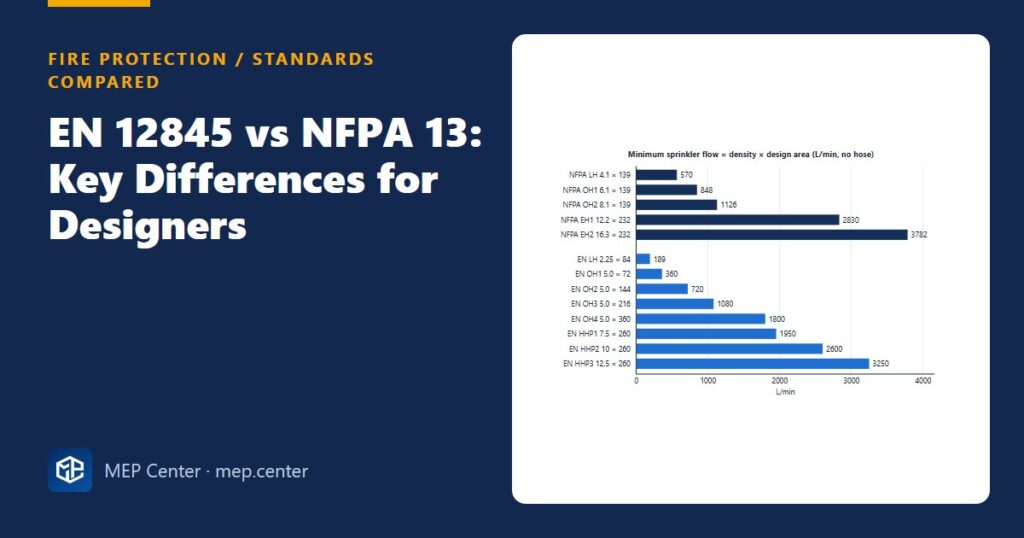
The chart below compares the theoretical minimum sprinkler flow (density × design area) of each class. The classes are not equivalent. An EN OH3 occupancy is not automatically an NFPA OH2. The chart shows the philosophy: NFPA starts higher and stays flat at 139 m², while EN starts lower and enlarges the area as the hazard group rises.
Example: an office floor. To NFPA 13 as Light Hazard: 4.1 × 139 = 570 L/min + 380 L/min hose = 950 L/min for 30 min → 28.5 m³ minimum.
To EN 12845 as LH: 2.25 × 84 = 189 L/min for 30 min → 5.7 m³ minimum, before overdischarge. The tank and pump can differ by a factor of three or more for the same building. The standard choice therefore has to be made before the plant room is sized.
What this means on a project
- The contract decides, not your preference. In Europe, EN 12845 with its national annex is usually mandatory or insurer-required. In the US and many Middle East and Asian markets, NFPA 13 is adopted by code. Global owners and insurers often impose their own rules on top of either.
- Never mix within a system. EN densities with NFPA areas, or EN spacing with NFPA wall distances, produce a design that complies with neither. If the authority accepts NFPA hydraulics but EN-certified components, write that down.
- Classify again, do not translate. Read each occupancy against the standard in use. See the sprinkler hazard classification guide for the NFPA side.
- Check the pump rules. EN 12845 has its own pump curve and supply grading rules, which differ from NFPA 20. See fire pump sizing to NFPA 20 for the US approach.
- Layouts transfer quite well. Coverage per head is nearly identical, so an NFPA grid usually needs only spacing and wall-distance checks to suit EN. See sprinkler spacing and location rules.
Fire Protection & Suppression Systems Design (NFPA)
20 narrated modules with animated diagrams, two complete worked projects (DWG + DXF), the Fire Calc Workbook and an online calculator.
Modules 1–3 are free, no account needed · full course €15,00 one-time
FAQ
Is EN 12845 or NFPA 13 more conservative?
Neither is simply more conservative. NFPA 13 uses higher densities and adds hose water, while EN 12845 uses larger design areas at higher ordinary hazard groups and grades water supply reliability. Each is complete on its own terms.
Can I use NFPA 13 spacing with EN 12845 densities?
No. Each standard is a consistent package of classification, density, area, spacing and supply rules. Mixing them produces a design that complies with neither, unless the authority explicitly accepts a defined combination.
Does EN 12845 include a hose allowance?
No. The EN 12845 sprinkler water supply covers the sprinklers only. Hose reels and hydrants are handled by their own rules and national regulations, whereas NFPA 13 adds inside and outside hose to the supply.
What is the minimum sprinkler pressure in each standard?
NFPA 13 typically requires 0.5 bar (7 psi) at a standard spray sprinkler. EN 12845 typically sets 0.7 bar for light hazard, 0.35 bar for ordinary hazard and 0.5 bar for high hazard.
More Fire Protection (Sprinklers, NFPA) articles
- Sprinkler Hazard Classification: LH, OH1, OH2, EH1 and EH2 Explained
- Fire Water Tank Sizing: Sprinklers plus Hose Streams
- Clean Agent System Design for Server Rooms (NFPA 2001)
- Dry Pipe vs Preaction: Choosing the Sprinkler System Type
- Fire Pump Sizing to NFPA 20: Rated Point, Curve Checks and Jockey
- Backflow Preventers on Fire Lines: Losses and Layout