
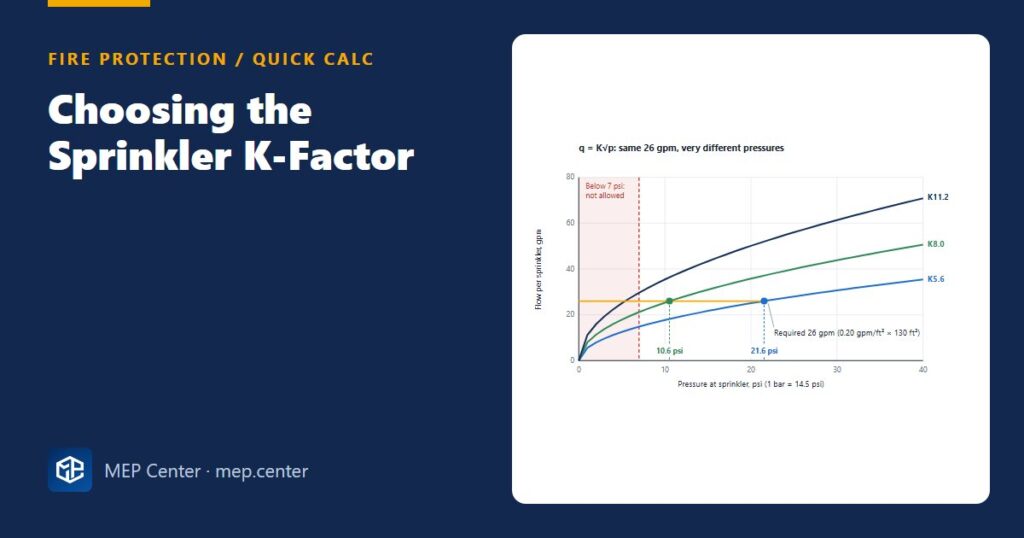
Pick the wrong K-factor and the whole sprinkler system pays for it: the remote heads need a high pressure, the pump gets bigger, or you end up putting more water on the floor than the hazard needs. Choosing K takes about five minutes on a calculator, once you know the formula and the limits.
The formula you need
Every standard spray sprinkler follows the orifice equation:
q = K · √p and, turned round, p = (q / K)²
- q = flow from one sprinkler, gpm (L/min)
- p = pressure at the sprinkler inlet, psi (bar)
- K = K-factor, gpm/psi½ (L/min/bar½). To convert, K(SI) ≈ 14.4 × K(US): K5.6 → K80, K8.0 → K115, K11.2 → K160.
The flow one sprinkler must deliver comes from the design density and the area it protects: qmin = density × protection area. The protection area is S × L, the spacing along the branch line times the spacing between lines.
Because flow rises only with the square root of pressure, doubling the flow needs four times the pressure. That is why changing to a larger K usually beats buying a bigger pump.
Density 0.20 gpm/ft² (8.1 mm/min), maximum OH spacing 130 ft² (12.1 m²) per sprinkler.
1. Required flow per head: q = 0.20 × 130 = 26.0 gpm (98 L/min).
2. K5.6: p = (26.0 / 5.6)² = 4.64² = 21.6 psi (1.49 bar).
3. K8.0: p = (26.0 / 8.0)² = 3.25² = 10.6 psi (0.73 bar).
4. Both exceed the 7 psi (0.5 bar) minimum, so the density governs, not the minimum pressure.
5. Result: the K8.0 head needs 11 psi (0.76 bar) less at the most remote sprinkler. Every head in the design area flows at a lower pressure too, so the saving at the riser is usually even larger. Choose K8.0 here if the supply is tight; K5.6 is acceptable if the supply easily covers 21.6 psi plus friction and elevation.
Sanity check: 8.0 × √10.6 = 8.0 × 3.26 = 26.0 gpm ✔
Rule-of-thumb table: pressure needed at the most remote head
Values below use the commonly used density points and the maximum protection area per sprinkler for each hazard. The pressure shown is what each K needs to reach the density. Where it falls below 7 psi, the head must still run at 7 psi.
| Hazard (density × area/head) | q per head | K5.6 (K80) | K8.0 (K115) | K11.2 (K160) |
|---|---|---|---|---|
| LH: 0.10 gpm/ft² × 225 ft² (4.1 mm/min × 20.9 m²) | 22.5 gpm (85 L/min) | 16.1 psi | 7.9 psi | 4.0 → 7 psi |
| OH1: 0.15 × 130 ft² (6.1 mm/min × 12.1 m²) | 19.5 gpm (74 L/min) | 12.1 psi | 5.9 → 7 psi | 3.0 → 7 psi |
| OH2: 0.20 × 130 ft² (8.1 mm/min × 12.1 m²) | 26.0 gpm (98 L/min) | 21.6 psi | 10.6 psi | 5.4 → 7 psi |
| EH1: 0.30 × 100 ft² (12.2 mm/min × 9.3 m²) | 30.0 gpm (114 L/min) | 28.7 psi | 14.1 psi | 7.2 psi |
| EH2: 0.40 × 100 ft² (16.3 mm/min × 9.3 m²) | 40.0 gpm (151 L/min) | 51.0 psi | 25.0 psi | 12.8 psi |
Typical values based on NFPA 13 (2022) — verify with the edition adopted locally and use the listed K-factor of the chosen product in the final calculation.
How to read the table on a real job
- Aim for the “middle” pressures. A remote-head pressure of roughly 10–25 psi (0.7–1.7 bar) is comfortable: high enough for good spray, low enough to keep the pump small.
- Too big a K wastes water. When the minimum 7 psi governs, the head flows more than the density needs. A K8.0 in OH1 at 7 psi delivers 21.2 gpm against the 19.5 gpm needed, about 9 % extra on every head in the design area. A K11.2 at 7 psi gives 29.6 gpm, half as much again. That raises the total demand and the fire water tank.
- Smaller spacing changes the answer. Spacing heads at 100 ft² instead of 130 ft² cuts the flow per head, so K5.6 may become fine again. The cost is more heads and more pipe.
- Small K-factors (K2.8, K4.2) are special. Wet systems only, hydraulically calculated, mostly light hazard and residential listings. They clog more easily, so do not use them to save pipe sizes.
- Storage has its own rules. Above 0.34 gpm/ft² (13.9 mm/min) the minimum is K11.2. ESFR and CMSA heads (K14 to K33.6) are designed by number of heads and minimum pressure, not by density. See ESFR quick rules.
- One K per compartment. Mixing K-factors in one room makes distribution and hydraulic balance harder to justify at review.
Where the K-factor fits in the full calculation
The K choice sets the starting pressure at the most remote head. From there you add friction, elevation and the hose allowance, working back to the supply. Our step-by-step sprinkler hydraulic calculation follows that path, and the hazard class that sets your density is explained in the hazard classification guide.
Fire Protection & Suppression Systems Design (NFPA)
20 narrated modules with animated diagrams, two complete worked projects (DWG + DXF), the Fire Calc Workbook and an online calculator.
Modules 1–3 are free, no account needed · full course €15,00 one-time
FAQ
What is the most common sprinkler K-factor?
K5.6 (K80 in SI units), the standard ½ inch orifice. It covers light hazard and most ordinary hazard work at remote-head pressures of about 7–25 psi (0.5–1.7 bar).
When should I use K8.0 instead of K5.6?
When K5.6 needs a high pressure to reach the density, typically OH2 or extra hazard at large spacing, or when the water supply is tight. In the OH2 example at 130 ft² per head, K8.0 needs 10.6 psi against 21.6 psi for K5.6.
How do I convert a K-factor from US to SI units?
Multiply by about 14.4. K5.6 becomes K80, K8.0 becomes K115 and K11.2 becomes K160 L/min/bar½. The SI values are rounded nominal figures; use the listed value in the calculation.
Can a sprinkler operate below 7 psi?
Not for a standard spray sprinkler under NFPA 13. The minimum is 7 psi (0.5 bar), unless the sprinkler is specifically listed for another minimum. Special sprinklers often need more.
More Fire Protection (Sprinklers, NFPA) articles
- Standpipe Classes I, II and III Explained
- Fire Hose Cabinets and Hose Valves: EN 671 vs NFPA 14
- Sprinkler Hydraulic Calculation: A Step-by-Step Worked Example
- Fire Water Tank Sizing: Sprinklers plus Hose Streams
- Dry Pipe vs Preaction: Choosing the Sprinkler System Type
- Fire Department Connection (FDC): Location and Arrangement