
Pick the wrong pipe material and the drawings still look fine. Then the hot water runs snake across the ceiling, a fitting splits because nobody allowed for expansion, or copper pits through in five years because the water is aggressive. Most of those failures could have been seen coming when the material was chosen.
The main materials at a glance
| Material | Hot / cold | Jointing | Strong points | Watch out for |
|---|---|---|---|---|
| PP-R (polypropylene random copolymer) | Both; use the higher pressure class (often PN20) for hot water | Heat fusion (socket or butt) | Cheap, does not corrode, fused joints do not leak if made right | Very high expansion, thick walls so the bore is small, softens as the temperature rises |
| PE-X (cross-linked polyethylene) | Both | Press, compression or expansion fittings | Flexible coils, few joints, good for manifold systems | High expansion, damaged by UV light, the fittings narrow the bore |
| Multilayer (PE-X or PE-RT with an aluminium layer) | Both | Press fittings | Keeps its shape when bent, low expansion, light | The fittings set the cost and the pressure loss; use one system from one maker |
| Copper | Both, including high temperatures | Soldering, brazing or press fittings | Long proven life, thin walls, fire resistant | Aggressive water (low pH, high free CO₂), erosion at high hot water velocities, price |
| Stainless steel (press-fit) | Both | Press fittings | Hygienic, strong, low expansion, suits large buildings | Chloride limits in the water, price; needs the matching press tools |
| Galvanised steel | Both in many markets (mains, risers, floor distribution); fire services | Threaded or grooved | Strong and robust, cheap in large sizes | The zinc layer wears faster in hot water, especially at higher temperatures; never put it downstream of copper (galvanic pitting) |
| PVC-U / CPVC (common in US practice) | PVC-U cold only; CPVC hot and cold up to about 82 °C (180 °F) | Solvent cement | Cheap, does not corrode | Brittle at low temperatures, care needed with cements and solvents |
In US practice the usual trio is copper tube (Types K, L and M by wall thickness), PEX and CPVC, all listed in the plumbing code’s water distribution tables. In Europe each plastic system is made to its own product standard, and its rating is given as a pressure class or an application class (a temperature profile). Read both: a plastic pipe that carries 20 bar cold may only be good for 6 to 10 bar at 70 °C.
Typical values — verify with the edition adopted locally.
Expansion: the number that decides the layout
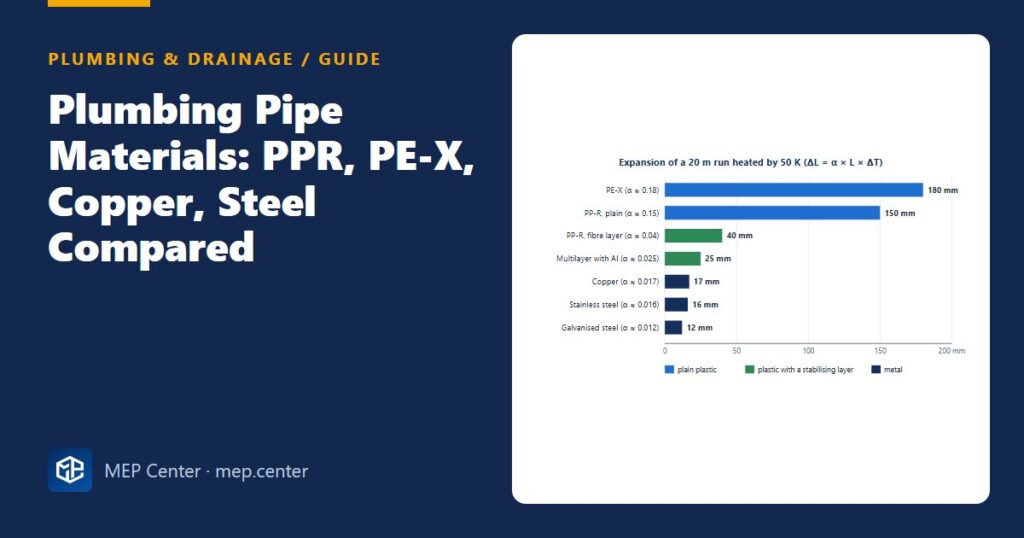
Every pipe grows when it heats up: ΔL = α × L × ΔT, where α is the linear expansion coefficient in mm/(m·K), L the run length in m and ΔT the temperature change in K. Plastics grow about ten times more than metals. On hot water risers and long ceiling runs that decides how many expansion loops, offsets and fixed points you need.
- Plain PP-R: ΔL = 0.15 × 20 × 50 = 150 mm. You need an expansion loop or offsets, plus fixed points, or the pipe will bow between its clips.
- Multilayer: ΔL = 0.025 × 20 × 50 = 25 mm. A change of direction with a free leg is usually enough.
- Copper: ΔL = 0.017 × 20 × 50 = 17 mm.
Sanity check: the plastic figure is about nine times the copper one. That ratio matches the coefficients (0.15 ÷ 0.017 ≈ 8.8), so the arithmetic holds.
Same bore, very different pipe
Pipe sizing works with the internal diameter, and wall thickness varies a lot between materials. The pipes below all have a bore of about 26 mm:
| Material | Outside diameter × wall (mm) | Approximate bore (mm) |
|---|---|---|
| PP-R, PN20 class | 40 × 6.7 | 26.6 |
| PE-X | 32 × 2.9 | 26.2 |
| Multilayer composite | 32 × 3.0 | 26.0 |
| Copper | 28 × 1.0 | 26.0 |
| Galvanised steel DN25, medium series | 33.7 × 3.2 | 27.3 |
So if a riser calculation asks for a 26 mm bore, that means a 40 mm pipe in PP-R but a 28 mm pipe in copper. Size from the bore, as explained in domestic water pipe sizing with fixture units, and check the friction loss with the Hazen-Williams pipe friction calculator.
How to choose, in five questions
- What temperature and pressure, and for how long? Why: plastic pipe ratings drop as the temperature rises. Check the rating at the hot water storage temperature (60 °C or more, see hot water recirculation and legionella) and at the disinfection temperature too.
- What is the water like? Why: soft, acidic or CO₂-rich water attacks copper and galvanised steel, and high chloride water limits stainless steel. Ask for a water analysis on large jobs.
- Where does the pipe run? Why: plastics must be protected from UV light and need fire sleeves or collars where they pass through fire-rated walls. Exposed plant room pipework is often metal for strength.
- Who will install it? Why: a fusion, press or soldering system is only as good as its installers and their tools. Do not mix fitting brands within one system.
- Are you joining different metals? Why: copper upstream of galvanised steel causes pitting, and a direct joint between copper and steel corrodes. Use dielectric fittings, or keep to one material per circuit.
Practical pairings
- Common practice in many markets: galvanised steel for the mains, risers and floor distribution, and plastic (PP-R, PE-X or multilayer) for the final connections to each fixture.
- Flats and houses (all-plastic alternative): manifolds with PE-X or multilayer to each fixture, and PP-R or multilayer for the risers.
- Hotels, hospitals, offices: copper or stainless steel for the risers and hot water loops, where low expansion and good temperature performance pay off. Plastics can feed the final branches.
- Plant rooms: metal pipework, properly supported, with flanged connections at the pumps and tanks.
- Fire mains: steel to the fire code, kept separate from the drinking water system.
Mixing materials also affects water hammer, because pressure waves travel much more slowly in plastic. See water hammer and arrestor sizing, and the wider list in common plumbing design mistakes.
Ready-made drawings and tools for your next project
CAD block libraries, detail drawings and AutoCAD tools made by practising MEP engineers.
FAQ
Which is better for hot water, PP-R or PE-X?
Both are used for hot water when the pressure class is right. PP-R is fused into rigid runs and suits risers, while PE-X comes in flexible coils for manifold systems. Both expand a lot, so plan loops, offsets and fixed points for either.
Can I use galvanised steel pipe for hot water?
Yes, and in many markets it is the usual material for hot and cold mains and distribution, with plastic fixture connections. The zinc layer wears faster in hot water, especially at higher temperatures, and corrosion is fast when copper sits upstream, so keep copper out of the circuit and check what the local code and water authority accept. Copper, stainless steel or a rated plastic system are the alternatives.
Why does a 32 mm plastic pipe carry less water than its size suggests?
Because the nominal size of plastic pipe is the outside diameter and its walls are thick. A 32 mm plastic pipe has a bore of about 21 to 26 mm, depending on the pressure class, while a 35 mm copper tube has about 33 mm. Always size from the internal diameter.