
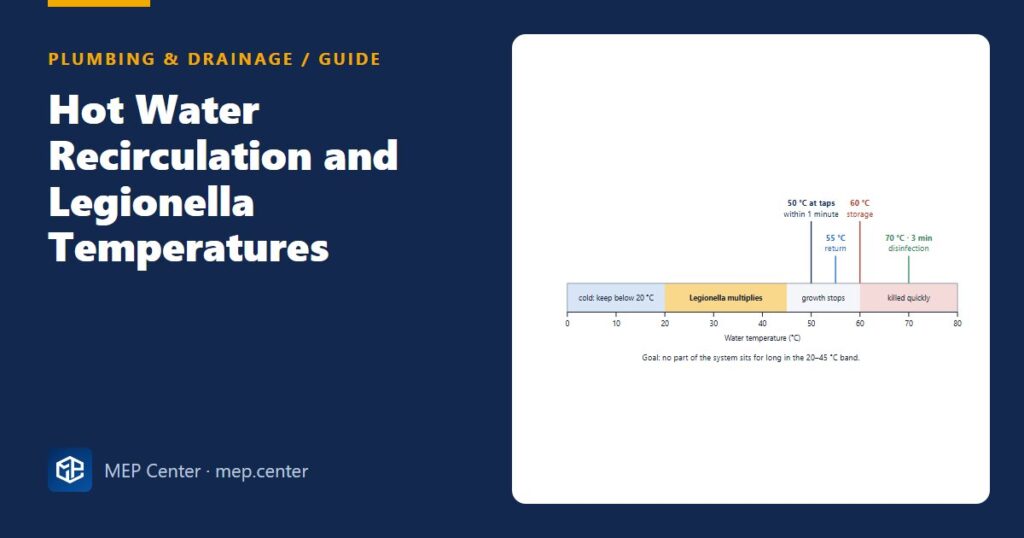
Legionella bacteria live happily in lukewarm water, and a long hot water pipe that cools between uses is exactly that. Recirculation keeps hot water hot all the way to the taps, so users do not wait and bacteria do not grow, but only if the temperatures, flows and balancing are right.
The temperature map
| Point in the system | Common target | Why |
|---|---|---|
| Water heater / storage outlet | ≥ 60 °C | Kills legionella within minutes |
| Return to heater | ≥ 55 °C (UK guidance: ≥ 50 °C) | Proves the whole loop stays above the growth band |
| Hot taps | ≥ 50 °C within about 1 minute (55 °C often used in healthcare) | Short dead legs, no lukewarm standing water |
| Cold taps | < 20 °C (within about 2 minutes in UK guidance) | Cold pipes warmed by hot pipes and ceilings are a common risk |
| Thermal disinfection | ≥ 70 °C at each outlet for about 3 minutes | Periodic or after contamination, with scald precautions |
In the United States the approach is different: ASHRAE Standard 188 asks for a water management programme for at-risk buildings rather than fixed temperatures, and the IPC asks for recirculation or heat tracing when the hot pipe from the heater to the furthest fixture is long (traditionally beyond about 100 ft, 30 m; recent editions limit the developed length to about 50 ft, 15 m). The scald side is also regulated: hot water to public hand-washing taps is commonly limited to about 43 °C (110 °F) with a tempering valve.
Typical values — verify with the edition adopted locally.
When do you need a recirculation loop?
A widely used German rule is the “3-litre rule”: if the water volume in the pipe from the heater to any tap is more than 3 litres, add circulation or trace heating. A 20 mm plastic pipe with a 16 mm bore holds about 0.2 l/m, so 3 litres is only about 15 m of pipe. In practice, almost every building bigger than a house needs a loop, and in a house it is the reason to keep the heater close to the bathrooms.
Whatever the loop, keep the unlooped ends (dead legs) to each tap short, and remove pipes that no longer serve anything: they are where stagnant warm water collects.
How to size the circulation flow
The loop must carry enough heat to replace what the pipes lose, while the water cools by no more than the allowed drop (usually 5 K from 60 to 55 °C):
Q = P ÷ (ρ × c × ΔT)
where P is the heat loss of the flow and return pipes in W, ρ × c ≈ 4 186 kJ/(m³·K) for water (so 4.186 kJ per litre per K), and ΔT is the allowed temperature drop in K. Q comes out in l/s.
Worked example
A loop has 120 m of insulated flow and return pipe. Taking manufacturer data of about 8 W/m for the insulated pipe at 60 °C: P = 120 × 8 = 960 W.
Q = 960 ÷ (4 186 × 5) = 0.046 l/s ≈ 165 l/h.
That is a very small flow. The return pipe can therefore be small (often the smallest size used on the project), and the pump head mostly comes from the balancing valves rather than the pipes. Sanity check: a single shower uses about 0.2 l/s, more than four times the whole loop flow.
Split the total flow between risers in proportion to their heat loss, and fit a balancing valve on each riser return. Thermostatic circulation valves are popular because they open automatically when a riser cools, and some can open further during a disinfection cycle.
Practical checklist
- Insulate both flow and return pipes fully, valves included; the loop’s heat loss is the running cost.
- Keep cold pipes away from hot pipes and warm ceiling voids, or insulate them too.
- Show a return-temperature sensor or thermometer at each riser and at the heater.
- Plan for disinfection: the heater must reach 70 °C, and scald protection (thermostatic mixing valves at outlets for vulnerable users) must cope with it.
- Do not let a storage cylinder sit cold at the bottom; that zone needs to reach 60 °C regularly too.
Size the draw-off pipes first with domestic water pipe sizing with fixture units. The same Q = P ÷ (ρ·c·ΔT) idea is used in hydronic heating pipe sizing, and you can try it with the heating pipe size calculator.
Ready-made drawings and tools for your next project
CAD block libraries, detail drawings and AutoCAD tools made by practising MEP engineers.
FAQ
What temperature kills legionella in hot water?
Legionella multiplies between about 20 and 45 °C and is killed within minutes at 60 °C and faster at 70 °C. That is why storage is kept at 60 °C or more and thermal disinfection uses about 70 °C at each outlet for a few minutes.
What should the hot water return temperature be?
Common European practice is at least 55 °C back at the heater, that is no more than 5 K below a 60 °C supply. UK guidance accepts at least 50 °C. Check the rule adopted where the building is.
How do I size a hot water recirculation pump?
Size the flow from the heat loss of the loop: Q = P ÷ (ρ·c·ΔT). For 960 W of pipe loss and a 5 K drop that is about 165 l/h. The head comes from the pipes plus the balancing valves at that flow.