
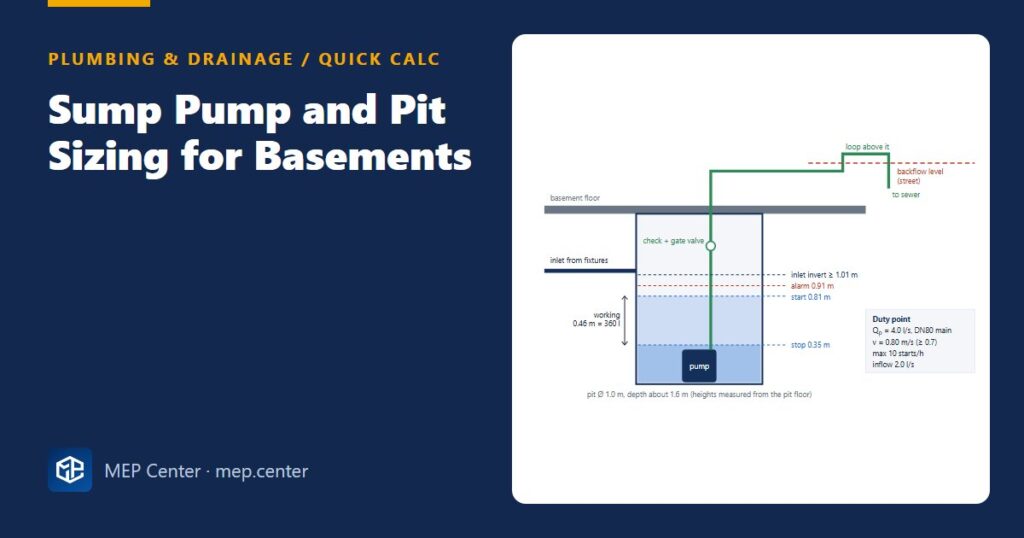
Any basement fixture below the level of the street sewer needs to be pumped. That includes a toilet, a shower, a plant room floor drain or a car park ramp gully. Get the pump or the pit wrong and you get either a motor that starts thirty times an hour and burns out, or a basement that floods the first time the sewer backs up.
Step 1: peak inflow
For foul water, add the discharge units of the connected fixtures and apply EN 12056-2: Qww = K × √ΣDU. Use the largest single appliance if that is larger. Under the IPC, use drainage fixture units and the code’s pump rules. For groundwater or ramp water, use the inflow from the drained area and rainfall intensity (Q = r × A × C, as in roof rainwater drainage sizing), plus any seepage the geotechnical report expects. Keep foul and surface water in separate pits where the rules ask for it.
Step 2: pump flow and rising main
The pump must deliver at least the inflow. For wastewater it must also keep solids moving in the rising main: about 0.7 m/s minimum and 2.3 m/s maximum under EN 12056-4. Lifting plants for WC waste normally need a DN80 rising main, while grinder (cutter) pumps can use a much smaller pipe. The head comes from the lift from the stop level to the top of the backflow loop, plus friction and valve losses at that flow.
Step 3: working volume
V = Qp × T ÷ 4, with T = 3600 ÷ Z
- V — pump-down volume between the start and stop levels, l.
- Qp — pump flow at the duty point, l/s.
- Z — maximum starts per hour the manufacturer allows for the motor (often 10 to 15 for small submersibles). T is the shortest allowed cycle time in s.
Why ÷ 4: a pump starts most often when the inflow is exactly half its capacity. Then filling and emptying take equal time and the cycle is 4V ÷ Qp. Sizing for that worst case keeps the starts within the limit at any inflow.
Fixtures: 4 WCs (2.0 DU), 4 washbasins (0.5 DU), 2 showers (0.6 DU). Office, K = 0.5.
- ΣDU = 8.0 + 2.0 + 1.2 = 11.2. Qww = 0.5 × √11.2 = 1.67 l/s. This is less than one WC (2.0 l/s), so the design inflow is 2.0 l/s.
- Rising main DN80, bore about 80 mm, area 0.00503 m². Minimum flow for 0.7 m/s: 0.7 × 0.00503 = 3.5 l/s. Choose Qp = 4.0 l/s, which gives v = 0.80 m/s. That is above 0.7 m/s, below 2.3 m/s and above the 2.0 l/s inflow.
- Motor limit 10 starts/h: T = 360 s. V = 4.0 × 360 ÷ 4 = 360 l.
- Pit 1.0 m inner diameter, area 0.785 m². Working height = 0.36 ÷ 0.785 = 0.46 m.
- Depth build-up from the pit floor: stop level 0.35 m (pump submergence from manufacturer data), start 0.81 m, high-level alarm 0.91 m, lowest inlet invert 1.01 m. With the inlet arriving 0.50 m below the basement floor, the pit depth is about 1.51 m → 1.6 m.
Sanity check: at the full 2.0 l/s inflow the pit fills in 360 ÷ 2.0 = 180 s and empties in 360 ÷ (4.0 − 2.0) = 180 s. That is a 360 s cycle, exactly 10 starts per hour, so the limit holds.
Rules of thumb
| Item | Typical value or practice |
|---|---|
| Rising main velocity, wastewater (EN 12056-4) | 0.7–2.3 m/s |
| Minimum velocity in a sewage pump discharge (IPC) | about 2 ft/s (0.6 m/s) |
| Rising main, WC waste, normal pumps | DN80; smaller only with grinder pumps |
| Small sump pit in a dwelling (IPC minimum) | 18 in diameter × 24 in deep (about 460 × 610 mm) |
| Starts per hour | from the motor data, often 10–15 |
| Valves per pump | check valve + isolation valve on each discharge |
| Pumps | duty + standby with alternation where the inflow must not stop (WCs, car park sumps) |
Typical values — verify with the edition adopted locally.
Details that keep the basement dry
- Backflow loop: the rising main must rise above the backflow level, usually the street level, before it joins the gravity drain. Why: otherwise a surcharged sewer drains back through the pump.
- Sealed and vented pit for sewage: use a gas-tight cover and a vent to the open air, never into a room. Why: sewer gas and pressure changes from the pump.
- Alarm: a high-level alarm on a separate float, reported to the building management system or a visible panel. Why: a pump failure must be noticed before the water reaches the inlet.
- Standby and power: fit a second pump where the inflow cannot be stopped, and consider standby power for car park and lift pit sumps. Why: storms and power cuts often come together.
- Access: lifting chains, a cover large enough to lift the pump out, and no pit under a parking bay without traffic-rated covers.
The pumped flow joins the gravity system; size that pipe with drainage pipe sizing (EN 12056 vs IPC) and set its falls and access with drainage falls and cleanouts. A grease-laden kitchen drain must pass a grease interceptor before it reaches any pump.
Ready-made drawings and tools for your next project
CAD block libraries, detail drawings and AutoCAD tools made by practising MEP engineers.
FAQ
How do I size a sump pit?
Size the working volume between the start and stop levels as V = Qp × T ÷ 4, where T is 3600 divided by the maximum starts per hour. Then add depth below for pump submergence and above for the alarm level and the inlet. A 4 l/s pump allowed 10 starts an hour needs about 360 l.
What velocity should a sewage rising main have?
EN 12056-4 asks for about 0.7 to 2.3 m/s in wastewater pressure pipes, and the IPC uses a minimum of about 2 ft/s. Below that, solids settle in the pipe; well above it, noise, wear and surge increase.
Why must the rising main loop above street level?
Because the public sewer can fill up to street level in a storm. A loop above that backflow level stops sewage flowing back through the pump into the basement.