
A loud bang in the wall every time the washing machine fills, or a dishwasher solenoid that rattles the whole riser, is water hammer. It is not only noise. The surge can be several times the working pressure, and it slowly fatigues fittings, flexible hoses and valve seats until one of them lets go.
The formula
Δp = ρ × a × Δv (instant or fast closure)
- Δp — pressure rise, Pa (divide by 100 000 for bar).
- ρ — water density, 1000 kg/m³.
- a — pressure wave speed in the pipe, m/s. It depends mainly on how stiff the pipe is (see the table below).
- Δv — change in velocity, m/s. For a full shut-off, this is the flow velocity before the valve closed.
The wave runs to the nearest open end (a riser, tank or larger main) and back. That trip takes the critical time tc = 2L ÷ a, where L is the pipe length from the valve to that open end. If the valve closes faster than tc, you get the full Joukowsky surge. If it closes more slowly, the surge drops to about Δp ≈ 2 ρ L v ÷ t, where t is the closing time in s. This is why slower valves help so much.
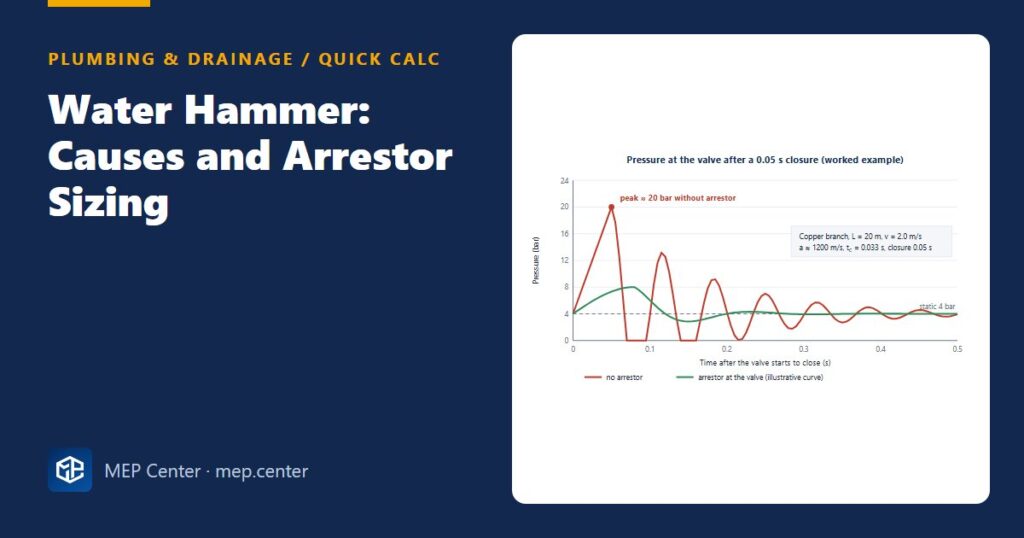
Inputs: static pressure 4 bar, velocity in the branch 2.0 m/s, L = 20 m to the riser, wave speed in copper a ≈ 1200 m/s, solenoid closing time about 0.05 s.
- Instant closure: Δp = 1000 × 1200 × 2.0 = 2 400 000 Pa = 24 bar.
- Critical time: tc = 2 × 20 ÷ 1200 = 0.033 s. The valve takes 0.05 s, which is slower, so use the slow-closure formula.
- Δp ≈ 2 × 1000 × 20 × 2.0 ÷ 0.05 = 1 600 000 Pa = 16 bar. Peak ≈ 4 + 16 = 20 bar on a system designed for 10.
- Cut the velocity to 1.5 m/s: Δp ≈ 2 × 1000 × 20 × 1.5 ÷ 0.05 = 12 bar. That is better, but still far too high, so fit an arrestor at the machine valve.
Sanity check: in PE-X pipe (a ≈ 400 m/s) the instant surge at 2.0 m/s would be 1000 × 400 × 2.0 = 8 bar. Plastic softens the blow but does not remove it. Here tc = 40 ÷ 400 = 0.1 s, which is longer than the closing time, so the full 8 bar arrives.
Rule-of-thumb values
| Item | Typical value |
|---|---|
| Wave speed, steel, copper, stainless steel | about 1100–1300 m/s |
| Wave speed, PVC-U and CPVC | about 350–450 m/s |
| Wave speed, PE, PE-X, PP-R | about 250–450 m/s (depends on the wall thickness) |
| Surge per 1 m/s stopped, metal pipe | about 12 bar (ρ × a = 1000 × 1200 = 1.2 MPa per m/s) |
| Design velocity in branches | up to about 2 m/s; lower near quick-closing valves |
| Arrestor size for a single appliance (US PDI sizing) | size A, the smallest, fitted at the appliance valve |
Typical values — verify with the edition adopted locally.
Sizing and placing arrestors
- List the quick-closing valves. These are solenoid valves on washing machines and dishwashers, flush valves, sensor taps, single-lever mixers and pump check valves. Why: an arrestor protects the valve that causes the surge, not the whole building.
- Add up the fixture units each arrestor protects. Why: the US method (PDI-WH 201, tested to ASSE 1010) picks sizes A to F from the fixture-unit load of the branch. A single appliance takes size A; larger batteries move up the manufacturer’s table.
- Place it close to the valve. Why: the further the arrestor sits from the valve, the more pipe is left between them to carry the full surge. On a branch serving several fixtures, put it at the end of the branch between the last two fixtures, and use two arrestors on long branches.
- Use sealed (piston or bellows) units, not plain air chambers. Why: an open stub of pipe loses its air into the water within months and then does nothing. Codes in the US accept only approved mechanical arrestors.
- Keep them accessible. Why: arrestors are replaceable parts, so put them behind an access panel, not inside a tiled wall.
European codes treat the problem through EN 806: limit velocities, choose valves that do not close abruptly and protect the system where they do. In practice the same sealed arrestors, or small membrane vessels, are used. On pumped systems use non-slam check valves and variable speed drives with soft stop; see booster pump set sizing.
Other ways to reduce surge
- Size the branches so the velocity stays at about 1.5–2 m/s, as in domestic water pipe sizing with fixture units. Surge is proportional to velocity.
- Lower the static pressure with a pressure reducing valve station. Fittings then have more margin left for the surge.
- Fix the pipes properly. Much of the “bang” is loose pipe hitting the structure.
- Remember that plastic pipe slows the wave but does not stop it; see plumbing pipe material selection.
Ready-made drawings and tools for your next project
CAD block libraries, detail drawings and AutoCAD tools made by practising MEP engineers.
FAQ
What causes water hammer in plumbing?
A valve that closes faster than the pressure wave can travel to the nearest open end of the pipe and back. The moving water stops suddenly and its momentum becomes a pressure surge of about ρ × a × Δv, which is around 12 bar for every 1 m/s stopped in metal pipe.
Where should a water hammer arrestor be installed?
As close as possible to the quick-closing valve it protects, such as a washing machine or dishwasher solenoid or a flush valve. On a branch with several fixtures, fit it at the end of the branch, and keep it accessible for replacement.
Do air chambers stop water hammer?
Only for a short time. The trapped air dissolves into the water and the chamber fills up, so it stops working. Sealed piston or bellows arrestors keep their gas charge and are what codes accept.