
Add up the maximum flow of every tap in a building and you will size the pipes two or three times too big: nobody opens all the taps at once. Fixture units (loading units) are how plumbing codes turn a list of fixtures into a realistic peak flow, and from there into a pipe size.
Step 1: give every fixture its unit value
In EN 806-3, one loading unit equals 0.1 l/s of draw-off flow. Typical values for ordinary fixtures:
| Fixture | Draw-off flow | Loading units (LU) |
|---|---|---|
| Washbasin, bidet, WC cistern, dishwasher | 0.1 l/s | 1 |
| Shower, domestic kitchen sink, washing machine | 0.2 l/s | 2 |
| Urinal flush valve | 0.3 l/s | 3 |
| Domestic bath | 0.4 l/s | 4 |
| Garden / hose tap | 0.5 l/s | 5 |
The IPC uses WSFU, which are not a flow but a weighting. For private (dwelling) use, for example, a flush-tank WC counts 2.2 WSFU and a lavatory 0.7 WSFU; a full private bathroom group with a flush tank counts 3.6. The code lists separate cold, hot and total values, and public fixtures carry higher numbers because they are used more often.
Typical values — verify with the edition adopted locally.
Step 2: add the units section by section
Start at the furthest outlet and walk back towards the meter. Every pipe section carries the sum of all the units downstream of it. Write the running total on the riser diagram; it makes checking easy and reviewers look for it.
Step 3: convert units to a probable peak flow
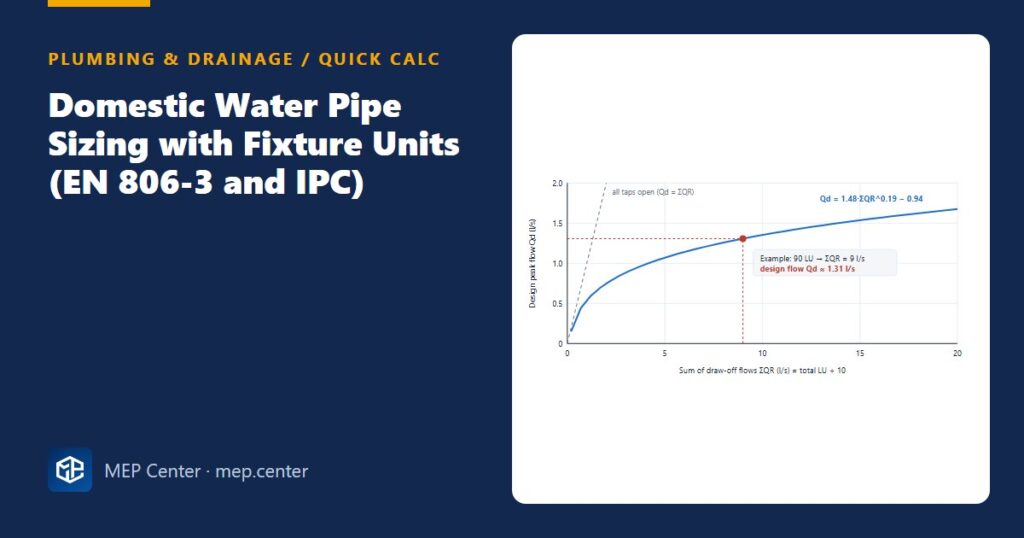
This is the step that matters. EN 806-3 gives a graph that turns total LU into design flow; the IPC uses Hunter’s curve (with separate branches for flush-tank and flush-valve systems) to turn WSFU into gpm. Many European designers use the German peak-flow formula for dwellings, which tracks the same idea:
Qd = 1.48 × (ΣQR)0.19 − 0.94
where ΣQR is the sum of draw-off flows in l/s (that is, total LU ÷ 10) and Qd is the design peak flow in l/s. If Qd comes out larger than ΣQR (only for very small totals), use ΣQR. Other building types (hotels, hospitals, schools) use different constants because their usage peaks are sharper.
Step 4: choose the pipe size by velocity
With the design flow known, the internal diameter follows from d = √(4·Q / (π·v)), with Q in m³/s and v in m/s. Common practice is about 1.5 m/s in mains and risers and up to 2 m/s in short branches; keep it lower near bedrooms and in plastic pipe where noise and water hammer matter. Remember to use the internal diameter of the actual pipe material: a 32 mm plastic pipe and a DN32 steel pipe have very different bores.
Worked example — 10-flat riser
Each flat: WC cistern 1 + washbasin 1 + shower 2 + kitchen sink 2 + washing machine 2 + dishwasher 1 = 9 LU (ΣQR = 0.9 l/s).
One flat branch: Qd = 1.48 × 0.90.19 − 0.94 = 1.48 × 0.980 − 0.94 ≈ 0.51 l/s.
Riser foot, 10 flats: 90 LU → ΣQR = 9 l/s. Qd = 1.48 × 90.19 − 0.94 = 1.48 × 1.518 − 0.94 ≈ 1.31 l/s.
Bore at 1.5 m/s: d = √(4 × 0.00131 / (π × 1.5)) = 0.0333 m ≈ 33 mm. A pipe with a 36 mm bore gives v = 0.00131 ÷ (π × 0.036² / 4) ≈ 1.29 m/s. Accept.
Sanity check: 9 l/s (all taps open) would have needed a bore of about 87 mm at the same velocity, which is clearly absurd for ten flats.
Step 5: check pressure at the worst outlet
Velocity alone does not finish the job. Starting from the available pressure (mains or booster set), subtract the static height to the highest outlet (about 0.1 bar per metre), pipe friction, meter and fitting losses. What is left must cover the minimum flow pressure of the worst fixture: about 1 bar is a common figure for ordinary taps, while flush valves and some thermostatic mixers need more, so check manufacturer data. At the other end, keep static pressure at outlets below about 5 bar (EN 806) or 80 psi (IPC) with pressure reducing valves on lower floors.
Rules of thumb
| Item | Typical practice |
|---|---|
| Velocity, mains and risers | about 1.5 m/s (5 ft/s) |
| Velocity, short branches | up to 2 m/s (6.5 ft/s) |
| Static height | 0.098 bar per metre (0.433 psi per ft) |
| Minimum flow pressure, ordinary tap | about 1 bar (15 psi) |
| Maximum static pressure at outlets | about 5 bar (EN 806) / 80 psi (IPC) |
Hot water pipes are sized the same way using only the hot share of each fixture; the return loop is sized for heat loss, not draw-off (see hot water recirculation and legionella temperatures). If the available pressure is too low, the next step is a booster pump set fed from a water storage tank. Use the MEP unit converter for l/s to gpm and bar to psi.
Ready-made drawings and tools for your next project
CAD block libraries, detail drawings and AutoCAD tools made by practising MEP engineers.
FAQ
What is a loading unit in EN 806-3?
One loading unit (LU) equals 0.1 l/s of draw-off flow. A washbasin is 1 LU, a shower or kitchen sink 2 LU and a domestic bath 4 LU; the total for a pipe section is converted to a design flow with the standard’s curve.
Can I convert IPC WSFU directly to EN 806 LU?
No. WSFU are weighting factors read against Hunter’s curve, while LU are tied to a real flow of 0.1 l/s. Size a project with one method from start to finish, the one adopted where the building is.
What velocity should I use for domestic water pipes?
About 1.5 m/s in mains and risers and up to 2 m/s in short branches is common practice. Go lower where noise matters, and always check the remaining pressure at the worst outlet.