
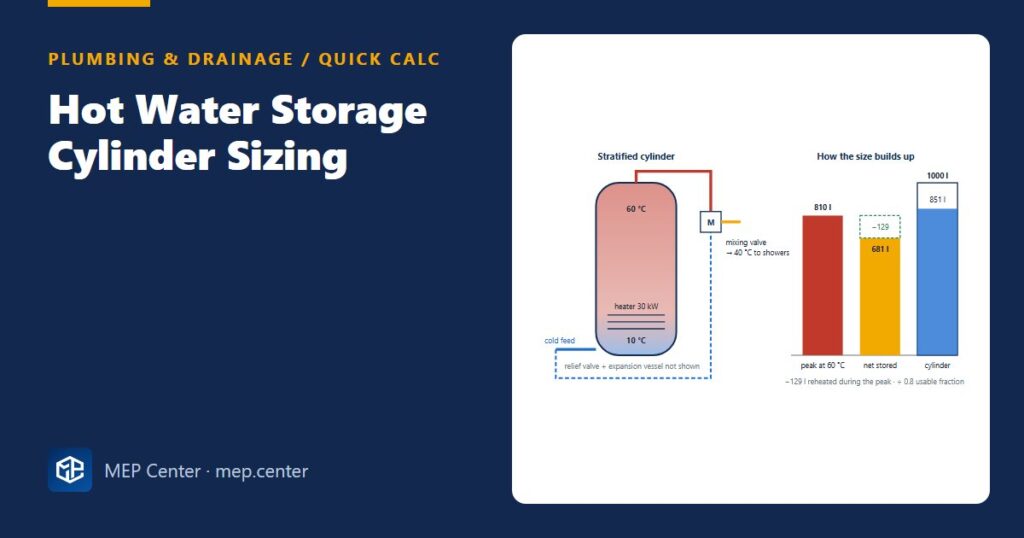
A hot water cylinder that runs cold halfway through the evening showers is a classic complaint. So is the opposite: a huge tank that takes all night to reheat, loses heat all day and leaves a lukewarm bottom zone where bacteria grow. Sizing it properly takes four numbers: peak demand, peak duration, heater power and usable volume.
The formula
1. Peak demand at storage temperature: V60 = Vuse × (Tuse − Tcold) ÷ (Tstore − Tcold)
2. Heater recovery during the peak: Vrec = P × t ÷ (4.186 × (Tstore − Tcold))
3. Cylinder volume: Vcyl = (V60 − Vrec) ÷ f
- Vuse — mixed water used in the peak period, l, at the use temperature Tuse (about 40 °C for showers).
- Tcold — cold water temperature, about 10 °C (use the local winter value).
- Tstore — storage temperature, 60 °C or more for legionella control.
- P — heater or coil output, kW; t — peak duration, s; 4.186 kJ/(l·K) is the heat capacity of water.
- f — usable fraction: the share of the cylinder you can draw off before the outlet temperature drops too far. Use about 0.7–0.8 for a well-stratified vertical cylinder, and less for horizontal or poorly stratified ones.
Inputs: 10 showers at 9 l/min, all running for 15 minutes after a match. Cold water 10 °C, storage 60 °C, use 40 °C. Heater output 30 kW. Usable fraction 0.8.
- Mixed water used: 10 × 9 × 15 = 1350 l at 40 °C.
- At storage temperature: 1350 × (40 − 10) ÷ (60 − 10) = 1350 × 0.6 = 810 l at 60 °C.
- Recovery: 30 ÷ (4.186 × 50) = 0.143 l/s; over 900 s that is 129 l.
- Net storage: 810 − 129 = 681 l. Cylinder: 681 ÷ 0.8 = 851 l → choose 1000 l (or 2 × 500 l).
- Reheat time for the used volume: 851 × 4.186 × 50 ÷ 30 ≈ 5940 s ≈ 1.7 hours.
Sanity check: if matches finish less than about two hours apart, the cylinder will not be full again in time. Then either raise the heater power or add storage. A 60 kW heater would recover 258 l during the peak and halve the reheat time.
Rule-of-thumb volumes
| Use | Typical volume per use (mixed, about 40 °C) |
|---|---|
| Shower, about 5 minutes | 40–50 l |
| Bath | 120–150 l |
| Hand washing at a basin | 2–5 l |
| Kitchen sink, washing up | 10–20 l |
| House with 1 bathroom: cylinder | about 150–200 l |
| House with 2 bathrooms: cylinder | about 200–300 l |
Typical values — verify with the edition adopted locally.
Storage versus heater power
The same peak can be met with a big cylinder and a small heater, or a small cylinder and a big heater. Where the heat comes from a boiler that is already large for space heating, a smaller cylinder with a fast coil is usually cheaper. Where it comes from a heat pump or solar collectors, which deliver heat slowly, plan for more storage. Instantaneous (storage-free) heating only works when the heater can deliver the full peak flow. That usually means one or two outlets, not a changing room.
Practical points
- Keep it at 60 °C, top to bottom. Store at 60 °C or more and let the whole volume, including the bottom, reach 60 °C regularly. Supply the outlets through mixing valves where scalding is a risk. See hot water recirculation and legionella.
- Pipe the cylinder to stratify. Cold feed low through a spreader, hot draw-off from the top, and the recirculation return low but not right at the cold inlet.
- Safety on unvented cylinders: a thermostat, a high-limit cut-out, a temperature and pressure relief valve piped to a visible drain, and an expansion vessel on the cold feed. See expansion vessel sizing for the method.
- Two cylinders for big buildings, so one can be cleaned or disinfected while the other stays in service.
- Size the pipes for the peak flow, not for the cylinder: use fixture-unit pipe sizing on the hot share of each fixture.
Ready-made drawings and tools for your next project
CAD block libraries, detail drawings and AutoCAD tools made by practising MEP engineers.
FAQ
How do I calculate hot water cylinder size?
Convert the peak-period hot water use to water at the storage temperature, subtract what the heater can reheat during that period, and divide by the usable fraction of the cylinder (about 0.7 to 0.8). For 10 showers over 15 minutes with a 30 kW heater, that is about 850 l, so choose a 1000 l cylinder.
What temperature should a hot water cylinder be stored at?
At 60 °C or more, with the whole cylinder reaching that temperature regularly, to control legionella. Use thermostatic mixing valves to bring the water down to a safe temperature at the outlets.
Why is not all of the cylinder volume usable?
Cold water enters at the bottom as hot water is drawn from the top, and the two mix in a layer. After about 70 to 80 % of the volume has been drawn off, the outlet temperature starts to fall below what users accept.