
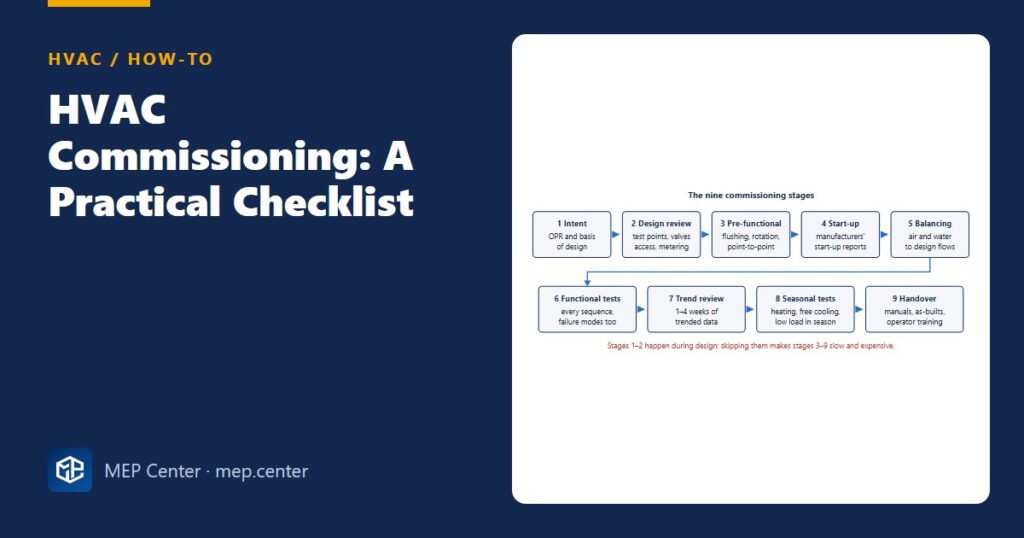
Commissioning that stops at “it runs” leaves the building with swapped sensors, valves stroked backwards and reset strategies switched off “temporarily” for ever. A short, structured checklist catches most of these before handover — and most of them are cheap to fix while the contractor is still on site.
The checklist
- Write the owner’s project requirements and basis of design: temperatures, redundancy, efficiency targets, control strategies. Why: without a written target, no test can pass or fail.
- Review the design for commissionability: test points, isolation valves, flow measurement, balancing dampers in accessible places, access panels. Why: a damper above a fixed ceiling cannot be balanced.
- Flush and clean the water systems before connecting coils and heat exchangers, then fill with treated water (heating systems typically pH 8.2–10, ≤ 8.5 with aluminium). Why: debris blocks PICVs, strainers and plate heat exchangers within weeks.
- Set expansion vessel pre-charges before the vessels are connected, and check the safety valve settings. Why: a vessel left at factory pre-charge is one of the commonest faults.
- Pre-functional checks: fan and pump rotation, motor currents, filters fitted and clean, condensate traps filled, drain falls, duct leakage tested to the specified class, fire and smoke dampers tested. Why: these are quick to fix before ceilings close.
- Point-to-point BMS checks: every input and output verified at the device and on the screen, sensors calibrated. Why: a swapped flow/return sensor makes every later test meaningless.
- Manufacturers’ start-up of chillers, boilers, heat pumps, cooling towers and VSDs, with written reports. Why: warranties often depend on it.
- Balance air and water to design flows within the specified tolerance: PICV settings, FCU EC fan speeds, VAV maximum and minimum airflows, proportional balancing of diffusers. Why: wrong flows waste the design work done upstream.
- Functional performance tests of each sequence, including failure modes: duty/standby changeover, chiller or boiler failure, loss of flow, power failure and restart, frost protection, alarms, fire-mode signals. Why: failures are when controls matter most.
- Life-safety ventilation: stair pressurisation pressure, open-door velocity and door opening force; smoke extract and car-park fan modes with the fire alarm. Why: these are witnessed tests for the authority.
- Trend review of one to four weeks of data for hunting, short cycling, set-point deviations and low chilled-water ΔT. Why: many faults only show over time.
- Seasonal tests of heating curves, optimum start, free cooling and low-load sequences in the relevant season. Why: a summer handover cannot prove a heating curve.
- Handover: systems manual, as-built drawings and control sequences in plain language, operator training, and a retro-commissioning plan. Why: the operators keep the building working, not the designers.
Classic findings — what to look for first
| Finding | Typical symptom | Quick check |
|---|---|---|
| Sensors swapped or badly located | Plant hunts or never reaches set point | Compare BMS reading with a calibrated probe |
| Valve stroked backwards | Room overheats when it calls for cooling | Drive the valve from the BMS and watch the actuator |
| DP sensor in the wrong place | Pumps at full speed or far-end starvation | Compare its location with the design schematic |
| Minimum-flow bypass never closes | Low ΔT, extra chillers running | Trend bypass position and plant ΔT |
| Reset strategies disabled | Fixed supply temperatures all year | Check the live set points against the sequence |
| Crushed flexible ducts | FCU or diffuser airflow low | Measure terminal airflow; inspect above the ceiling |
| Dry condensate traps | Water spitting from drain pans, odours | Fill traps; check seal depth against fan pressure |
Design-side checks that make commissioning easier are covered in duct design common mistakes and expansion vessel sizing. Terminal settings come from fan coil unit selection and VAV box selection.
Typical values — verify with the edition adopted locally, the project specification and the manufacturers’ commissioning instructions.
HVAC Systems Design — Heating, Cooling & Ventilation
28 modules from heat loss to plant room: boilers, heat pumps, cooling loads, psychrometrics, AHUs and ductwork. The VRF course is included.
Modules 1–3 are free, no account needed · full course €15,00 one-time
FAQ
What are the stages of HVAC commissioning?
Design intent, design review, pre-functional checks, equipment start-up, balancing, functional performance tests, trend review, seasonal testing, and handover with documentation and training.
What is a point-to-point check?
Every BMS input and output is verified at the field device and on the operator screen: a sensor reading matches a calibrated instrument, and a command moves the right valve or starts the right motor.
Why is seasonal commissioning needed?
Heating curves, optimum start, free cooling and low-load sequences can only be proven in the weather they were designed for. A building handed over in summer needs its heating modes tested in the first winter.