
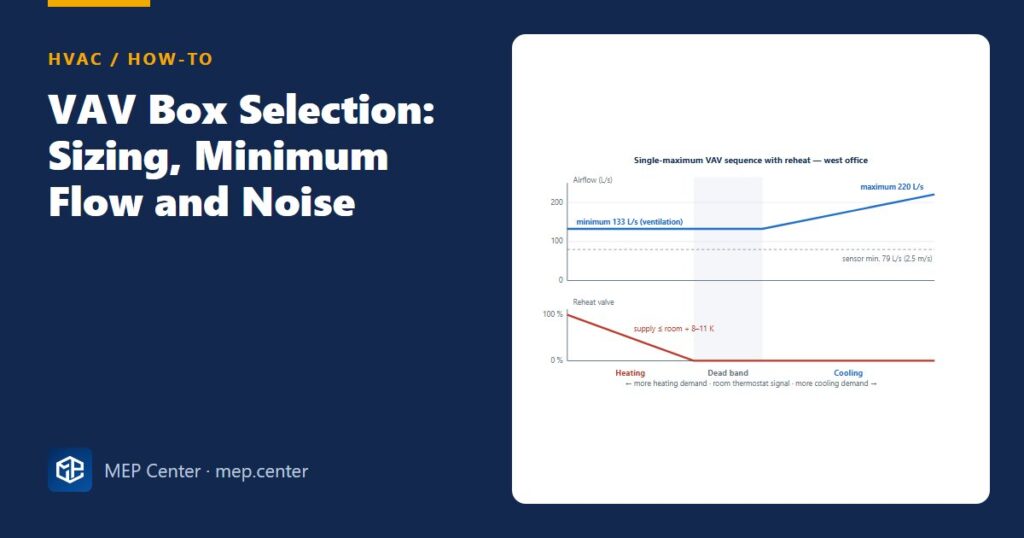
A VAV box is a small device with three ways to go wrong: a maximum airflow that does not match the load, a minimum airflow that is either too high (reheat energy all year) or too low to measure (hunting dampers), and an inlet so small that the box whistles. Here is how to select one in a few steps.
Step by step
- Maximum airflow from the sensible load: qmax = Qs / (1.2 × (θroom − θsupply)). Why: the box can only deliver the cooling that its maximum airflow carries at the supply temperature.
- Ventilation minimum: outdoor air needed by the zone divided by the outdoor-air fraction of the supply air (the multiple-zone procedure of the ventilation standard). Why: at minimum flow the zone must still get its outdoor air.
- Sensor minimum: inlet area × about 2.5 m/s. Why: below roughly 2–3 m/s the velocity-pressure signal is too small and the control hunts.
- Diffuser minimum: the airflow at which the diffusers still throw and mix the air (manufacturer data). Why: cold air dumping on desks is a classic VAV complaint.
- Heating airflow if the box has reheat: the airflow needed to deliver the heating load at a supply air no more than about 8–11 K above the room. Why: hotter supply air stratifies under the ceiling.
- Inlet size for about 5–10 m/s at maximum, checked against the sensor minimum. Why: too small is noisy; too large cannot measure the minimum.
- Noise from the box data at the design inlet static pressure, for both discharge and radiated paths. Why: boxes near the fan see the highest pressure and the most noise.
- Straight inlet duct (as the manufacturer requires, often several diameters) and an access panel. Why: a bend right before the sensor gives false readings.
Worked example: west office zone
Maximum: 2 640 / (1.2 × 10) = 220 L/s.
Ventilation minimum: 40 / 0.30 = 133 L/s.
Inlet DN200 (area 0.0314 m²): at maximum 0.220 / 0.0314 = 7.0 m/s ✓; sensor minimum 0.0314 × 2.5 = 79 L/s.
Governing minimum: max(133, 79, 70) = 133 L/s (60 % of maximum).
Reheat check (heating, room 21 °C, supply up to 31 °C at minimum flow): coil 1.2 × 133 × (31 − 14) = 2.7 kW; heat delivered to the room 1.2 × 133 × (31 − 21) = 1.6 kW. If the zone’s heat loss is higher, use a dual-maximum sequence or a separate perimeter heater.
Alternative inlet DN250 (0.0491 m²): 4.5 m/s at maximum, sensor minimum 123 L/s — still below 133 L/s, but with very little margin. DN200 is the better choice.
Sanity check: a 60 % minimum is high; with a dedicated outdoor-air system the ventilation minimum disappears and the sensor/diffuser minimum (≈ 80 L/s) would govern, saving reheat and fan energy.
Single or dual maximum?
In the classic single-maximum sequence the airflow sits at minimum through the dead band and heating, and reheat raises the supply temperature. In the dual-maximum sequence, common under current energy codes, heating first raises the supply temperature at minimum airflow and then increases the airflow up to a heating maximum (for example 50 % of the cooling maximum). It allows a lower dead-band minimum and less reheat energy. Old practice set minimums at 30–50 % of maximum; current codes push lower.
Quick reference
| Item | Typical value |
|---|---|
| Supply air temperature | ≈ 13–14 °C |
| Sensible-heat constant | 1.2 W per L/s per K |
| Inlet velocity at maximum | ≈ 5–10 m/s |
| Reliable sensor minimum | ≈ 2–3 m/s inlet velocity |
| Reheat supply limit | ≈ 8–11 K above room |
| Office noise target | NR 30–35 (private), 35–40 (open plan) |
The load comes from cooling load calculation basics; the AHU side from AHU sizing quick rules; ventilation minimums from ASHRAE 62.1 vs EN 16798. For fan-coil alternatives see fan coil unit selection.
Typical values — verify with the edition adopted locally and with the box manufacturer’s data.
HVAC Systems Design — Heating, Cooling & Ventilation
28 modules from heat loss to plant room: boilers, heat pumps, cooling loads, psychrometrics, AHUs and ductwork. The VRF course is included.
Modules 1–3 are free, no account needed · full course €15,00 one-time
FAQ
How do I calculate the maximum airflow of a VAV box?
Divide the zone’s peak sensible load by 1.2 times the room-to-supply temperature difference. For 2.64 kW and 24/14 °C that is 2 640 / (1.2 × 10) = 220 L/s.
What sets the minimum airflow of a VAV box?
The largest of the zone’s ventilation requirement, the minimum the airflow sensor can measure (about 2–3 m/s inlet velocity), the diffusers’ minimum and the heating airflow if the box has reheat.
What inlet velocity should a VAV box have?
About 5–10 m/s at maximum airflow. Lower velocities make the minimum hard to measure; higher velocities make the box noisy. Check the box noise data at the actual inlet static pressure.