
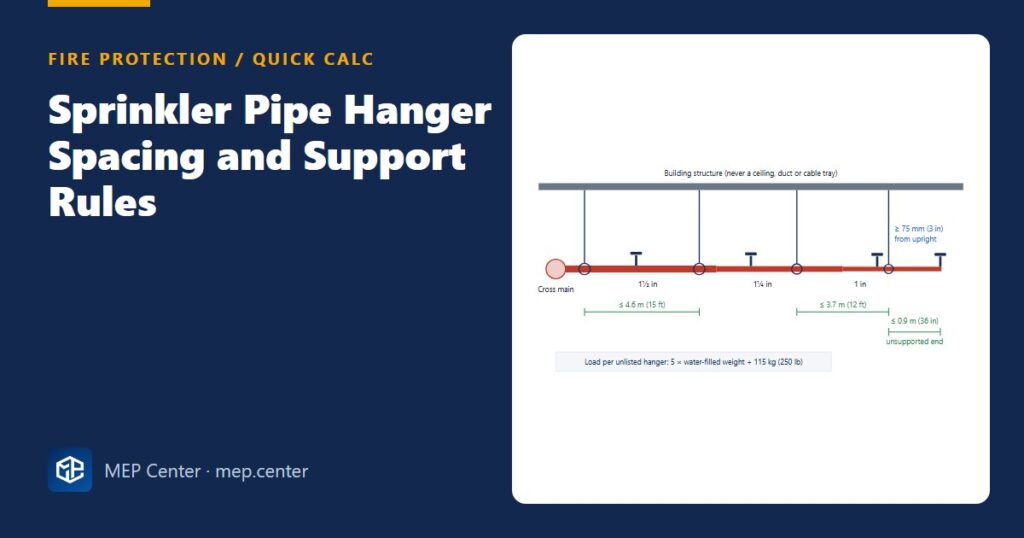
Hangers are the part of a sprinkler system everybody assumes someone else has checked. Too few of them, an end sprinkler hanging on a long unsupported pipe, or a hanger clamped to a duct: these show up at inspection, or worse, when a sprinkler opens and the pipe whips. Here are the spacing rules and a quick way to check the load on a hanger.
Maximum hanger spacing: rule-of-thumb table
| Pipe | Smaller sizes | Larger sizes |
|---|---|---|
| Steel, Sch 10 / Sch 40 | 3.7 m (12 ft) for 1 in–1¼ in | 4.6 m (15 ft) for 1½ in and up |
| Threaded lightwall steel | 3.7 m (12 ft) in all sizes used | |
| Copper tube | 2.4 m (8 ft) up to 1 in; 3.0 m (10 ft) for 1¼–1½ in | 3.7 m (12 ft) for 2–3 in; 4.6 m (15 ft) for 3½ in and up |
| CPVC (listed) | About 1.7–3.0 m (5½–10 ft) by size: the listing governs, with closer spacing in hot spaces | |
| Ductile iron (above ground) | 4.6 m (15 ft) | |
Three more rules travel with the table:
- Every length of pipe between couplings gets at least one hanger, apart from short sections.
- Hangers attach to the building structure: beams, slabs and purlins. Never hang them from ceilings, ducts, cable trays or other services.
- On branch lines, keep hangers at least 75 mm (3 in) from the centreline of an upright sprinkler so they do not cut the spray.
Unsupported ends and armovers
The distance from the last hanger to the end sprinkler is limited. When the sprinkler opens, the reaction force otherwise swings the pipe and can lift the sprinkler out of position.
| Pipe size | Steel | Copper |
|---|---|---|
| 1 in | 0.9 m (36 in) | 0.45 m (18 in) |
| 1¼ in | 1.2 m (48 in) | 0.6 m (24 in) |
| 1½ in and larger | 1.5 m (60 in) | 0.75 m (30 in) |
| Max pressure over 6.9 bar (100 psi) | 0.3 m (12 in) | 150 mm (6 in) |
An unsupported armover to a sprinkler is limited to about 0.6 m (24 in) for steel and 0.3 m (12 in) for copper, halved above 6.9 bar. If the layout breaks these limits, add a hanger, or extend the pipe past the sprinkler and support the extension.
Quick calc: hanger load and rod size
If a hanger is not listed for the load, it must be designed to carry:
W = 5 × (w × s) + 115 kg (250 lb), where w is the weight of the water-filled pipe per metre (or foot) and s is the hanger spacing.
Example: a 2 in Sch 40 steel cross main with hangers at the maximum 4.6 m (15 ft).
Empty pipe ≈ 3.65 lb/ft. Water: internal diameter 2.067 in → 3.36 in² × 12 in = 40.3 in³ per foot ≈ 1.45 lb/ft. Water-filled w ≈ 5.10 lb/ft (7.6 kg/m).
W = 5 × (5.10 × 15) + 250 = 5 × 76.5 + 250 = 632 lb ≈ 287 kg (2.8 kN).
Sanity check: the water-filled pipe weighs only about 35 kg per span. The factor of 5 and the 115 kg allow for water hammer, reaction forces and a fitter leaning on the pipe. That is why hanging from ceiling grid wire or duct flanges is never acceptable.
Takeoff estimate: a 27 m run of 2 in main → 27 ÷ 4.6 = 5.9 → 6 spans → about 7 hangers. Final positions follow the couplings, fittings and structure.
Typical NFPA 13 rod sizes are 3/8 in (9.5 mm) rod for pipe up to 4 in, 1/2 in (12.7 mm) for 5–8 in pipe and 5/8 in (15.9 mm) for 10–12 in pipe. Anchors and powder-driven fasteners are allowed only within their listing for pipe size, base material and orientation.
Typical values — verify with the edition adopted locally.
Dry systems, seismic zones and other traps
- Dry and preaction pipe must drain. Hangers set the pitch: about 4 mm/m on branch lines and 2 mm/m on mains. A sag between hangers holds water that freezes. See dry pipe vs preaction.
- Seismic bracing is separate from hangers. Lateral braces go at up to 12.2 m (40 ft) and longitudinal braces at up to 24.4 m (80 ft) on mains, with a four-way brace at the top of each riser. Hangers alone do not resist sway.
- Trapezes are used where the structure does not line up with the pipe. Size the cross member for the combined load of every pipe it carries.
- Hangers move the sprinklers. A hanger dropped below a beam can push deflector distances out of the limits in sprinkler spacing and location rules.
More reviewer favourites are collected in 12 common sprinkler design mistakes.
Fire Protection & Suppression Systems Design (NFPA)
20 narrated modules with animated diagrams, two complete worked projects (DWG + DXF), the Fire Calc Workbook and an online calculator.
Modules 1–3 are free, no account needed · full course €15,00 one-time
FAQ
What is the maximum hanger spacing for sprinkler pipe?
For steel pipe, NFPA 13 typically allows 3.7 m (12 ft) for 1 in and 1¼ in pipe and 4.6 m (15 ft) for 1½ in and larger. Copper needs closer spacing, and CPVC follows its manufacturer’s listing.
How much load must a sprinkler hanger carry?
An unlisted hanger is designed for five times the weight of the water-filled pipe it supports plus 115 kg (250 lb). Listed hangers are used within their listed load.
How far can the end sprinkler be from the last hanger?
On steel pipe, typically 0.9 m (36 in) for 1 in, 1.2 m (48 in) for 1¼ in and 1.5 m (60 in) for 1½ in and larger. Copper allows half of that, and above 6.9 bar (100 psi) the limits drop to 0.3 m for steel and 150 mm for copper.
Can sprinkler pipe hang from a duct or a ceiling grid?
No. Sprinkler hangers must be attached to the building structure that can carry the load, never to ceilings, ducts, cable trays or other services.
More Fire Protection (Sprinklers, NFPA) articles
- Standpipe Classes I, II and III Explained
- Fire Pump Sizing to NFPA 20: Rated Point, Curve Checks and Jockey
- Fire Department Connection (FDC): Location and Arrangement
- 12 Common Sprinkler Design Mistakes Reviewers Reject
- Sprinkler Hydraulic Calculation: A Step-by-Step Worked Example
- Fire Pump Room Design Checklist