
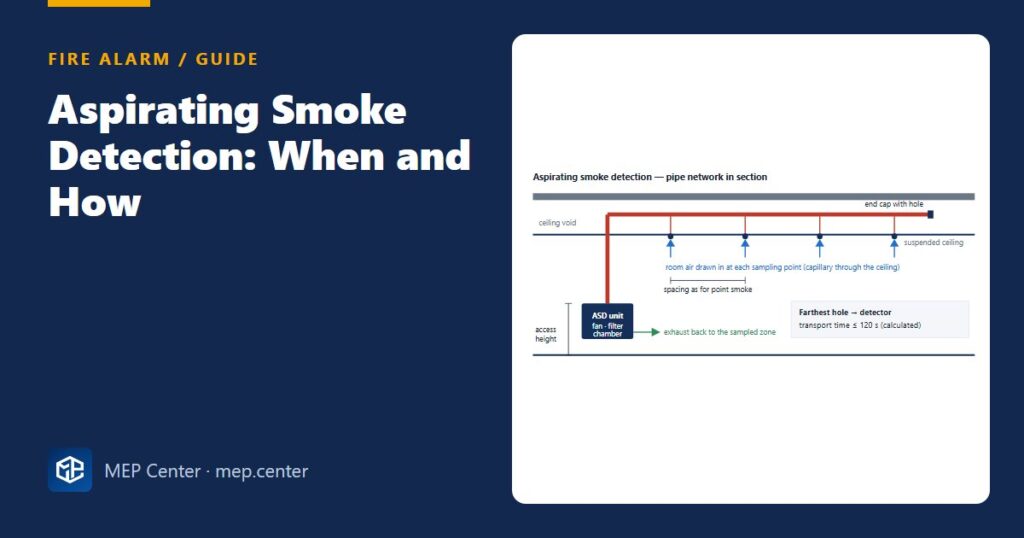
Some rooms cannot wait for smoke to reach a point detector: a data hall with fast air changes, an archive where a small fire destroys irreplaceable records, or a 20 m atrium where no ladder reaches the ceiling. Aspirating smoke detection (ASD) solves these by bringing the air to the detector instead of waiting for smoke to arrive.
How it works
A fan in the detector unit pulls air through a rigid sampling pipe (typically about 25 mm plastic pipe) fitted with drilled holes. The air passes a filter and a high-sensitivity optical chamber; the unit raises several staged signals — typically alert, action and fire — so staff can investigate an overheating cable long before there is visible smoke. An airflow monitor in the unit signals a fault if a pipe breaks or holes block.
When to choose it
| Situation | Why ASD fits | Usual alternative |
|---|---|---|
| Data centres, UPS and telecom rooms | High air change dilutes smoke; very early warning before equipment damage; sampling at cooling unit return grilles | Point detectors in larger numbers (often as backup to ASD) |
| Archives, museums, heritage interiors | Early warning for high-value content; capillary points almost invisible | Point smoke detectors |
| Ceilings above about 12–16 m (atria, warehouses, halls) | Class A/B sensitivity compensates for dilution; unit at ground level | Beam detectors |
| Clean rooms | Detects very low smoke concentrations in filtered, fast-moving air | — |
| Cold stores, dirty or hard-to-reach areas, cells | Unit placed outside the hostile or secure area; only the pipe inside | Heat detectors |
For ordinary offices and corridors, point smoke detectors remain simpler and cheaper. For open halls without sensitive content, beam smoke detectors are often enough.
Sensitivity classes (EN 54-20)
- Class A — very high sensitivity: very early warning in highly diluted air (clean rooms, data halls, very high spaces).
- Class B — enhanced sensitivity: early warning where dilution is significant (high ceilings, rooms with strong ventilation).
- Class C — normal sensitivity: equivalent to a point smoke detector at each hole; used for maintenance access or concealment.
In the ceiling height logic of EN 54-14 practice, ASD remains suitable at 12–16 m (class A or B), 16–25 m (class A) and 25–45 m (class A with extra hole rules), where point smoke detectors are no longer suitable.
Design rules that matter
- Lay out holes as point detectors. Each hole covers what a point smoke detector would (EN 54-14 practice: 6.2 m radius on flat ceilings); NFPA 72 likewise treats each port as a spot-type detector for spacing. Why: the class gives sensitivity, not a larger coverage area.
- Keep the transport time within 120 s from the farthest hole, under both EN 54-20 and NFPA 72. Why: early warning is pointless if the sample takes minutes to arrive.
- Balance the network with the manufacturer’s software. Hole sizes, pipe lengths and the number of holes per pipe decide the suction at each hole; submit the calculation output with the drawings. Why: the farthest holes otherwise draw almost nothing.
- Sample where the air goes. In data halls add primary sampling across the return grilles of the cooling units, alongside the room (secondary) sampling. Why: with fast air movement, smoke reaches the return grilles before the ceiling.
- Return the exhaust to the sampled zone when the unit sits in a different pressure zone (for example sampling a ceiling void or a pressurised room). Why: a pressure difference between the holes and the exhaust upsets the airflow and its monitoring.
- Put the unit where it can be tested. Accessible height, outside cold or dirty zones, with a test point at the end of each pipe. Why: maintenance access is half the reason for choosing ASD.
- Write the alarm levels into the cause and effect matrix. Alert to the operator, action to the duty engineer, fire to evacuation and, if used, as one input of a coincidence (double-knock) release for gas suppression. Why: staged signals only help if someone knows what each one triggers.
Typical values — verify with the edition adopted locally.
Plan the ASD units as loop devices or interfaced inputs in your fire alarm loop design, compare the room layout with smoke and heat detector spacing, and record every staged output in the cause and effect matrix.
Fire Detection and Alarm System Design
Detector selection and layout, loops, panels, voice alarm and real DXF projects to EN 54-14 and NFPA 72.
Modules 1–3 are free, no account needed · full course €8,00 one-time
FAQ
What is aspirating smoke detection?
It is a smoke detection system that draws air through a network of sampling pipes into a very sensitive central detector. It is tested to EN 54-20 and gives very early warning in rooms where smoke is diluted or detectors are hard to reach.
How far apart are aspirating sampling holes?
Each sampling hole is laid out as if it were a point smoke detector, so the normal point detector spacing applies. The manufacturer’s software then checks suction balance and transport time.
What is the maximum transport time for an aspirating system?
The air from the farthest sampling hole must reach the detector within 120 seconds under both EN 54-20 and NFPA 72.
More Fire Alarm articles
- How to Write a Fire Alarm Cause and Effect Matrix
- Optical Beam Smoke Detectors: Where and How to Place Them
- Conventional vs Addressable Fire Alarm Systems Explained
- Fire Alarm Loop Design: Addresses, Isolators, Zones and Cables
- Manual Call Point Placement: Distances, Heights, Exits
- EN 54-14 vs NFPA 72: Fire Alarm Design Differences