
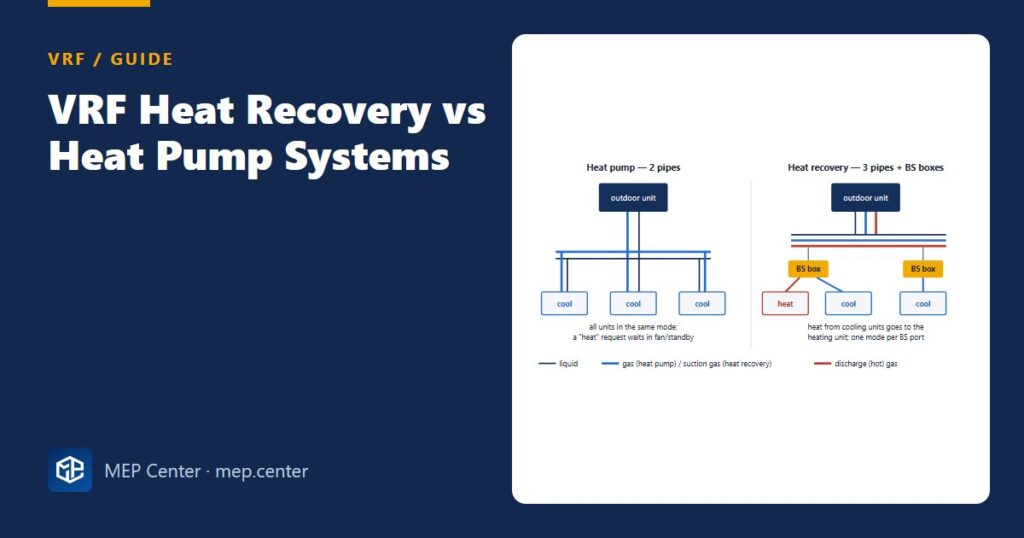
Spring morning in a deep-plan office: the north side wants heating, the sunny south side and the windowless meeting rooms want cooling. A heat pump VRF system can do only one of the two at a time. Whether that matters decides between heat pump and heat recovery VRF.
How the two systems differ
| Topic | Heat pump VRF | Heat recovery VRF |
|---|---|---|
| Pipes from outdoor unit | 2 (gas, liquid) | 3 (liquid, suction gas, discharge gas), or 2 to a central branch controller in the two-pipe concept |
| Simultaneous heating and cooling | No — the whole system follows one mode | Yes — per BS port or branch controller port |
| Mode selection | Mode master controller, central controller, or first-come / majority logic | Each port follows its own room demand |
| Extra components | None | BS boxes or branch controller, with access, power and sometimes a drain |
| Efficiency in mixed demand | Not applicable — one side is simply unserved | Very high when cooling and heating roughly balance: heat is moved, not made |
| Cost and commissioning | Lower, simpler | Higher: more pipe, BS boxes, more complex commissioning |
| Good fit | Small and medium offices without large cores, schools, retail, one system per dwelling or floor | Hotels, deep-plan offices with internal zones, mixed orientations, long shoulder seasons, heat for hot water via hydro-box units |
Design rules for heat recovery
- One BS port, one mode. Group units on one port only if they always want the same mode, for example two cassettes in one open office.
- Count ports and capacity per BS box; both are limited by the manufacturer.
- Place BS boxes with access and away from quiet rooms; refrigerant noise during changeover can be heard. Show them on the drawings with power and any drain.
- Follow the manufacturer’s sizing method for the two-pipe concept; pipe sizes, lengths and charge are product-specific.
Making heat pump VRF work
Most “we need heat recovery” problems can also be solved by splitting systems by orientation or use: one system for the north side, one for the south, one for the core. Each system then serves zones with similar needs. What you must never do is put a room that needs cooling all year — server, UPS, telecom — on a heat pump system that heats in winter. Those rooms get dedicated split or close-control units, duty and standby.
Example: one office floor, two options
Indoor unit totals: north perimeter 30.0 kW, south perimeter 34.0 kW, internal meeting rooms 12.0 kW (they need cooling even in winter). Outdoor capacity typical 2.8 kW per HP. House rule: indoor total ≤ 100 % of outdoor, target about 90 %, step up above about 92 %.
Option A — three heat pump systems. North: 12 HP (33.6 kW) → 30.0 / 33.6 = 89 % ✓. South: 14 HP (39.2 kW) → 34.0 / 39.2 = 87 % ✓. Core: 5 HP mini-VRF (14.0 kW) → 12.0 / 14.0 = 86 % ✓, free to cool while the perimeter heats.
Option B — one heat recovery system. Total 76.0 kW. 28 HP (78.4 kW) → 97 %, above 92 % → step up. 30 HP (84.0 kW) → 76.0 / 84.0 = 90 % ✓, with BS boxes per zone group.
Decision: both meet the rules. Option B recovers core heat into the north side in the shoulder seasons and gives one outdoor installation; Option A is cheaper and simpler. Choose on the load profile and life-cycle cost, not by default.
Typical values — verify with the edition adopted locally and with the selected manufacturer.
For the selection method, read VRF outdoor unit selection and connection ratio; for joints on either type, VRF branch kit selection; and for the traps to avoid at concept stage, common VRF design mistakes. A heat recovery system still has one refrigerant charge, so do the refrigerant leak safety check for its smallest room.
VRF / VRV System Design
From room loads to a buildable VRF drawing set: unit selection, connection ratio, refrigerant piping, EN 378 checks and worked projects.
Modules 1–3 are free, no account needed · full course €10,00 one-time
FAQ
What is the difference between heat pump and heat recovery VRF?
A heat pump VRF system runs all indoor units in the same mode on two pipes. A heat recovery system lets some units heat while others cool, using three pipes and BS boxes or a two-pipe branch controller, and transfers heat between zones.
Is heat recovery VRF always more efficient?
Only when cooling and heating demands occur at the same time. In a building where all zones want the same mode, it behaves like a heat pump system but costs more.
Can I avoid heat recovery by using several heat pump systems?
Often yes. Splitting systems by orientation or use, such as north, south and core, lets each system follow its own mode. Year-round cooling rooms like server rooms still need their own split units.
More VRF & Refrigeration articles
- VRF Refrigerant Piping Design: Sizing, Limits and Charge
- Refrigerant Leak Safety to EN 378: The Smallest Room Check
- VRF Branch Kits (Refnets): Selection and Installation Rules
- 10 Common VRF Design Mistakes
- VRF Connection Ratio: How to Select the Right Outdoor Unit
- Refrigerant Pipe Insulation: Thickness and Condensation